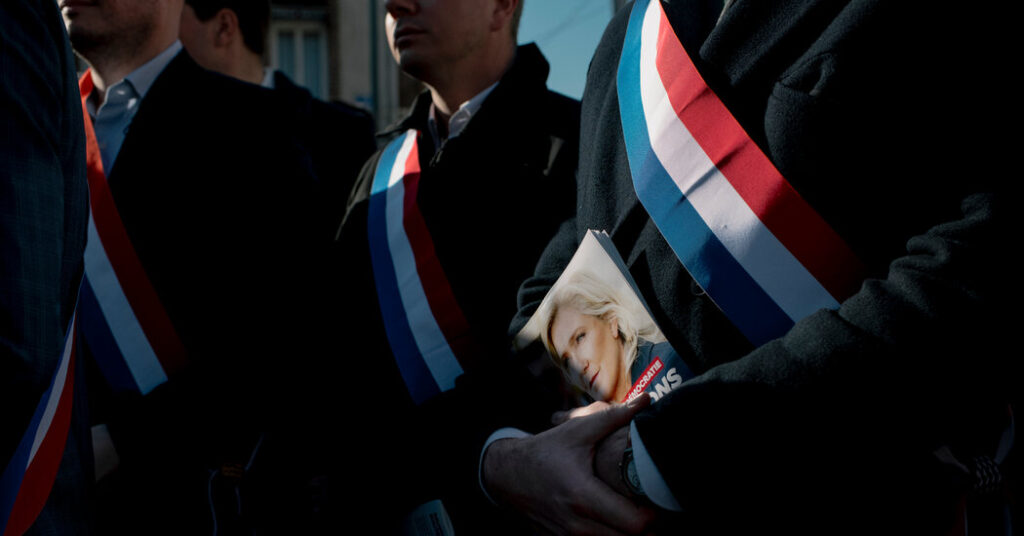
Marine Le Pen, France’s far-right firebrand, began her appeal on Tuesday against an embezzlement conviction that barred her from elected office for five years. The verdict, expected during the summer, will decide whether Ms. Le Pen can run for president next year and could shape France’s political future.
If the ban is overturned, it will make Ms. Le Pen, whose party currently leads national opinion polls, the favorite to win the presidency in 2027. She could become France’s first far-right head of state since World War II.
If her appeal fails, Ms. Le Pen’s 30-year-old protégé, Jordan Bardella, will likely run in her stead as candidate for the National Rally, France’s main far-right party. Mr. Bardella is currently president of the party.
For years, Ms. Le Pen, 57, worked to distance her populist, anti-immigrant party from its antisemitic roots, gradually bolstering her national standing. Now, she may have to give up on a role she has spent her entire career chasing, just as she seemed poised to take it.
What is Ms. Le Pen appealing against?
Ms. Le Pen is trying to overturn a ruling by a criminal court in Paris from March 2025 that convicted her of embezzlement and barred her from running for public office for five years.
The court found her National Rally party guilty of misusing almost $5 million provided by the European Parliament. The party used the funds between 2004 and 2016 to pay assistants to lawmakers for work that was unrelated to European Union business, the court ruled.
Ms. Le Pen was found guilty of overseeing the complex scheme; over 20 other people, including current and former party officials, were convicted on charges related to the case. Ms. Le Pen was sentenced to four years in prison, with two of those years suspended, and was fined 100,000 euros, or about $116,500. The jail term and the fine were put on hold after she appealed, though the electoral ban remained in place.
The trial at the Paris Appeals Court is expected to last a month, followed by several months of deliberations by the court. The judges could overturn the electoral ban, or reduce its duration, while maintaining her conviction.
Why did the ban shock France?
The decision disqualified France’s top contender for the presidency, spurring a furor over whether unelected judges should be allowed to interfere with voters’ electoral choices. The ban was contentious because the judges, citing the gravity of the case, kept it in place even after Ms. Le Pen appealed; in France, all aspects of a conviction are usually suspended during the appeals process.
Politicians from across the spectrum said she should be allowed to run, while others said the judges were right to uphold the rule of law. Ms. Le Pen called it a “democratic denial.” Prominent foreign leaders, including President Trump, voiced support for her.
But no major protests erupted in France, where laws against political corruption have been strengthened in the past decades. Polls showed voters were divided over whether Ms. Le Pen should face such stringent consequences.
What will Ms. Le Pen do if the ban is upheld?
After initially suggesting that nothing would deter her from running, Ms. Le Pen eventually conceded that Mr. Bardella, her protégé, would run for president in her place if the electoral ban was maintained on appeal.
That may not harm her party. Polls consistently show that both Mr. Bardella and Ms. Le Pen would win the first round of the election, and stand a strong chance of winning the second.
And if Mr. Bardella wins the presidency, he could still appoint Ms. Le Pen as his prime minister — a powerful position that can be held by unelected officials.
What is Mr. Bardella’s background?
Mr. Bardella earned his stripes leading the party to victory in the 2024 elections for the European Parliament, where he has since taken a prominent role, although he has faced criticism for his infrequent attendance there.
“It is a media platform that he can then use at the national level,” said Francisco Roa Bastos, a political scientist at Paris 1 Panthéon-Sorbonne University.
But Mr. Bardella, a college dropout who joined the party when he was 16, had never held public office before his first election to the European Parliament in 2019. His leadership of the National Rally has been criticized: in 2024, the party’s campaign during parliamentary elections was marred by controversies, including over racist or antisemitic remarks made by some candidates.
“At some point, voters will weigh up this lack of experience,” said Jean-Yves Camus, a political scientist who studies nationalist movements in Europe.
So far, Mr. Bardella has denied aspiring to the presidency. “I am not a presidential candidate,” he told journalists on Monday. “I am a candidate for the position of prime minister.”
What impact might the appeal have outside France?
The proceedings are likely to be closely watched by other populist leaders, including Mr. Trump, who threw their support behind Ms. Le Pen after her original conviction.
Fears of American interference in French affairs grew when Der Spiegel, a German newsmagazine, reported in December that the State Department had considered imposing sanctions on the judges who convicted Ms. Le Pen last year.
A top judge at the Paris court, Peimane Ghaleh-Marzban, warned in a speech last week that, if proven true, these allegations “would constitute unacceptable and intolerable interference.”
A senior State Department official, Sarah B. Rogers, denied the accusation, calling it “stale and false” on social media.
Ségolène Le Stradic is a reporter and researcher covering France.
The post Marine Le Pen Is Appealing a Conviction That Bars Her From Office. Here’s What to Know. appeared first on New York Times.