In the 19th century, the young United States grew in leaps and bounds.
First there was the Louisiana Purchase in 1803, in which Thomas Jefferson bought from the French a chunk of what is now America’s Midwest, West and South.
Next was the Mexican Cession, in 1848. As part of a peace deal after the Mexican-American war, Mexico handed over territory including what is now California, Nevada and other states.
And then there was the Alaska Purchase, from the Russians, in 1867, which at the time was derided as an icebox and too expensive.
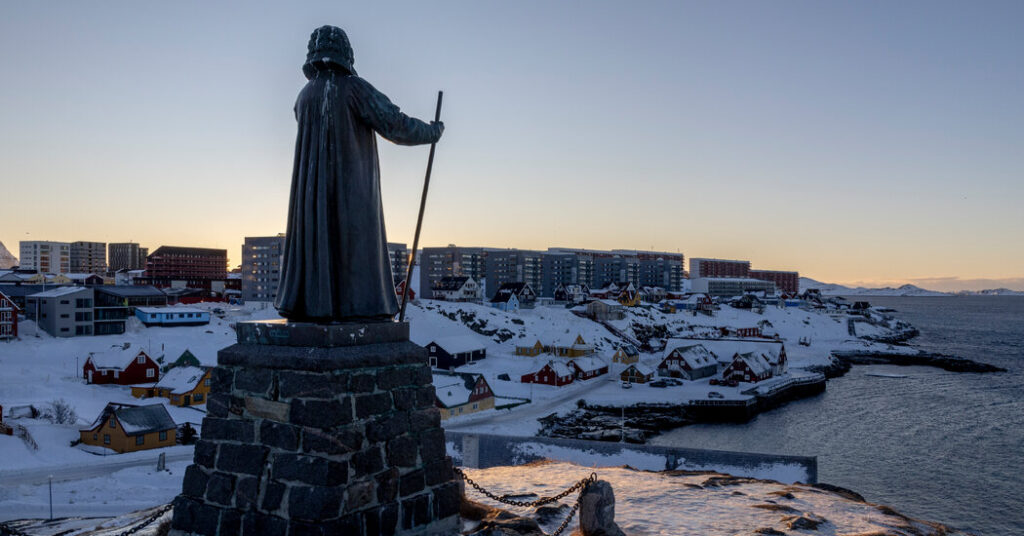
But if President Trump gets his way and, as he has insisted, takes over Greenland “whether they like it or not,” it would be bigger than any of those, according to the National Archives, the U.S. census and the C.I.A. World Factbook. At 836,000 square miles, Greenland is bigger than France, Britain, Spain, Italy and Germany — combined. It would be the largest territory the United States ever added, if the United States were to acquire it.
Mr. Trump has based his fixation on Greenland, which has been part of the Danish Kingdom for more than 300 years, on reasons of “national security,” citing threats from Russia and China. But he made a past remark about Greenland’s size, and scholars say the territorial grandeur itself is at least part of what appeals to him.
“Trump’s a real estate guy,” David Silbey, a historian at Cornell University, said in an email, “and the idea of grabbing that much land seems to me his particular guiding force: THE MOST LAND EVER.”
He added that Mr. Trump “likes to pick on targets that are too weak to fight back, which certainly describes Denmark,” he added.
This week, Secretary of State Marco Rubio is meeting to discuss the future of Greenland with Danish and Greenlandic officials, both of whom say that the island, the world’s largest, is not for sale.
But that has not deterred Mr. Trump and his team so far.
In an interview last week with The New York Times, Mr. Trump said the best way for the United States to handle Greenland would be to own it because ownership is “psychologically needed for success.”
At another point, he said, “I would like to make a deal the easy way, but if we don’t do it the easy way, we’re going to do it the hard way.”
Mr. Trump has dismissed the importance of a longstanding American-Danish defense pact that already guarantees the U.S. broad military access in Greenland. During World War II and the Cold War, the United States had thousands of troops and more than a dozen bases on the island; now it has just one.
Daniel Immerwahr, a historian at Northwestern University, said Mr. Trump seemed more interested than any other recent president in expanding American borders. He cited Mr. Trump’s insistence on taking back the Panama Canal, his repeated comments that Canada could become America’s 51st state, his talk last year of taking over Gaza and his fixation on Greenland.
“It’s clear that Trump is bent on territorial annexation in a way that presidents in past decades have not been,” Dr. Immerwahr said. “Trump’s annexationist ambition echoes those of presidents in the distant past — Polk, Teddy Roosevelt — but no one in the post-1945 period.”
Greenland’s size was indeed part of Mr. Trump’s thinking, according to “The Divider,” a book about the first Trump administration written by Peter Baker, a White House correspondent for The Times, and Susan Glasser, a staff writer for The New Yorker.
“I love maps,” Mr. Trump said, according to an interview he gave for the book. “And I always said: ‘Look at the size of this. It’s massive. That should be part of the United States.’’’
American officials floated the idea of buying Greenland in 1867 and 1946, but it never materialized.
Greenlanders find the whole idea insulting. Even if the United States were to offer each of Greenland’s 57,000 residents a million dollars, Greenlanders wouldn’t take it, said Aqqaluk Lynge, a former member of Greenland’s Parliament.
“We don’t sell our souls,” he said.
Amelia Nierenberg contributed reporting from London.
Jeffrey Gettleman is an international correspondent based in London covering global events. He has worked for The Times for more than 20 years.
The post Greenland Would Be the Largest U.S. Land Acquisition, if Trump Got His Way appeared first on New York Times.