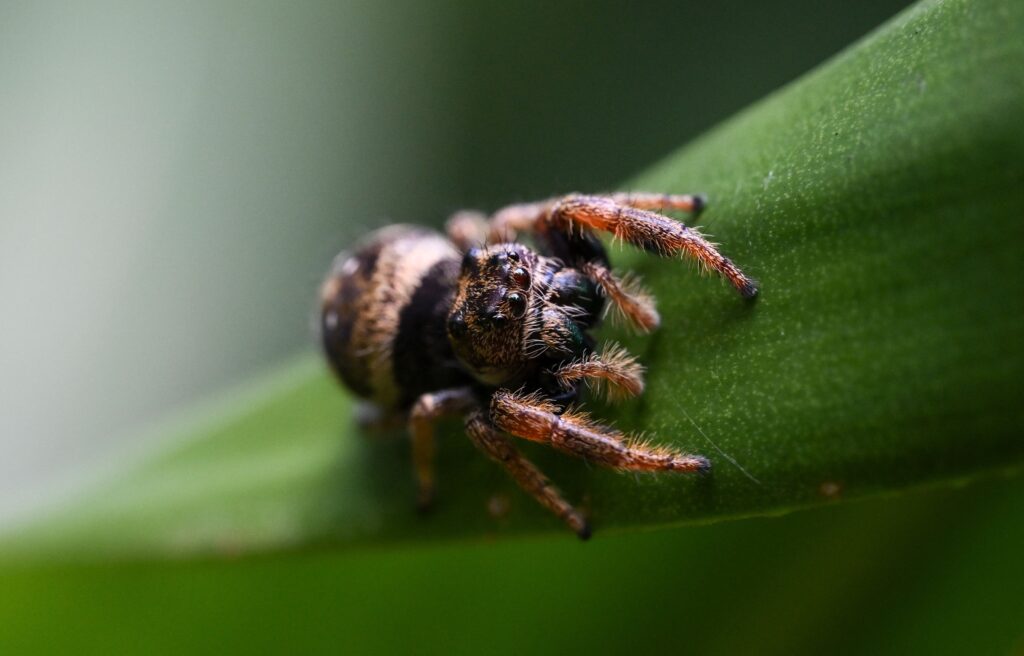
Jessiah Hahs Brinkley’s fear of spiders turned into fascination, and then infatuation.
As a child, he had nightmares after smashing black widows with his grandfather in the eaves and crannies of his house in California’s Mojave Desert.
“I was a full-blown arachnophobe,” he said.
One day, his grandfather offered him a rose-haired tarantula as a pet. Today, Hahs Brinkley, 22, is president of the Invertebrate Club of Southern California. “There’s something for everyone” among the 1 million or so insect species on the planet, he said. “It’s just such an incredible diversity of creation.”
Many Americans are deeply creeped out by creepy-crawlies. But we are the weird ones. Civilizations from China to Mexico have eaten and extolled insects for millennia. Only now are we starting to catch up.
Petco sells tarantulas and millipedes. Blue death feigning beetles are coveted companions. “Flower the jumping spider” has 352,000 followers on Instagram.
For Hahs Brinkley, invertebrates are more than a hobby. “I want to protect these things that nobody else seems interested in,” he said, citing his Christian faith. “Not a whole lot of people want to conserve, more people want to smash.”
Humans — as we destroy habitats, spray pesticides, light up the night and overheat the planet — are accelerating what some scientists call the insect apocalypse. Populations have seen steep declines almost everywhere that they’re studied, declining by 1 to 2 percent a year. In some places, they’re collapsing.
So I decided to find out what I’ve been missing. Last month, my family became the proud bug parents of eight painted lady caterpillars (soon to be butterflies if we don’t mess it up). I’m now trying to persuade my wife to adopt a blue death feigning beetle. (You’ll never have to take it for a walk.) A jumping spider may also be in the cards.
Can my family learn to love insects? Can all of us?
Who’s afraid of little bugs?
Let’s confront our fears up front. Wasps and bees sting. Mosquitoes and ticks spread devastating diseases. The movie “Arachnophobia,” the “Jaws” of the insect world, saddled spiders with an (unearned) lethal reputation.
But fear may be mostly learned. Fewer than 1 percent of insect species are dangerous to humans. You’re more likely to be killed by cows or lightning bolts in the United States than, say, a black widow (no deaths have been reported since 1983). And few of us despise dogs because we were nipped (or shun cats, despite thousands of deaths attributed to cat-borne diseases).
Still, it’s a hard sell: the articulated legs, the fangs, the eyes. Fascinating but not cuddly.
That is, until I met jumping spiders, the Labradors of the arachnid world. Silly and photogenic! From there, it was not a far leap to daddy longlegs (not technically spiders), and the many, many little guys living in the recesses of my house, doing the dirty work for free (a domestic spider may eat thousands of bugs each year).
The vast majority of spiders are “essentially harmless.” Of the tiny fraction capable of harming humans, most just want to avoid you (even venomous black widows or the brown recluse only bite when disturbed — but if you are bitten by these species, medical attention is essential).
Like it or not, humans and insects are in this together — roommates, even. The average home anywhere on the planet has about 100 insect species, according to a five-year, seven-continent scientific expedition by California Academy of Sciences entomologist Michelle Trautwein. No matter what residents did to spray or exterminate, Trautwein found, the same diversity of insects persisted. “Bugs don’t respect the limitations, the borders we’ve created,” Trautwein told The Washington Post. “They just view our houses as extensions of their habitat.”
So if you can’t beat them, join them.
How to learn to love insects
For centuries, singing bell crickets lulled Japanese royalty to sleep in tiny golden cages on their pillows. Fighting crickets captivated China’s attention the way football enthralls modern Americans. Butterflies teach children about beauty, and beetles elicit comparisons to brave warriors.
This fascination persists today, especially in Japan, where convenience stores carry insect homes, and prized stag beetles called “black diamonds” have sold for more than $90,000. Pokémon owes its existenceto its creator’s experience hunting insects as a child.
Americans are starting to get it.
While statistics are lacking, enthusiasts say they’ve witnessed an explosive interest in their hobby in the last few years, much of it driven by charismatic microfauna. “Insects are no longer viewed only as feeders or curiosities,” said Vance Noland of Fluker’s Cricket Farms, which sells multiple species of insects. “For many people, they are the primary pet.”
For insect lovers like Zack Lemann, a former insect curator at the Audubon Insectarium in New Orleans, it’s just what happens when you’re introduced to the right insect. He estimates he’s converted hundreds, perhaps thousands, into insect lovers.
“People keep insects for the same reason people take up golf,” Lemann said. “You find a thing inherently fascinating.”
How to find the right bug for you
Walk into Lemann’s study and you’ll meet more than a dozen seemingly content creatures in glass terrariums and plastic containers. There’s a pair of large wolf spiders, three species of tarantulas, a flightless giant water bug, two desert huntsman spiders, and for “some adrenaline,” a black widow (he still reminisces about his first, Widow Wetherby).
Lemann revealed the marvels of the insect world to thousands of people visiting the Audubon Insectarium every year. Most kids, he observed, start out loving bugs. Over time, as people’s exposure to insects wanes, they lose their fascination.
But, he argues, it can be rekindled. Today, new parents stop him regularly to reminisce about their field trips to see his insects — and bring their own children.
Keeping insects and arthropods as pets is one way to keep this fascination — and the species — alive. Here’s what Lemann, Hahs Brinkley and others recommend as the best insects to begin.
Beetles
Stag and rhinoceros beetles are popular in Japan. In the United States, the patent leather beetle (also know as bess beetles) are ideal starter pets. In the wild, these insects turn wood into soil. They’re docile, large and easily handled. “I love patent leather beetles,” Lemann said. “They make cute little sounds.” Desert darkling beetles and blue death feigning beetles (so named for the tendency to play dead) have also risen in popularity. You can feed them oatmeal and carrots, and they’ll live for several years.
Butterflies
Raising butterflies, of course, is really raising caterpillars. In the spring and summer, you can collect them near your home and then release them. If you’re looking for a kit, you can order a painted lady, a common insect across the United States, complete with food and housing. Once they emerge as butterflies, they can be kept in enclosures. Native species can be released. Just make sure you don’t release species that can become pests in your region.
Isopods and roaches
Isopods — also known as roly-polies, pill bugs or wood lice — are colorful invertebrates that don’t bite or sting. They’re easy to keep and act as cleanup crews in terrariums, eating organic matter on the ground. Powder blue isopods (Porcellionides pruinosus) and zebra isopods and their relatives (Armadillidium sp.) are good starter pets. “Hobbyists are moving beyond simple display enclosures and toward full, living ecosystems, and isopods play a big role in that,” Noland said.
Roaches have a bad name (deservedly for the household varieties, which can carry disease), but wild species such as the Madagascar hissing cockroach and cave cockroaches are low-maintenance, clean and quiet pets that eat fruits, veggies and grains. Make sure the enclosure is escape-proof.
Mantises
“Predators are perhaps the safest to keep as pets, particularly mantises,” said Lynn Kimsey, a professor emeritus of entomology at the University of California at Davis. “There are some really lovely ones, too.” Few predators are as capable and gorgeous as mantids, which eat insects such as crickets or flies, and require only ventilation, branches and a moist substrate. They live for about a year. Ghost mantises (Phyllocrania paradoxa) have become quite popular.
What to avoid
Not all species are suitable for beginners. Crickets, while cute, have a penchant for escaping. Ant farms ordered online typically contain workers that live for a few months; sustaining a true colony is more challenging. Millipedes, centipedes and some spiders are more advanced (tarantulas can live for 15 years).
“Avoid anything that has strong venom, is super fast, or is sensitive or difficult to care for,” said Hahs Brinkley. “A lot of things that are venomous (like assassin bugs, jumping spiders and wolf spiders) are not dangerous and can be kept by beginners, so long as respect for and caution with the animals is maintained.” Never release insects that do not natively reside in your area.
How to buy
Use captive-breeding programs, not wild-caught stock — unless you collect them yourself or can verify that they’re responsibly sourced. Some species are being decimated by the commercial pet trade.
Once people become proud bug parents, many encourage insects around their own home by planting native plants, eliminating pesticides, building habitats (bug hotels, pollinator gardens) and doing less work on their yards. Long grass, brush piles and undisturbed areas are bugs’ best friends. Contact invertebrate clubs for local recommendations.
The post Why you should consider a jumping spider as your next pet appeared first on Washington Post.