To win elections, the moderates and progressives in the Democratic Party will have to learn to live together.
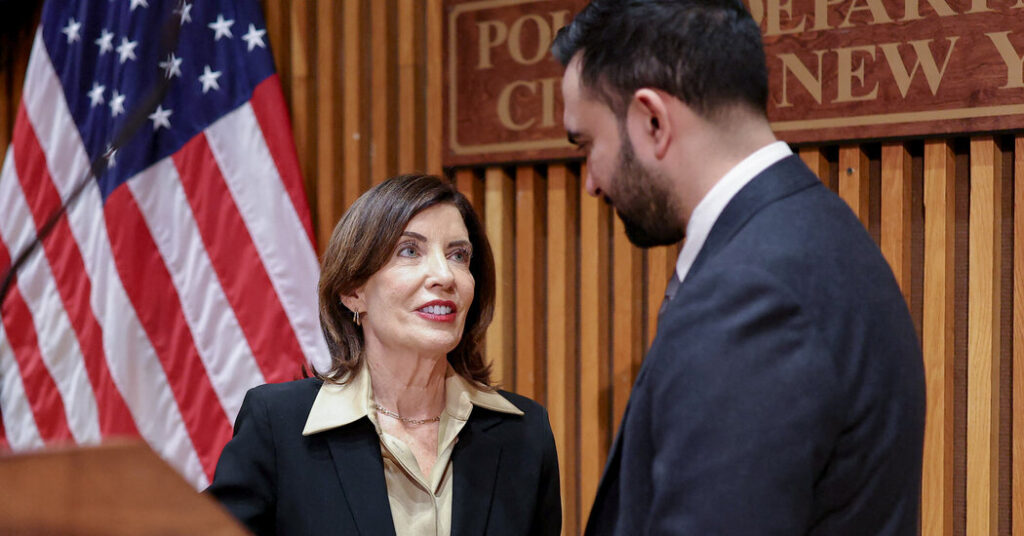
That’s why the experiment in big-tent governing in New York being conducted by Gov. Kathy Hochul, a moderate Democrat, and Mayor Zohran Mamdani, the democratic socialist, is worth closely watching.
In their first major act together, Ms. Hochul and Mr. Mamdani last week unveiled the first part of a much-anticipated plan to provide free child care in the country’s largest city and one of its most populous states. The initiative, which will greatly expand the state’s safety net, could take years and billions of dollars to carry out fully. But the pair are together giving Americans a clear vision for what Democratic governing can look like, evoking parts of the New Deal era in a bracing contrast with the growing cruelty and wantonness of the Trump administration.
The two hail from different generations, and represent very different wings of their party. Ms. Hochul, 67, comes from the centrist Democratic establishment, while Mr. Mamdani, 34, has an activist-style approach increasingly embraced by the party’s younger and leftist voters. While the two wings of the party sometimes agree about big problems, such as President Trump and the need to create affordable housing, they have been in deep conflict over how to approach some of the most intractable issues in American politics, from the role of big business and corporations to U.S. policy toward Israel. As progressives like Mr. Mamdani gain ground with Democratic voters, the two factions have been vying for control of the party.
Despite this, because of the political landscape in New York, these two Democrats need each another. Mr. Mamdani cannot deliver the free child care and free buses he promised without Ms. Hochul and the State Legislature, which control much of the funding needed to undertake the initiatives as well as the M.T.A., which runs the city’s transit system. Ms. Hochul needs the political capital and voters that an alliance with Mr. Mamdani can bring. The governor won re-election in 2022 by fewer than 380,000 out of nearly six million votes cast (or fewer than seven percentage points), an uncomfortably narrow margin in a heavily Democratic state.
Since Mr. Mamdani has taken office Jan. 1, the two have already appeared together several times, presenting a united front before voters even as they continue to have substantive differences.
Sometimes it’s been a little awkward.
There was the mayor’s inauguration, where Ms. Hochul sat silently on a riser while Mr. Mamdani was sworn in by Bernie Sanders, a democratic socialist, and the crowd broke out into chants of “Tax the rich!”
There was a news conference several days later at the New York Police Department headquarters, where Mr. Mamdani stood stone-faced as Ms. Hochul bragged about bail changes that she championed and that Mr. Mamdani did not support, and expounded the virtues of adding police officers in the city’s subways, something Mr. Mamdani has often opposed.
Their joint appearances are also serving as a backdrop for jockeying among the Democrats running for Congress. When Ms. Hochul and Mr. Mamdani celebrated the anniversary of congestion pricing, Representative Daniel Goldman, who is facing a tough primary challenge from the left, waded through a large crowd so he could stand directly behind Mr. Mamdani as the cameras rolled. Mr. Mamdani has expressed support for Mr. Goldman’s challenger, Brad Lander, the progressive former city comptroller.
Behind the scenes, the pair forged their relationship over many months last year. The day of the city’s Pride Parade, shortly after Mr. Mamdani won the June primary, the two Democrats met in a Midtown conference room for over an hour. Mr. Mamdani told the governor he hoped to expand his coalition beyond his base, according to someone familiar with the meeting; the governor urged him to do things many in New York’s establishment were suggesting, like committing to keeping Jessica Tisch as police commissioner, and engaging in more outreach with business leaders and Jewish groups.
The mayor and governor call and text frequently, and their staffs are in near-constant contact, according to people close to them. It’s quite a contrast to the toxic masculinity contest that defined the governor-mayor relationship between Andrew Cuomo and Bill de Blasio.
Despite the promising start, as the work of governing gets underway, the Hochul-Mamdani alliance is likely to become harder to maintain. Navigating issues like policing and tax policy, for instance, could be especially fraught (Mr. Mamdani wants to raise taxes on the wealthy, something Ms. Hochul hopes to avoid). The two could clash over approaches to handling crime or running the M.T.A., or positions on rental protections and unions, or even how to respond to immigration raids and handle Mr. Trump.
Mr. Mamdani has also yet to endorse the governor, who is up for re-election this year and is facing a challenge from the left in Antonio Delgado, the lieutenant governor. The endorsement could be especially critical because of the city’s increasingly dominant role in state politics. Long Island has become significantly more Republican in recent years. The shift means that to win statewide, Ms. Hochul needs to run up the margins in New York City.
If it is successful, though, the uneasy alliance in New York could offer a path forward for the Democratic Party. Such a coalition would combine the left’s energy with the center’s experience. The party in many ways is still struggling to define to Americans what it stands for after the Biden presidency. One answer is to prove that Democrats can govern — not only keeping crime low and picking up the trash and talking about affordability, but fighting for middle- and working-class people when increasingly only the richest can afford to get by.
“There’s much greater awareness that yeah, there are tremendous inequities in our system, and it does discriminate against working people,” David Axelrod, a Democratic strategist who was a senior adviser to President Barack Obama, told me. “That’s not a radical concept. That’s what a lot of Americans are living.”
With Mr. Mamdani’s meteoric political ascent, Ms. Hochul appears to have embraced this idea, along with the promise of free child care on which Mr. Mamdani campaigned. The initiative, done properly in the United States, could help millions of Americans.
It’s also an agenda both appear to be prepared to take significant political risks to deliver. Mr. Mamdani, for example, asked Ms. Tisch to remain on the job despite significant differences over policy, a decision that risked alienating parts of his base but won him good will with New York’s establishment, making it easier for Ms. Hochul to work with him. Ms. Hochul has maintained her alliance with Mr. Mamdani despite anger among some of her supporters over some of the mayor’s policy positions, like his calls to tax the rich and his views on Israel.
The alliance between the governor and mayor will be tested constantly. It’s a glimpse at the challenges and opportunities democratic competition can bring.
We live in a divided country where a president is being allowed to govern more like a king, flouting the law and engaging in imperial adventure on a whim. We are learning that building a democratic opposition party capable of stopping a would-be tyrant is harder.
The Times is committed to publishing a diversity of letters to the editor. We’d like to hear what you think about this or any of our articles. Here are some tips. And here’s our email: [email protected].
Follow the New York Times Opinion section on Facebook, Instagram, TikTok, Bluesky, WhatsApp and Threads.
The post The Hochul-Mamdani Experiment Is an Opportunity for Democrats appeared first on New York Times.