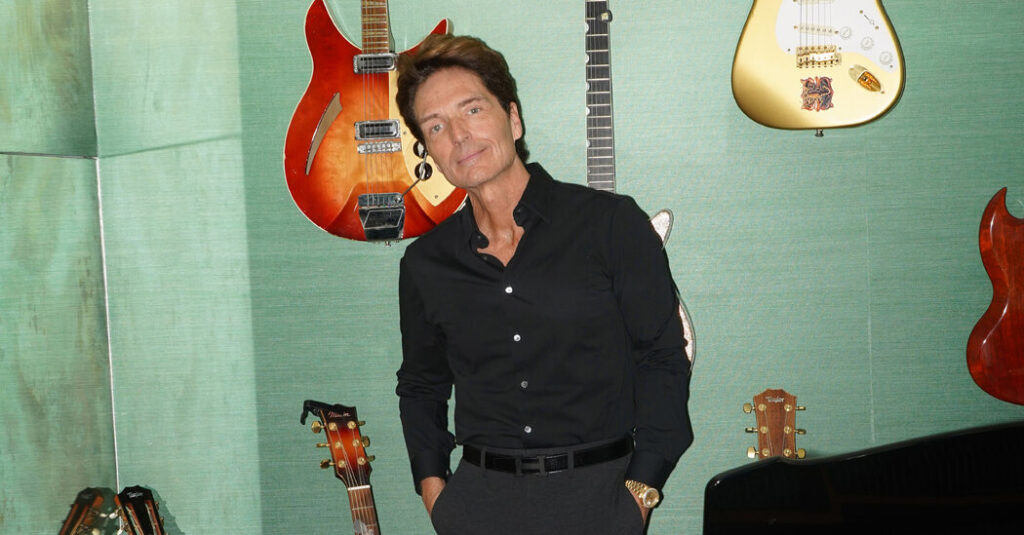
Last year, Richard Marx and his wife, Daisy Fuentes, were drinking martinis in their living room and listening to swing music on the radio, when they heard Frank Sinatra’s version of “Fly Me to the Moon.” Marx sat at his piano and tried to figure out the chords. “The next thing I knew,” he said, “I’d written this beautiful little interlude, a ballad version with long notes.”
On his new album out Friday, “After Hours,” Marx delivers swinging renditions of Great American Songbook chestnuts like “Fly Me to the Moon,” “Summer Wind” and the Gershwins’ “Love Is Here to Stay,” alongside originals he wrote in a similar spirit. He recorded it live, in only three days, with a band of session pros and an orchestra. Except for the clarity and sincerity of his tenor voice, it bears little resemblance to the soft-rocking hits he made starting in 1987, or the videos that featured him in a mullet and head-to-toe denim.
Marx, 62, is the only male artist to have his first seven singles chart in the Top 5, with three of them reaching No. 1: “Hold On to the Nights,” “Satisfied” and the perennial wedding favorite “Right Here Waiting.” He’s written for a wide range of acts, including Ringo Starr, Keith Urban and Luther Vandross. And except for having cut the mullet, he looks enviably similar to the way he did in 1987.
During a recent video interview from his home in Hidden Hills, Calif., Marx talked convivially about getting drunk with Rod Stewart, why he started taking drugs and how he romanced Fuentes, a former MTV V.J. who he’s been married to for a decade. These are edited excerpts from the conversation.
Is “After Hours” the type of music your parents, Ruth and Dick Marx, performed?
Yeah, to a degree. In the heyday of his career as a jazz pianist in Chicago, my dad did covers of the Great American Songbook. But he looked down his nose at it — he thought it was beneath him. Then he took a job writing TV and radio jingles. He started his own company and, for 25 years, was one of the biggest jingle writers in the country, all based on super poppy melodies. My mom was a big-band singer and she sang on the commercials he wrote, which I did too, when I was a kid.
Did getting older have anything to do with embracing this music?
I’m sure age is part of it. When the idea came up, I’d recorded five songs with a ’70s Southern California vibe. I had my Fleetwood Mac song, my Jackson Browne song, my J.D. Souther song. Then my brain hijacked this idea. I’m at a point, frankly, where for better or worse, when it comes to choosing projects, my mantra is “Why the [expletive] not?”
Doing only covers didn’t appeal to me, but I thought I could write songs that fit alongside the Great American Songbook. I pretended it was 1947 and I was pitching a song to Sinatra — that’s “All I Ever Needed.” I didn’t want to do “Sway,” because it’s been overdone, so I decided to write a song that’s similar to it — that’s “Magic Hour.”
Your friend Kenny G is on “Big Band Boogie.” What do you hear in his playing that his detractors don’t?
He’s one of my best friends for 30 years. I was not a fan of his music. But his dedication piqued my interest — he practices for three hours, every day. We did a private show together 10 years ago in Japan, and his intonation was perfect. He does all that showbiz, circular breathing stuff, which has entertainment value. But there’s also his tone, his choice of notes, his technique.
To a lot of people, it’s not their cup of tea. People hated Michael Bolton’s singing, and that’s fine, but you can’t say he’s not a great singer, because that’s factually incorrect.
I wanted Kenny to play something that wasn’t what you’d expect from him. When I sent him this super up-tempo, big-band boogie song, he said, “This is not what I normally do. Plus it’s in a lousy key for a sax player.” He worked on it for a few days and played tenor, which he hardly ever does, and he nailed it.
When you talk to Kenny G, do you call him “Kenny G”?
We call each other bro. Or he calls me Ricardo and I call him Kenneth.
Your sarcastic sense of humor and combativeness — are those qualities evident in your songs? Do you see them as a separate thing?
It’s a separate thing. James Taylor has a very dry personality, which doesn’t come through in his music. The dirtiest jokes I’ve heard in my life were told to me by Kenny G and Michael Bolton.
This will sound a little pretentious, but I’ll say it anyway: My personality and my music are both authentic. I’ve written some songs that would surprise you lyrically. But the perception is that I’m very romantic, sweet, safe. And that’s OK, because I am those things too.
Alcohol figures prominently in your podcast, Stories to Tell. What are you like when you’ve had a few too many?
I love everybody. I’ll compliment everything about you, even if I wouldn’t have thought to do it two martinis ago.
The drunkest I’ve ever been was about two years ago, with Rod Stewart. The next day, he told me it was the drunkest he’s ever been. I have a warped badge of honor about it. And it was an example of manifestation for me — because I dreamed my whole life of drinking with him.
I’m going to use some questions you’ve asked your podcast guests. Did you have naysayers?
Oh yeah, quite a few. The producer and writer David Foster told me I shouldn’t sing. I was 19, and it had weight because I admired him so much. Every label rejected me several times even though my demo included “Endless Summer Nights” and “Should’ve Known Better.” But I also had Lionel Richie telling me, “You’re good. Do it.”
Has success undervalued your talent as a musician in the public’s eye?
I don’t think the public has a sense of the level of my success. Plenty of people online have said, “You’re a one-hit wonder.” One time I said, “Yeah, but which one?” [Laughs]
You said on your podcast that at the age of 50, you’d never tried any drug, even pot. What changed?
Daisy! [Laughs] I’m not going to blame her, but she does love the idea of having a drink and a great conversation.
I think the first time we went out, I told her I didn’t like martinis. She said, “You don’t like vermouth, I bet.” So she ordered me a vodka martini, clean, lemon twist, no vermouth.
That’s called straight vodka.
Yes, but very cold and a little watered down.
In terms of drugs, the only reason I took a hit was because I needed both hips replaced and was in a lot of pain. I had definitely been a prude about drugs. Daisy said, “Have you thought about trying pot for the pain?” I don’t remember whether it made my hips feel better, but I certainly forgot about them.
I took mushrooms during the pandemic and I know I’ll do it again.
What are you good at? What’s the specific skill behind your success?
I think I’m a very skillful songwriter. It’s knowing how to master the puzzle. And, honest answer? I’m a really skillful singer. On this album, I did three takes of each song. No stopping or punching in.
In your memoir, you wrote that you’ve been pigeonholed as a balladeer, even though most of the music on your first few albums was rock. Is it possible that you’re just better at writing ballads than rock songs?
Even though I’m putting out a new album, I’m a touring artist. I’m a greatest-hits show. When people sway to “Right Here Waiting,” I love it. When they dance to “Don’t Mean Nothing,” I love it.
Years ago, part of me wondered why I wasn’t being accepted as the rocker that I actually am. Then it was like, “Who cares?” I’ve had my axes to grind in the past, but I got over that.
On a podcast you did with Daisy, you said that when you started dating, you played it cool. How so?
I had admired her from afar for years, in her MTV days and after that. I always thought, “I bet she’s a good hang.”
When we met, I was freshly out of a very long marriage. It was a painful time and I hadn’t been single that long. We started hanging out and she was one of the funniest people I’d ever met — sarcastic and quick. I didn’t want to scare her off. But that didn’t last long. She realized I was courting her, really pursuing her.
You did an interview with the Los Angeles Times in 1990, where you said —
Oh, God.
It’s not so bad. The interviewer asked what a future history book would say about you. You said, “It’s going to say, ‘He took a lot of [expletive] for a long time, and now he’s getting the respect he deserves.” Has that happened?
Yeah, for the most part. I still take some [expletive], but the people whose opinions matter to me have given me grace. I feel respected as a songwriter. All these years later, I don’t know how important that is to me. But it’s better than a poke in the eye with a sharp stick.
The post Richard Marx Is No Softy appeared first on New York Times.