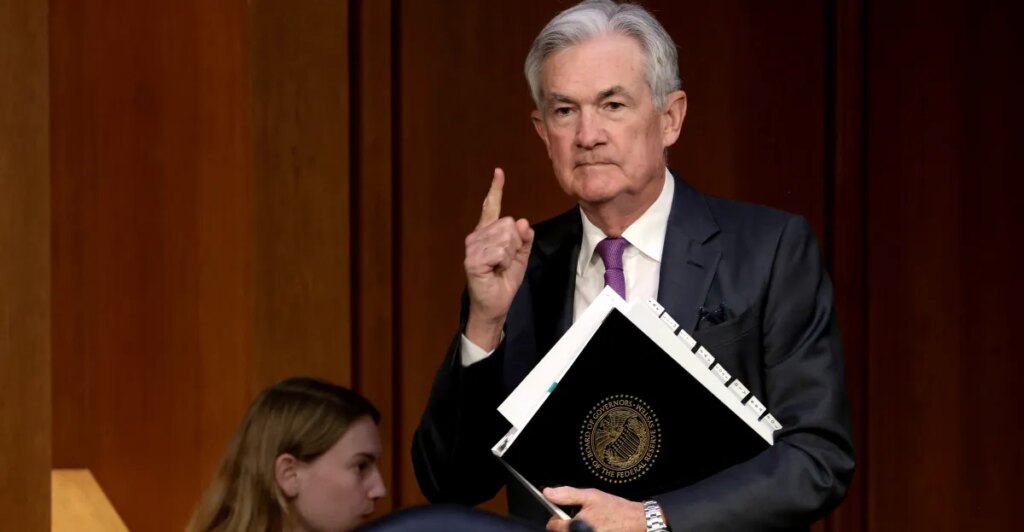
On Sunday night, Federal Reserve chair Jerome Powell gave a surprise video statement declaring he was under threat of criminal indictments, having been served with grand jury subpoenas from the Department of Justice. On paper, the matter was over cost overruns for renovations to historic Federal Reserve buildings and Powell’s related testimony to Congress. But Powell said that these were just a pretext, and the real reason was “a consequence of the Federal Reserve setting interest rates based on our best assessment of what will serve the public, rather than following the preferences of the president.”
Grand jury subpoenas on the Federal Reserve chair are a major escalation of President Donald Trump’s war against the central bank. Trump denied any involvement in the investigation, but the perception that it was part of an intimidation campaign against Powell was so strong that it generated unusually strong bipartisan pushback in Congress. Powell, who was nominated by Trump in his first term and later renominated by then-President Joe Biden, is respected among many elected officials in both parties. Sen. Thom Tillis (R-NC), a member of the Senate Banking Committee, has already said he’ll oppose any new nominee while these charges are ongoing. Sen. Lisa Murkowski (R-AK) made a similar statement. Other Republican senators sound, at minimum, concerned.
The confrontation is the dangerous but inevitable result of President Trump’s new vision of executive power, one in which the president directly exercises control over economic policymaking without any independent institutions to slow him down. So far it’s largely been a successful endeavor — with the notable exception of the Federal Reserve, where Trump has faced higher legal and political hurdles. Perhaps for that reason, it’s become the place he’s most focused on. The Powell fight will now prove the biggest test yet of his ability to impose his unfettered will on the most powerful economic institutions in the world.
How Trump consolidated economic power
Only a year into his second term, Trump has exercised far more personal power over economic policy decisions than in his first.
He has canceled spending, frozen funds, and pursued aggressive rescissions that treat appropriations as optional. He’s dismantled programs supported by Congress in a bipartisan manner, like the foreign aid services at USAID. He’s pursued mass firings of federal government workers, bypassing civil service protections, and leading to a nearly 10 percent headcount reduction in 2025. He’s unilaterally declared sweeping tariffs across countries and products at levels not seen in a century, raising hundreds of billions of dollars in taxes without Congress. He directed the government to take equity positions in private firms, ranging from a “golden share” arrangement in US Steel, which Trump told reporters he personally controls, to a 9.9 percent stake in Intel. Trump fired the Bureau of Labor Statistics commissioner because he baselessly argued one jobs number was “rigged” to make his economy “look less stellar.”
With few exceptions, Trump has largely been unopposed in this effort. Republicans in Congress, who should have an interest in defending their power of the purse to determine government spending, have typically deferred to the president and his power over their party. The Supreme Court looks like it will give the president broad control over regulatory agencies. Though they recently heard a challenge to the legality of Trump’s tariffs and may limit them based on how oral arguments went, even there Trump officials say they are prepared to fight an adverse decision with different tariff powers rather than stand down.
But there’s one place that Trump has encountered especially stiff resistance: the independence of the central bank.
The Fed exception
The unique power of the Fed loomed over the president’s earlier efforts to take over independent agencies. In February of last year, shortly upon taking office, Trump issued an executive order, “Ensuring Accountability for All Agencies,” that declared that all independent agencies, including ones designed by Congress to have a layer of independent authority, “must be supervised and controlled by the people’s elected President.” This is the direct result of the unitary executive theory, a once fringe but now central conservative constitutional theory, that gives the president direct powers to hire and fire any independent agency head.
The administration soon got to work, firing Democratic commissioners at the Federal Trade Commission, the Merit Systems Protection Board, and the National Labor Relations Board. But the executive order asserting this level of control had a carve-out:
This order shall not apply to the Board of Governors of the Federal Reserve System or to the Federal Open Market Committee in its conduct of monetary policy. This order shall apply to the Board of Governors of the Federal Reserve System only in connection with its conduct and authorities directly related to its supervision and regulation of financial institutions.
It wasn’t intuitively clear why the administration lawyers drafting this left the Federal Reserve’s monetary policy outside their newly claimed powers, while insisting they do control how the Federal Reserve regulates the financial system. The Federal Reserve is like any other independent agency created by Congress. If the president can claim these powers over other agencies, why would it stop there?
The answer lies in the Fed’s unique importance to the economy. The central bank is tasked with pursuing a “dual mandate” of low inflation and low unemployment, which it pursues mainly by controlling interest rates. Keeping inflation down can sometimes require raising rates in order to deliberately slow the economy, which is why the Fed is supposed to make these decisions instead of politicians, who are unlikely to want to tank the job market in an election year. Fed chairs are granted 4-year terms and governors are granted 14-year terms in order to further insulate them from political considerations. Anything that throws that independence into question risks creating an expectation that the US won’t take inflation seriously, which could have untold spillover effects across the economy.
The Supreme Court stepped into this vacuum with Trump v. Wilcox in May of 2025, which allowed the firings at the NLRB and MSPB to stay in place for the time being. But they went out of their way to say that any likely decisions on these fronts wouldn’t impact the Federal Reserve. Why? As the Court wrote, “The Federal Reserve is a uniquely structured, quasi-private entity that follows in the distinct historical tradition of the First and Second Banks of the United States.”
This didn’t make much sense to financial and legal historians, who argued there was little in the law to distinguish between the two categories. But it looked like the Supreme Court wanted to find a way to ensure central bank independence while giving the executive branch control over everything else, given the potential economic upheaval.
How Trump escalated his war on the Fed
It was probably inevitable that, even when granted personal control over so much of the government, Trump would become fixated on the one place the Supreme Court wanted him to avoid.
In the ensuing months, Trump pushed against Federal Reserve independence in other ways, sending Powell a note in June with central bank rates for other countries and saying that Powell should be cutting rates faster. He publicly started attacking Powell for “costing” Americans too much money on interest payments and complained he needed lower rates to make it easier to finance federal budget deficits.
Even jawboning the Fed was widely considered, at minimum, indelicate before Trump. But things escalated from a war of words to more serious territory when the administration initiated a legal investigation into a Federal Reserve governor who votes on interest rates, Lisa Cook. Last August, the Department of Justice opened criminal investigations into Cook based on a referral from the Federal Housing Finance Agency (FHFA) and its head Bill Pulte based on a mortgage application. These kinds of FHFA allegations have conspicuously been used against many political opponents under Trump, including New York state Attorney General Letitia James, Sen. Adam Schiff of California, and California Rep. Eric Swalwell (Pulte is also reported to be behind the Powell investigation.)
Trump used the Cook investigation as a pretext to attempt to fire her from the Federal Reserve over a decade before her 14-year term was supposed to expire. The move was blocked by the Supreme Court while they examined the issue, with a case that will be heard next week.
That the Supreme Court has handed Trump such expansive new powers and protections while trying to hold this one line on central bank independence, and that Trump doesn’t respect that line, suggests it will take intense pushback from the courts and Congress alike to maintain it.
But even if the line does hold, the president has lots of new powers under this new centralized control system to effect monetary policy. Trump has claimed control over the Federal Reserve’s financial regulatory authority, and it’s at least possible the Supreme Court sides with him even if it preserves its role in setting interest rates. As macroeconomic analyst Matthew Klein notes, this authority is prone to abuse. One way that monetary policy works is through financial markets, making it more attractive to take out loans and borrow. If Trump and his appointees can determine how strict financial regulations are based on political considerations, it gives him a substantial amount of control over monetary policy in practice.
Moreover, Trump can direct his agencies to do de facto monetary policy. On Friday, Pulte announced that Fannie Mae and Freddie Mac would launch a major $200 billion mortgage bond buying program. Putting direct pressure on lowering mortgage rates through financial markets feels very similar to the quantitative easing programs the Federal Reserve has executed during recessions. There are times, especially in deep recessions, where fiscal and monetary policies can and should coordinate. But these are not those times, and simply lowering mortgage rates outside any kind of broader housing market reforms or other efforts to bring down rates is likely to have unintended consequences.
It’s easy to say that this campaign against the Federal Reserve is happening because the Trump administration doesn’t understand economic policy or simply wants to juice growth no matter the longer-term trade-offs. But it’s also the inevitable result of conservative courts and a Republican Congress abetting Trump: As he amasses more and more control over the government’s power to tax, spend, and regulate, it comes as no surprise he wants to control the ability to print money. And given his success in steamrolling these checks and balances, who will stop him?
The post The enormous stakes of Donald Trump’s fight with Jerome Powell appeared first on Vox.