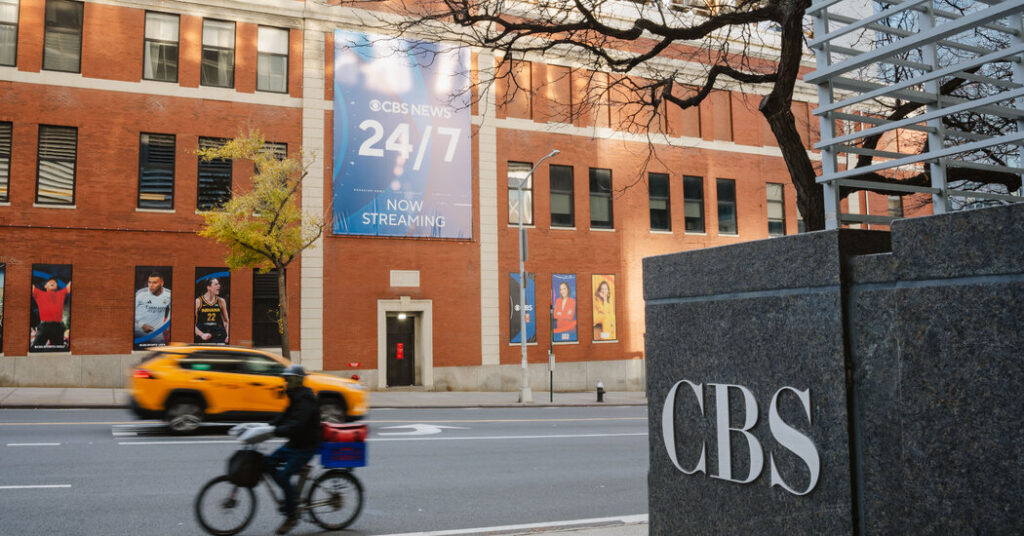
Bari Weiss’s message to the “CBS Evening News” team was blunt.
“Let’s make sure every single night has something with viral potential,” Ms. Weiss, the new editor in chief of CBS News, wrote to top producers as they prepared for the show’s new anchor, Tony Dokoupil, to start his tenure this month with a two-week tour of the country.
“The goal for this road show is not to deliver the news so much as it is to *drive the news*,” Ms. Weiss wrote in a note obtained by The New York Times. “We need to *be the news* for these 10 days.”
Ms. Weiss has achieved that goal — perhaps not in the way she hoped.
Her reimagining of CBS News has faced heavy scrutiny, and even became a punchline on her own network: At Sunday’s Golden Globes, broadcast by CBS, the host, Nikki Glaser, earned one of her biggest laughs when she declared that CBS News was “America’s newest place to see BS news.” (David Ellison, the technology heir who controls CBS and installed Ms. Weiss, was in the audience.)
That Ms. Weiss’s news division merited a mention at a Hollywood awards show speaks to how the disruptions at CBS have penetrated the culture beyond the media in-crowd — and underscored questions already hanging over her bumpy stewardship of a major news institution.
Ms. Weiss, who took over in October, has presented her reinvention of the “Evening News” as a necessary change to an often-staid half-hour format, and the sort of reform she hopes to enact at CBS News, which ranks behind ABC and NBC in viewership.
But problems have piled up. Mr. Dokoupil’s debut weeknight telecast on Jan. 5 was marred by a teleprompter issue that left the anchor grasping for words and shaking his head with frustration in front of millions of live viewers. “First night, big problems here,” he conceded. The blunder occurred in part because Ms. Weiss and her aides were rewriting the “Evening News” script up until minutes before the 6:30 p.m. airtime, three people with knowledge of the events said.
Then Mr. Dokoupil got his viral moment: a tonally confused segment in which he showed internet memes featuring the secretary of state, Marco Rubio, and praised his “impressive résumé.” Mr. Dokoupil concluded with an ad-libbed remark that raised eyebrows: “Marco Rubio, we salute you. You’re the ultimate Florida man.”
The segment was meant to be lighthearted, part of Ms. Weiss’s effort to inject more personality and informality into the newscast, a person familiar with internal discussions said. But Mr. Dokoupil’s improvised sign-off was pilloried on social media by critics who called it inappropriate for an anchor expected to report evenhandedly on Mr. Rubio’s State Department.
CBS also posted a message from Mr. Dokoupil introducing himself to viewers. He accused “legacy media” of having “missed the story” by relying too heavily on “academics or elites,” a claim that closely mirrored the critiques often published by The Free Press, the news and opinion site co-founded by Ms. Weiss. Besieged by online critics, Mr. Dokoupil responded in part by promising that his show would be “more transparent than Cronkite,” prompting more mockery.
All the attention on a nightly newscast — a format sometimes dismissed as a dinosaur — reflects the outsize interest in Ms. Weiss, a longtime opinion journalist who rose to fame in part by accusing mainstream media outlets like CBS News and The New York Times of groupthink.
She caused a firestorm last month when, at the last minute, she postponed a “60 Minutes” segment that was critical of the Trump administration. The correspondent who reported the segment called the move “political,” and Ms. Weiss faced accusations that she was, at best, mismanaging staff and, at worst, censoring journalism to please President Trump. (The incident also seemed to prompt another joke by Ms. Glaser at the Golden Globes, when she announced that “the award for most editing goes to CBS News.”)
Ms. Weiss has said the “60 Minutes” segment needed work to be more “comprehensive and fair,” and later blamed “a slow news week” for the firestorm over its postponement.
Mr. Ellison selected Ms. Weiss to run CBS News last year after he acquired the network’s parent company, Paramount. The Trump administration approved his purchase after Paramount paid $16 million to settle a defamation lawsuit brought by Mr. Trump against “60 Minutes.” The lawsuit, which many legal experts called frivolous, accused the show of editing an interview to harm Mr. Trump’s presidential campaign.
Ms. Weiss and her allies insist that she does not take orders from either Mr. Ellison or Mr. Trump. They maintain that she is exercising her prerogative as the network’s editor in chief. “The majority of Americans say they do not trust the press; it isn’t because they’re crazy,” Ms. Weiss wrote in a recent memo to her staff.
Ms. Weiss is also proud of the newsmakers that Mr. Dokoupil has booked for the program, some of whom she helped secure. He has interviewed Thomas Homan, Mr. Trump’s top border official; Pete Hegseth, the defense secretary; and María Corina Machado, the Venezuelan opposition leader.
Part of the debate inside CBS News is whether Ms. Weiss’s early stumbles are a symptom of partisanship, inexperience or something else. She had never managed an organization nearly as large as CBS News, and she often relies on a small circle of lieutenants, some of whom she brought with her from The Free Press. Among that group is Adam Rubenstein, who previously worked with Ms. Weiss on the Opinion desk of The Times, and Sascha Seinfeld, the daughter of the comedian Jerry Seinfeld.
Privately, Ms. Weiss has been deeply frustrated by the negative reaction to her decisions, and has blamed some subordinates for not stanching the criticism, three people familiar with internal discussions said. Ms. Weiss’s wife, Nellie Bowles, a former reporter at The Times, openly mocked the objections of the “60 Minutes” staff who had clashed with her spouse in a column published by The Free Press, which Ms. Weiss continues to oversee.
“My lovely wife asked some 60 Minutes producers to report out a story a little more, literally Hey guys make a couple more phone calls and then we’ll run the piece in a week or two,” Ms. Bowles wrote. “No! the media collectively shrieked. We shan’t!” (CBS News declined to make Ms. Weiss available for an interview. Referring to Ms. Bowles’s column, Ms. Weiss said in a statement that The Free Press was “completely editorially independent,” and added, “Also: My wife is the funniest writer in America.”)
Mr. Dokoupil’s teleprompter flub last week came about after Ms. Weiss asked to add an on-air analysis of why Mr. Trump had extricated Nicolás Maduro from Venezuela.
In the rush before airtime, the new material was inadvertently added twice into the script, the three people with knowledge of the evening’s events said. Mr. Dokoupil was flummoxed when he encountered the same words twice, asking his producers out loud which segment he was supposed to turn to next.
“Are we going to Kelly here, or are we going to go to Jonah Kaplan?” he said, before lapsing into five seconds of silence. The error led to recriminations in the CBS control room, where Ms. Weiss and her top aides had gathered to watch the broadcast, the people said.
“Mistakes like what happened with the prompter tonight can never happen again,” the show’s executive producer, Kim Harvey, wrote to her staff hours later, after 1 a.m., announcing “a new schedule and process” that would take effect immediately.
“We get 19 minutes (and 30 seconds) every night,” Ms. Harvey added. “We need to nail it.”
Michael M. Grynbaum writes about the intersection of media, politics and culture. He has been a media correspondent at The Times since 2016.
The post ‘We Need to Be the News’: Inside Bari Weiss’s Bumpy Revamp at CBS appeared first on New York Times.