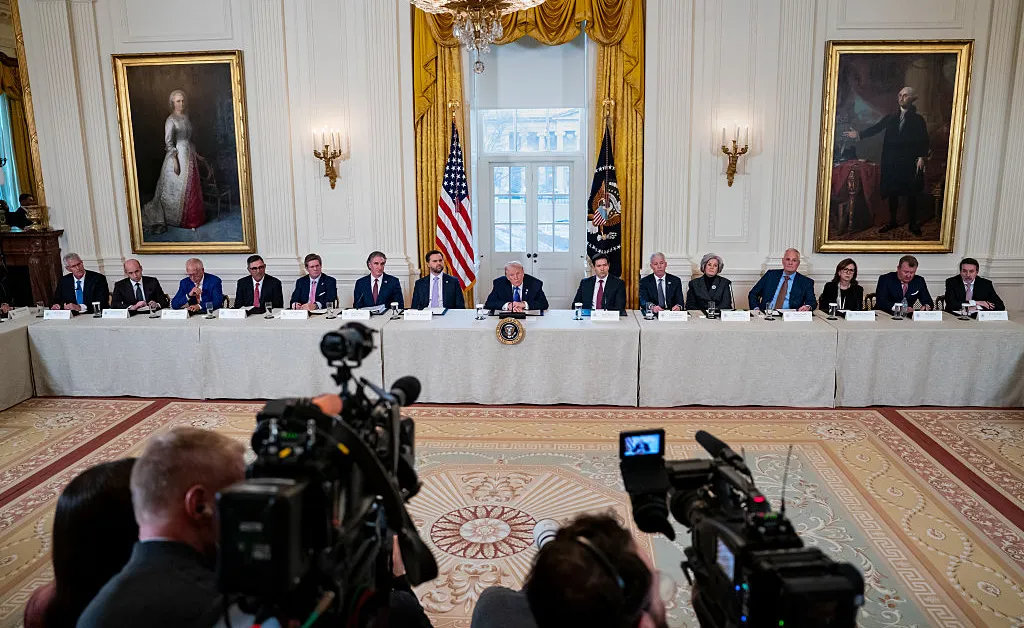
In an optimistic interview, Speaker Emerita Nancy Pelosi confidentially predicted that the Democrats will regain control of Congress.
This optimism is not entirely unfounded. President Donald Trump’s favorability is faltering, MAGA stalwarts have begun to show dissent, and special elections have provided Democrats with a ripple of victories. And still, the Democratic Party could snatch defeat from the jaws of victory.
[time-brightcove not-tgx=”true”]
Just as the Republican Party continues to wrestle with its MAGA takeover, Democrats too remain engaged in a battle for the direction of the party. The latest fight is over the incorporation of a state wealth tax in California. Governor Gavin Newsom has vowed that “Wealth taxes are going nowhere.” Despite Europe retreating from failed wealth tax experiments, progressives in the states have remained steadfast, following national leaders like Massachusetts Senator Elizabeth Warren.
Democrats must recognize what Trump initially grasped in 2016: Americans do not resent business success—they admire it, provided it is earned rather than extracted through ill-gotten advantages. The Marxist prediction that workers would develop class consciousness against the wealthy never materialized in the U.S. Even when over 25% of the U.S. working-age population was unemployed during the Great Depression, socialism did not fully take root. Historians Seymour Martin Lipset and Gary Wolfe Marks explain that the U.S. has never nurtured a strong socialist movement due to factors like the absence of a feudal past and the cultural focus on individual opportunity shared by immigrants and longstanding citizens.
Instead, as Thorstein Veblen observed in his 1899 work The Theory of the Leisure Class, Americans aspire to join the successful, not tear them down. His terms of “emulation” and “conspicuous consumption” captured the striving spirit of Americans who celebrate the successful among us, as long as they did not cheat to win.
Meanwhile, even the MAGA base has begun to question the extremes to which Trump has pursued a Maoist-styled state capitalism, demanding stakes in public companies such as Intel and instilling regulatory regimes with partisan agendas. Trump’s return to power has meant a surge of indiscriminate tariffs, increased government intervention in the private sector, disregard for the rule of law, and the dismantling of the systems that supported American exceptionalism, among other effects. The result for the Trump Administration has been record-low approval ratings on his handling of the economy.
The Democrats have a rare opportunity to fill the void of economic rationality left by the traditionally pro-business GOP by moving toward the political center and working with the business community.
Recent election outcomes have provided no clear answer for the party. It could shift further left by embracing the high-energy Democratic Socialist camp, exemplified by New York City mayor Zohran Mamdani. Or it could move closer to the center by aligning with the governors-elect of New Jersey and Virginia, Mikie Sherrill and Abigail Spanberger, respectively.
In short, American business is stuck with a Republican party it hardly recognizes. The Democratic alternative must decide what it wants to become after a hard reset. To us, the answer is clear: why wouldn’t a political party in dire need of practical counsel collaborate with the source that led the U.S. to become the most prosperous nation in history? Especially when the bar set by the Trump Administration is so low.
As the 2026 midterms approach, affordability will again be the deciding issue among voters. And one year into the second Trump presidency, the American public no longer believes the cost-of-living crisis can be pinned on President Joe Biden. Yet, the Democrats still need common-sense, practical economic policies to convince their base and swing voters that they can be better stewards. No other group is better suited to advise on this concern than corporate leaders.
Throughout President Trump’s first year back in the White House, we have had the privilege of hearing directly from the CEOs of organizations large and small, from the iconic U.S. companies shaping global trends to the regional businesses powering local economies. Many have shared their deep frustrations with the direction of the Republican Party. Sometimes these occur during our quarterly CEO forums, in public but off-the-record exchanges. Others come during private discussions.
Regardless of the format, three concerns have consistently emerged as critical to ensuring the long-term health of the domestic economy and solving the affordability problem. All can align with the principles of the right Democratic platform.
Don’t fall for the false allure of state capitalism
State capitalism is not a solution to market failures or societal inequities—it will only exacerbate them. Government equity stakes in corporations create market distortions favoring those with enough resources to navigate them. Revenue-sharing agreements divert profits that could otherwise flow to pension funds serving teachers, first responders, and blue-collar workers. Political interference in mergers and acquisitions approvals and daily operations repels foreign investment and damages confidence in market operations.
While the Trump Administration has framed government ownership as correcting Biden-era errors, Democrats should draw a different lesson: industrial policy can advance national security interests through proven levers—direct loans, loan guarantees, fast-tracked permitting, workforce development, and cross-sector partnerships. But implementation must move swiftly. Bureaucratic excesses and multi-purpose policies cannot burden it, as was the case with the CHIPS Act and the Inflation Reduction Act.
Think smart regulation, not more regulation
The dealmaking bonanza on Wall Street since Biden Administration officials left office offers a reasonable gauge of the damage inflicted when regulatory agencies are captured by ideology. Under President Biden, the FTC and DOJ slowed large transactions, suggesting that all big businesses were bad businesses. Blocking mergers to protect luxury handbag markets or attacking low-margin grocers for price gouging were misplaced efforts.
That does not mean regulators should let businesses operate without oversight. Stripping coal-fired power plant emissions standards or narrowing vaccine approvals, as Trump has done, removes protections that most CEOs support.
The practical answer to the short two-year election cycles lies in targeted regulation, ambitious yet realistic, and, above all, informed by political leaders, corporate heads, small business owners, unions, and consumer associations. As argued in his book Abundance, Ezra Klein explains how America’s growth has been hindered by well-meaning regulations, permitting requirements, and veto points that have blocked affordable housing, infrastructure, and clean energy development.
There are many issues in need of smart regulation. Social media companies continue to promote harmful content without consequence. A decades-long energy transition requires collaboration with the fossil fuel industry to ensure U.S. energy security. Federal regulation of AI can protect the public while maintaining American tech supremacy. Business leaders, of course, have their own interests and shareholders to serve, but Democrats can still protect the public interest while giving CEOs a seat at the table to reach pragmatic answers to difficult questions like these.
Economic prosperity through partnership
Many Americans still believe that rebuilding advanced manufacturing in the U.S. could provide good jobs and growth opportunities for hollowed-out regional economies. Access to critical minerals, semiconductors, and essential goods is paramount for economic security. However, as the Trump Administration has discovered, America cannot cost-effectively produce many products that allied nations manufacture with fair competitive advantages.
This reality was evident at our September CEO forum, where two-thirds of the more than 70 top chief executives from major global companies do not expect to invest in domestic manufacturing or infrastructure because of the shift in trade policy.
Extractive trade deals secured through tariffs may boost egos, but capitalizing on decades of American goodwill and power is not negotiating prowess—it is short-sighted dealmaking that will leave future generations managing resentful international partners. To compete against China, America needs allies that can trust its commitments.
Many CEOs support tariffs against fair market manipulators like China, but they understand that generalized tariffs are primarily a tax on U.S. stakeholders. Business leaders at the September CEO forum estimated that 80% of the tariffs have been borne equally by domestic companies and consumers. Iconic companies like Nike and Ford expect to incur billions in additional costs. Worse, the tariff burden is a regressive tax that falls hardest on lower-income households and small businesses with less bargaining power.
The time has arrived for the Democratic Party to reclaim its identity as America’s “big tent” coalition, not through ideological purity tests, but through practical economic stewardship. Party leaders have a unique chance to begin by offering the business community a genuine seat at the policymaking table, not as donors to be courted during campaign season, but as partners whose operational expertise can inform realistic solutions to the affordability crisis.
As President Harry Truman advised, “We can keep our present prosperity, and increase it, only if free enterprise and free government work together to that end.”
The post Democrats’ Chance to Defend Capitalism From Trump appeared first on TIME.