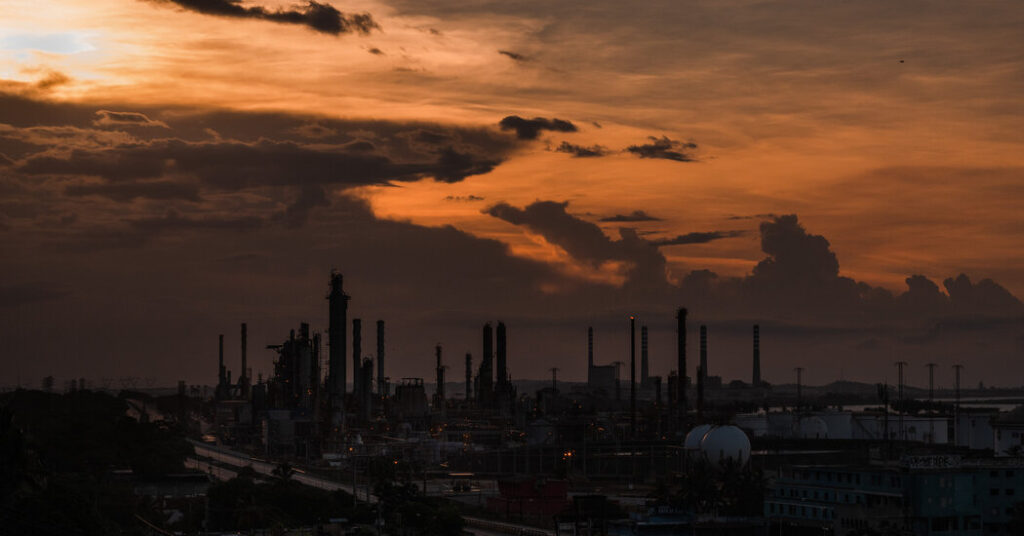
President Trump’s ambitious plans for transforming Venezuela’s oil production will most likely take years to revive the country’s troubled industry — if they succeed at all. But it’s already clear that winners and losers will emerge from the changes.
Among the likely winners are the oil producers already positioned in Venezuela, like Chevron, and the American refiners in the Gulf Coast that stand ready to process the kind of heavy crude produced from Venezuela’s fields.
Washington’s control of Venezuela’s resources could “mark a notable shift in global energy dynamics,” analysts at J.P. Morgan wrote in a recent note to clients. The United States could potentially “exert more control over oil market trends, helping to stabilize prices and keep them within historically lower ranges,” they added.
American consumers would benefit if the Venezuelan production translates into cheaper gasoline for American drivers.
But there will also likely be losers among countries and companies that have grown close to Venezuela in the recent years or profited from its standoff with Washington. For example, Mr. Trump has said he wants to cut off Venezuela’s oil flows to Cuba, long a mainstay for the Havana government.
China, the largest destination for Venezuelan crude, may see flows of heavily discounted Venezuelan oil reduced or halted, particularly for the small, independent businesses in China known as teapot refineries that are the main customers.
More broadly, if prices fall too low as a result of increased Venezuelan supplies, the global oil industry, including the shale drillers in the United States that Mr. Trump has courted, could be slammed.
Certainly, members of the oil cartel OPEC that have long tried to manage the oil markets will be watching Washington’s experiment closely.
Venezuela, a founding member of the producers group, has lost influence in recent years as its industry has declined and sanctions have crimped production. As a result, Venezuela is exempt from the production quotas of OPEC Plus, a larger group of oil producers.
What is likely to ease OPEC’s concerns is an emerging consensus that changes in Venezuela may take years to translate into large output increases. “In terms of Venezuela’s membership and potential for an eventual substantial return of Venezuelan production, I think OPEC will feel that it can handle that,” said Richard Bronze, head of geopolitics at Energy Aspects, a market research firm.
Jim Burkhard, vice president and head of oil market research at S&P Global Energy, a data analysis firm, figures that Venezuela’s production could increase 50 percent, to about 1.5 million barrels a day, in a year or two.
But that additional half-million barrels a day would be less than half of 1 percent of global oil supplies. “It’s not inconsequential, but it’s not something that on its own is going to move the oil price,” Mr. Burkhard said.
It remains unclear if U.S. oil giants are ready to sink huge capital expenditures in Venezuela. At a White House meeting on Friday where President Trump urged them to spend at least $100 billion to turn around Venezuela’s resource-rich but decrepit industry, the response was cautious.
Darren Woods, Exxon Mobil’s chairman and chief executive, said Venezuela was “uninvestable” without significant changes to the legal and commercial systems.
Nevertheless, if the United States, in coordination with the Venezuelan government, is able to encourage substantial investment, it could become a significant source of oil to meet continued demand into the 2030s, after fields in other countries decline, analysts say.
Venezuela has very large deposits of oil and gas that could lure investors at a time when other resources like shale in the United States are expected to be peaking or, as in the case of Russia, potentially off limits because of sanctions.
“The Venezuelan reserves are going to be attractive to companies in a post-2030 scenario, just because of the security of the geology,” said David L. Goldwyn, a former U.S. Department of State special envoy for energy, who is now president of Goldwyn Global Strategies, a consulting firm.
If Venezuelan production does expand, the global market could shift. There seems to be little question that the United States will gain access to Venezuelan oil that could lower the costs for American consumers.
Analysts say that China, with ample oil in storage, is likely to be able to weather any reductions of Venezuelan crude, which accounted for only a small portion of China’s overall imports in 2025, according to Kpler, a research firm.
On the other hand, analysts say that if crude supplies from Venezuela increase beyond what the United States can handle, India may be able to buy more, reducing its dependence on Russia.
Assuming Mr. Trump is successful, Chevron will be among the winners. Mark A. Nelson, vice chairman of the U.S. oil giant, which produces about a quarter of Venezuela’s oil output with permission from Washington, told Mr. Trump that the company could increase production — about 240,000 barrels a day — by 50 percent in 18 to 24 months.
Two European companies, Italy’s Eni and Spain’s Repsol, have ventures in Venezuela that are struggling because of U.S. sanctions and the billions of dollars owed to them by the Venezuelan government. They are in a position, though, to quickly ramp up activities if conditions improve.
“We are on the ground, we have people, we have facilities, we have technical capabilities, and we are ready to invest more in Venezuela,” Josu Jon Imaz, Repsol’s chief executive, told the White House in its meeting on Friday, according to the company, adding that Repsol could triple current production of 45,000 barrels a day in the coming years.
At the same meeting, Claudio Descalzi, chief executive of Eni, said it was ready to bring in U.S. companies to help develop its Venezuelan resources.
Shell, Europe’s largest energy company, has a license from Washington to pursue a plan to develop an offshore Venezuelan natural gas field called Dragon. The gas would flow into a liquefied natural gas facility on neighboring Trinidad that Shell partly owns, and then continue on to world markets.
Valero, an American refining company, and others like it seem well positioned to buy Venezuelan oil. Many refineries in the United States were built decades ago to process heavy Venezuelan crude but now cannot obtain enough of the viscous stuff.
Valero “has emerged as the biggest beneficiary of the developments in Venezuela,” Vikram Bagri, an analyst at Citigroup, wrote in a recent note to clients.
On the other hand, Canadian oil producers that have taken advantage of Venezuela’s problems to ship heavy crude to U.S. refiners, may eventually find themselves squeezed.
Stanley Reed reports on energy, the environment and the Middle East for The Times from London. He has been a journalist for more than four decades.
The post Venezuela’s Oil Riches Are Years Off, but Winners and Losers Will Emerge appeared first on New York Times.