As the Iranian authorities impose a near-total communication blackout on a country convulsed by mass protests, videos and witness accounts slowly emerging suggest that the government is waging one of its deadliest crackdowns on unrest in more than a decade.
Eyewitnesses say government forces have begun opening fire, apparently with automatic weapons and at times seemingly indiscriminately, on unarmed protesters. Hospital workers say protesters had been coming in with pellet injuries but now arrive with gunshot wounds and skull fractures. One doctor called it a “mass-casualty situation.”
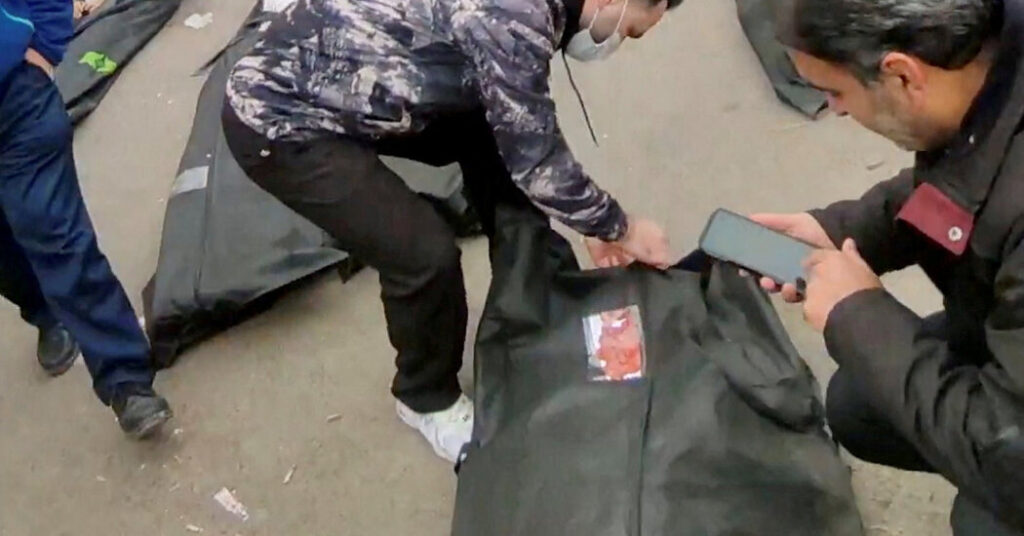
Despite the communications blockade, a recurring image has made its way out of Iran: rows and rows of body bags.
In videos uploaded by opposition activists on social media, families can be seen sobbing as they huddle together over bloodied corpses in unzipped bags. And in footage aired on Iranian state television, a morgue official, sheathed in blue scrubs, stands amid bags neatly arranged along the floor of a white room, under glaring fluorescent lights.
“The majority of these people are ordinary people,” the official says, sighing and shaking his head. “Their families are just ordinary families.”
Those who still support Iran’s theocratic government and those in the streets calling for its downfall agree: These are days of brutality unlike anything they have ever seen.
The toll of dead and injured across the country is unclear. Human rights groups are struggling to reach their contacts inside Iran and follow the methodology they normally use to verify information but say they have counted hundreds dead already.
A senior Iranian health ministry official, speaking on the condition of anonymity, said about 3,000 people had been killed across the country but sought to shift the blame to “terrorists” fomenting unrest. The figure included hundreds of security officers, he said.
Another government official, also speaking on the condition of anonymity, said he had seen an internal report that referred to at least 3,000 dead, and added that the toll could climb.
If confirmed, the violence would be among the worst in recent Iranian history.
Witnesses spoke of seeing snipers positioned on rooftops in downtown Tehran and firing into crowds; of peaceful protests turning abruptly into scenes of carnage and panic as bullets pierced through people’s heads and torsos, sending bodies toppling to the ground; and of an emergency room treating 19 gunshot patients in a single hour.
“The regime is on a killing spree,” said one protester, Yasi. She, like other Iranians interviewed by The New York Times, asked that her full name be withheld for safety.
Yasi, who is in her 30s and works for a publishing company, said she was marching along Andarzgoo Boulevard in Tehran on Friday night with friends when security forces stormed in and shot a teenage boy in the leg as his mother looked on.
“My son! My son! They shot my son!” the woman cried, Yasi said.
For the past five days, the Iranian authorities have shut down the internet, international phone lines and sometimes even domestic mobile phone connections. That has left rights groups, journalists and families alike struggling to understand the scope of what has happened.
But videos trickling out of the country and the messages of some Iranians who occasionally get satellite internet connections offer a devastating picture of bloodshed.
“I managed to get connected for a few minutes just to say it’s a blood bath here,” Saeed, a businessman in Tehran, told The Times. He said he was using a Starlink internet connection late on Sunday.
When protests over the dire Iranian economy broke out in Tehran’s marketplace, on Dec. 28, Saeed took to the streets to join them. He had done the same during the protest movement in 2022 and those before it, he said.
But as Iran descends into deeper isolation, it has become increasingly clear, he said, that this crackdown is “unlike any of the protests that came before.”
“I personally saw a young man get shot in the head,” he told The Times in recorded audio messages. “I witnessed someone get shot with a bullet to the knee. The person fell to the ground unconscious, and then security forces gathered over him.”
Two weeks ago, when a sharp currency devaluation sent protesters into the streets, officials acknowledged their grievances as legitimate, though they warned protesters not to be swayed by “rioters.”
But in the past week, the smaller demonstrations in city markets and universities exploded into a broader popular movement, with throngs of protesters filling major city squares and rural town centers alike. Now Iranian officials have begun to talk of them being taken over by “terrorists,” and foreign agents loyal to its enemies, the United States and Israel.
“Take firm and effective measures to avenge the martyrs and those killed,” Iran’s attorney general, Gholam-Hossein Mohseni-Ejei, said at a meeting of the Supreme Judicial Council on Monday, according to the semiofficial news agency, Tasnim.
In a sign of the scale of the crackdown, the government has taken the unusual step of acknowledging that there have been large numbers of casualties, but has sought to portray the victims as primarily members of the security forces.
Nine residents of Tehran, along with two doctors and a nurse who work at government hospitals, said they had witnessed the government’s harder line firsthand.
Two said in interviews that they had seen snipers firing down at crowds in the Sattarkhan and Pasvaran neighborhoods of Tehran, and one recounted a security agent in the Aghdasieh neighborhood indiscriminately shooting at the crowd as he drove by.
A Tehran resident who went to Sattarkhan with his wife on Saturday night said he had witnessed security forces open a barrage of gunfire with machine guns into a crowd of young men and women. They dropped to the ground on top of one another, he said.
At Nikan Hospital in northern Tehran, a nurse said medical workers had been overwhelmed when 19 gunshot victims came in almost at once. At Shohada Hospital in the Tajrish neighborhood of Tehran, a doctor said many protesters taken there were declared dead upon their arrival at the hospital, and that many had been shot at a close range in the head, neck, lungs and heart.
The Center for Human Rights in Iran, which is based in New York, released testimony on Monday from a doctor who has been treating patients in Tehran and Isfahan since the crackdown began. The group withheld his name for safety.
Earlier in the protests, the doctor said, protesters were being treated for tear gas exposure and pellet gun wounds. Then on Thursday, the doctor said, he started hearing heavy machine gunfire from the hospital.
“This was a mass-casualty situation,” the doctor said in his account. “Our facilities, space and personnel were far below the number of injured people arriving. The trauma cases I saw were brutal, shoot to kill.”
The executive director of the Center for Human Rights in Iran, Hadi Ghaemi, said his team had pieced together accounts from Karaj, west of Tehran, and Kermanshah, in western Iran, indicating that hospitals and clinics had been occupied by security forces who were searching for wounded protesters and collecting their personal information.
Saeed, the Tehran businessman, described a similar experience in the capital.
“They take the injured protesters to the hospital and if they recover, they arrest them,” he told The Times. “If their families arrive, they try to somehow help them escape. The families who come to receive the bodies of those killed are forced into humiliating confessions: They have to say that the ‘terrorists’ have killed them.”
Activists at the Washington-based Iranian rights group HRANA have gathered reports from hospitals suggesting that in some cases security officials were detaining protesters even before they had been treated for their wounds.
Skylar Thompson, the deputy director of HRANA, said her organization’s death toll has jumped in fits and starts over the past two days, as people sporadically managed to get online and share what they had learned.
On Saturday, the group was putting the toll at 70 dead. By Monday morning, the number had grown to 572 protesters and 69 members of the security forces killed. There will most likely be another spike, Ms. Thompson said, once the group works through verifying 500 other cases.
The Center for Human Rights has chosen not to keep a toll, Mr. Ghaemi said, because it has been unable to connect with enough people to follow its typical procedures of corroborating the accounts of local rights activists with those of victims’ families.
“We can’t confirm detailed numbers, but all indications so far point to large-scale killings over the past few days,” Mr. Ghaemi said in an interview. “We estimate at least 1,000 deaths nationwide and potentially higher. But the current information is just the tip of the iceberg.”
Whether the violent crackdown will succeed in intimidating protesters into silence remains to be seen. On Monday, fewer videos of the unrest appeared than in previous days. But Saeed insisted that the killings would not stop the protesters.
“People are not afraid anymore,” he said.
Malachy Browne and Monika Cvorak contributed reporting.
Farnaz Fassihi is the United Nations bureau chief for The Times, leading coverage of the organization. She also covers Iran and has written about conflict in the Middle East for 15 years.
The post ‘Shoot to Kill’: Accounts of Brutal Crackdown Emerge From Iran appeared first on New York Times.