As mass protests have swept Iran, some Iranians have called for an unexpected figure to take center stage — Reza Pahlavi, scion of the Pahlavi monarchs who ruled Iran before their ouster 47 years ago.
Mr. Pahlavi has long sought to market himself as a potential counterweight to the clerics who wield power in Tehran. But Iranians are bitterly divided about him, with many recalling the repressive rule of his father, Shah Mohammed Reza Pahlavi.
For two weeks, huge crowds of Iranians have joined the protests that now openly seek the ouster of the Islamic Republic. Human rights groups say hundreds have been killed and thousands arrested in the government crackdown.
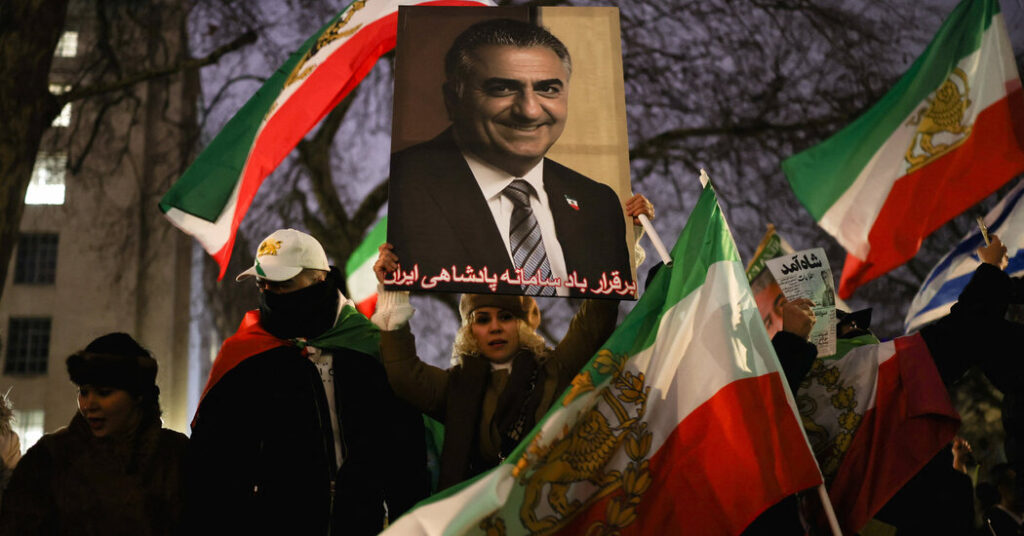
Protesters have been filmed raising the flag flown by the government before the Islamic Revolution. Some demonstrators appear to be rallying around Reza Pahlavi, even chanting, “Long live the shah,” using the Farsi word for “king.” Others reject any sort of authoritarian rule, chanting, “Death to the oppressor, be it king or supreme leader.”
Analysts say it is difficult to assess how many Iranians on the ground seriously hope Mr. Pahlavi would return as a future leader, because of both a government-imposed internet blackout and his own polarizing reputation. His critics accuse him of exaggerating his support within the country, and say they face frequent harassment and threats from his supporters.
Last Thursday, many activist groups and dissidents, including Mr. Pahlavi, called for the mass protests. Huge crowds have taken to the streets of large metropolises and marginalized rural provinces alike.
Born in the Iranian capital, Tehran, in 1960, Mr. Pahlavi, now 65, was the second of five siblings. His father married three times, first to an Egyptian princess who gave birth to Mr. Pahlavi’s sister, Shahnaz. Mr. Pahlavi was born to his father’s third wife, Farah Diba, and as the oldest boy, he became the crown prince and heir apparent.
The Pahlavis’ autocratic rule was broadly secular, and they were close to the United States. But under the monarchy, the Iranian security services routinely arrested and tortured dissidents, a legacy that Mr. Pahlavi has either declined to address or sought to play down.
In an interview with The New York Times in 2009, Mr. Pahlavi was asked about his father’s repressive rule, particularly his “brutal secret police.” He did not directly address the question, saying that he wanted to focus on the future.
Popular fury finally boiled over in Iran in 1979, leading to the Pahlavis’ ouster and ushering in the rule of the Islamic Republic. The family fled to the United States, and Mr. Pahlavi has lived in exile there since the revolution.
Mr. Pahlavi graduated from the University of Southern California, married and had three daughters. He has continued his campaign against the Islamic Republic, urging its overthrow and pitching himself as a potential future leader for Iran.
But even in exile, Mr. Pahlavi has not managed to bring together under one banner Iranian opponents to the current government in Tehran, in part because of his insistence that he take charge, said Sanam Vakil, an Iran expert at Chatham House, a research institute based in London.
Mr. Pahlavi, nonetheless, has a base of supporters among the Islamic Republic’s opponents, in part because the Iranian government has jailed many other potential leaders, said Ali Vaez, an Iran analyst at the International Crisis Group.
“It seems to be a broad base — the older generation with nostalgia for the past, the younger generation desperate for a redeemer and the disgruntled willing to support anyone who could topple this regime,” Mr. Vaez said.
In public remarks, Mr. Pahlavi has stressed that he hopes to serve as a transitional leader steering Iran toward democracy. But many Iranians are not fully convinced, as Ayatollah Ruhollah Khomeini — leader of the Islamic Revolution — “made the same promise but ended up monopolizing power,” Mr. Vaez said.
Mr. Pahlavi also most likely needs the vote of another man who seems equally skeptical of his relevance: President Trump. Asked last week whether he would meet with Mr. Pahlavi, Mr. Trump demurred and suggested it would be better to see how things played out.
“Well, I’ve watched him and he seems like a nice person,” Mr. Trump said in a radio interview. “But I’m not sure that it would be appropriate at this point to do that as president. I think we should let everybody go out there and see who emerges.”
Mr. Pahlavi has, nevertheless, attempted to curry favor with Mr. Trump, writing on social media that the American president would “Make Iran Great Again” and comparing him favorably to former Democratic presidents, who, Mr. Pahlavi argued, had betrayed Iran.
On Sunday, Mr. Pahlavi said he supported U.S. intervention against the Iranian government, calling on Mr. Trump to follow through on his threats to retaliate militarily if protesters were killed.
Addressing Mr. Trump, Mr. Pahlavi said: “They know that you’re not going to throw them under the bus, as has happened before. This is why they are empowered — by the hope that you have their back.”
Aaron Boxerman is a Times reporter covering Israel and Gaza. He is based in Jerusalem.
The post Deposed Shah’s Son Seeks Center Stage Amid Iran Protests appeared first on New York Times.