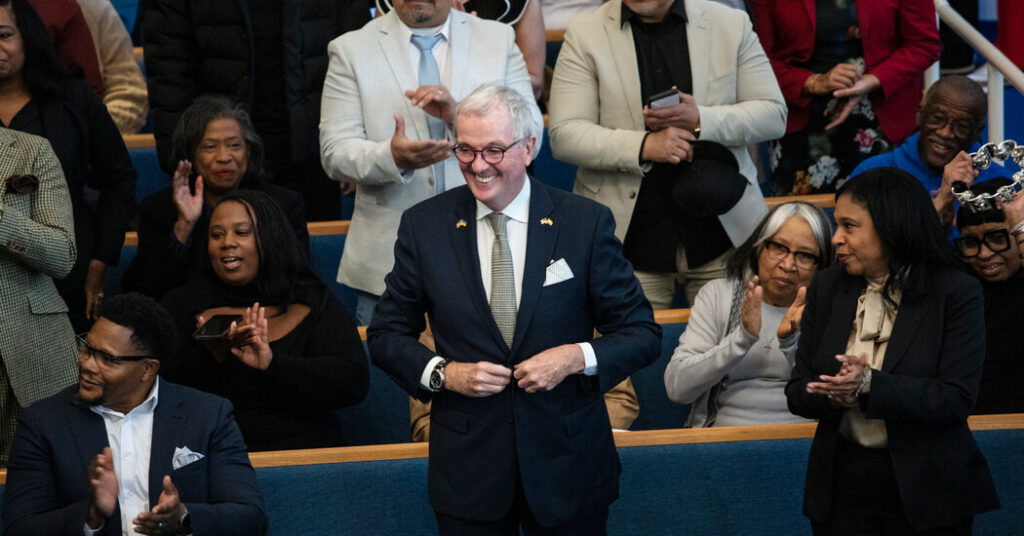
Philip D. Murphy will deliver his final State of the State address on Tuesday after eight years as the governor of New Jersey, a period that included a deadly pandemic and policies that improved the state’s credit ratings and opened a legal market for marijuana.
A new commercial, paid for by his allies, recounts what the governor sees as his accomplishments ahead of Jan. 20, when he will turn the reins over to Mikie Sherrill, a fellow Democrat. “I would argue we’ve turned this place around,” Mr. Murphy said last week in his final “Ask Governor Murphy” appearance on News 12 New Jersey.
New gun control laws, a statewide reduction in shootings, expanded property tax refunds and initiatives that made community college free for 51,000 low-income residents are among his pages-long, self-described list of achievements.
Mr. Murphy’s two terms also included a variety of crises that made national news.
A high number of Covid-19 deaths in state-run veterans’ homes led the Biden administration’s Justice Department to conclude that New Jersey had violated patients’ constitutional rights. A bizarre comment last year by the governor about his willingness to house a migrant in an apartment on his private estate earned him the ire of President Trump’s border czar — and a subpoena from federal prosecutors. And an outside law firm is leading a criminal inquiry into a protracted slowdown in traffic enforcement by state troopers that coincided with an sharp uptick in fatal crashes; New Jersey paid the independent counsel $2.6 million between April and September, records show, and the inquiry is not yet complete.
A wealthy former Goldman-Sachs executive and an ambassador to Germany, the Massachusetts-reared governor became known for his oratory skills that blended the stage presence of the performer he once was at Harvard University with the upbeat patter of a talk-show host fond of dad jokes. (“We’re from Jersey baby,” he liked to intone, “and you’re not.”) The designs he had on higher office for both himself and his wife, Tammy Murphy, who campaigned unsuccessfully for the U.S. Senate, at times overshadowed his tenure in Trenton.
Here are six other ways the Murphy administration left its mark on New Jersey:
Credit Rating Upgrades
Republicans regularly criticize the sheer growth in state spending during the Murphy administration. In 2019, the year after Mr. Murphy took over, New Jersey’s budget was $39 billion. This year it is $59 billion.
But Mr. Murphy and the architects of New Jersey’s annual budget, including Elizabeth Maher Muoio, the state’s treasurer, have also been steadfast in their commitment to drafting spending plans that minimize the state’s debt, credit rating analysts said.
New Jersey has fully funded its pension obligations for the last four cycles while setting aside a rainy-day surplus — areas where political leaders from both parties have in the past skimped, leading to hugely inflated debt payments.
In turn, the state has been rewarded with consecutive credit upgrades since March 2022 from three rating agencies, Moody’s, Fitch and S&P Global.
Geoff Buswick, the managing director of S&P Global’s public finance team, noted that most other states have also experienced improved credit scores since 2020 and that New Jersey’s historically low ratings contributed to its upward trajectory. New Jersey, he said, has “had more upgrades than other states, but they also started from a lower base.”
Still, there is no doubt that the state’s focus on fully funding its pension obligations, after years of sometimes making “bare minimum” contributions, has fueled market confidence, said Oscar Padilla, a director at S&P Global. “It’s fair to say that during Governor Murphy’s terms there’s been an eye toward fiscal prudence,” Mr. Padilla said.
Film Industry Growth
Mr. Murphy has for years nurtured the state’s relationship with the film and television industry and has significantly increased the tax breaks available to companies interested in investing in New Jersey.
The state’s Motion Picture and Television Commission has also established a Film Ready program to instruct towns and cities on how to attract and prepare for productions, leading to an uptick in local filming. “A Complete Unknown,” “Springsteen: Deliver Me From Nowhere” and “Happy Gilmore 2” were each produced in parts of New Jersey.
Three major entertainment companies are also in the process of building large studios in New Jersey, in Bayonne, Newark and Monmouth County, generating roughly $2 billion in “planned studio and production investments,” according to the Murphy administration.
Dozens of other sound stages are already open for business and capitalizing on the state’s proximity to New York City.
Public Information Rollbacks
Several bills that Mr. Murphy signed during his second term were regularly cited as failures by individuals and good-government advocacy groups that were closely aligned with the governor during his first four years in office.
One eviscerated the ability of the state’s election law watchdog agency to enforce campaign finance rules while raising the donation limits to county political parties. Another did away with a requirement that forced government boards to purchase ads from news outlets to notify the public about pending legislative activities and development projects.
Last year, he signed a bill that made it harder for the public to access government records.
“There’s already inherent distrust in government,” said Amol Sinha, the executive director of the American Civil Liberties Union of New Jersey. “There’s already too much that is kept secret. To further put up barriers in access to public records was a real disappointment.”
Expanded Rights
During Mr. Murphy’s terms, New Jersey expanded early voting options and restored voting rights to people on probation or parole. Citizens can also automatically register to vote at certain government agencies, including the Department of Motor Vehicles.
Mr. Murphy has granted more than 300 clemencies, and on Sunday he issued an executive order to allow people to serve on juries after completing their sentences for crimes that predate the order, ending a lifetime ban.
“In a climate where democracy was under attack, both at the beginning of his tenure as governor and now at the end, he partnered with us,” said Ryan P. Haygood, the president of the New Jersey Institute for Social Justice. “He had a heart for social and racial justice issues.”
New Jersey has also reduced its jail and prison population roughly 50 percent since 2011. That decline is tied to the legalization of marijuana in 2020, the elimination of cash bail during former Gov. Chris Christie’s term and a novel law that granted prisoners credit for early release during the Covid-19 pandemic.
“And as it’s happened,” Mr. Sinha said, “it’s important to remember that crime across all major categories has been trending downward.”
Economic Initiatives
Early in his first term, Mr. Murphy signed a law that raised the minimum wage and tied it to the Consumer Price Index. The minimum hourly wage in New Jersey is now $15.92 for most employees. He also supported an initiative that allowed some workers to take up to 12 weeks off to care for a sick relative or a new baby while collecting 85 percent of their earnings.
In 2021, he implemented a so-called millionaires tax on incomes over $1 million to alleviate budget shortfalls caused by the pandemic.
“A lot of previous leaders drove forth the idea that if implemented it was going to hurt businesses or the economy,” said Brandon McKoy, the president of the Fund for New Jersey, a philanthropic group focused on policy initiatives.
“He rejected that framing entirely.”
Phone-Free Public Schools
Last week, Mr. Murphy signed a law that he said would result in a “bell-to-bell” ban on cellphone use in public schools. The law requires boards of education throughout New Jersey to adopt rules that restrict the use of cellphones and other “internet-enabled devices” throughout the school day.
Mr. Murphy, borrowing a battle cry used by New York City’s new mayor, Zohran Mamdani, described the initiative as audacious, likening it to legislation that required seatbelt use and outlawed smoking on airplanes. New Jersey, however, follows several dozen other states and cities, including New York State and New York City, in enacting similar rules, according to the National Conference of State Legislatures.
“I say this as a dad of four, more so than a governor,” Mr. Murphy said before signing the bill, “I wish this ban had been in place a long time ago.”
Tracey Tully is a reporter for The Times who covers New Jersey, where she has lived for more than 20 years.
The post A Governor’s Legacy: Fewer Shootings, Free College and Covid Deaths appeared first on New York Times.