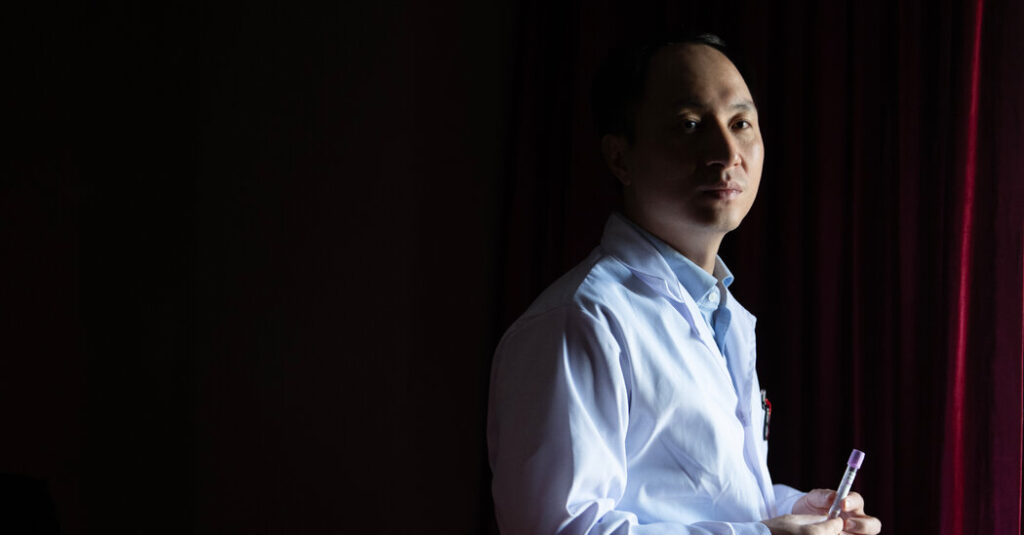
For creating the world’s first genetically edited babies, He Jiankui has been reviled as the Chinese Dr. Frankenstein. He was sent to prison for three years, convicted in China on charges of deceiving medical authorities.
But as China ramps up ambitions to become a biotechnology superpower, the disgraced researcher, 41, has not been muzzled or pushed into obscurity. Instead, he is living and speaking openly at his home in a government-backed research hub north of Beijing, boasting about his work and insisting his country is ready to embrace him.
He can’t travel abroad because his passport has been seized, but he has become a small, but outspoken figure in China’s biotech landscape, neither silenced nor fully rehabilitated. The question is why.
“For a country that is adept at censorship and control, they are leaving him curiously unfettered,” said Benjamin Hurlbut, an associate professor in the University of Arizona’s life sciences department, who has known Dr. He for years.
“In a period of increasing tension between China and the West, at a time when China really is making significant progress in technology,” he added, Dr. He is “not seen as a liability, but is apparently seen as a potential asset.”
In an interview at his cavernous apartment, provided, along with a bodyguard, by a financial sponsor he declined to name, the Chinese scientist said there was a growing demand for researchers like him who are willing to push boundaries.
He said he had recently been offered a post by a government-funded medical academy in Shenzhen, the southern Chinese city next to Hong Kong where he worked until his arrest in 2019.
Dr. He’s 2018 experiment in editing embryos, which produced twin girls and later a third baby from another set of parents, caused outrage around the world because so little is known about the safety and long-term health effects of altering genes in embryos. It also opened what many saw as a Pandora’s box on the road toward designer babies or eugenics.
But unlike Silicon Valley billionaires looking for ways to breed smarter babies, Dr. He, who said his experiment was geared toward creating babies resistant to H.I.V. infection, insists his work aims only to prevent disease. “If anyone uses this for I.Q. enhancement, put the scientist in jail,” he said.
He said he has resumed his gene-editing research at a laboratory in Beijing, focusing on ways to eliminate Alzheimer’s disease, which his mother has, and Duchenne muscular dystrophy, or D.M.D., a hereditary neuromuscular disease. He added that he was experimenting only with mice, not humans.
Dr. He is unapologetic about his past work, saying he was merely ahead of his time. “People were not yet ready to accept what I was doing.”
But this, he insisted, is changing, pointing to an opinion poll conducted by Sun Yat-sen University in Guangzhou showing overwhelming public support in China for gene editing to prevent disease — though not to increase I.Q. — and recent Chinese government regulations covering research on “new biomedical technologies.”
He thinks that China’s push to become a world leader in science and technology means it is only a matter of time before he wins acclaim as a pioneer of gene editing, at least in China.
Dr. He’s work on human embryos, using a technique known as Crispr-Cas9, was not technically very difficult, said Mr. Hurlbut of the University of Arizona. But his move to implant them in women to create babies made him a “center of gravity for bigger moral and geopolitical issues that have come to orbit around him.”
While tight-lipped about his current affiliations, Dr. He is voluble about how Chinese biotech is racing ahead of research in the United States, which he sees as too tethered by ethical review boards, persnickety regulators and fear of the unknown.
“Chinese gene-editing will take over the world just like Chinese electric vehicles have already done,” he predicted.
A fusillade of accusations from American scientists that his past work in Shenzhen trampled on medical ethics, he said, show why the United States will lose out to China in biomedicine.
The air of mystery surrounding Dr. He extends to his personal life. Early in 2024, he married Cathy Tie, a Chinese-born Canadian biotech entrepreneur, only for the couple to split after she was denied entry to China in May.
Ms. Tie, who runs a start-up called Manhattan Genomics that says it is working to develop “safe, ethical gene correction therapies,” shares Dr. He’s beliefs about China’s potential to drive the future of the technology.
She said the United States still had an edge, but she added that “China has historically had very fast execution in frontier technology, particularly in medicine. They benefit from less regulation.”
She declined to discuss why she was barred from entering China, or to comment on a cryptic message she posted on X about the intense scrutiny she believes the field draws: “China thinks I’m a C.I.A. spy and the U.S. thinks I’m a C.C.P. spy.”
China’s top leader, Xi Jinping has set a goal of global leadership in science and technology by 2049, the centennial of the Communist Party’s seizure of power. The government is spending heavily on becoming a leader in what is known as “genetic manipulation technology.”
In a 2019 speech to the Chinese Academy of Science, Mr. Xi decreed that “we must not let red tape tie the hands and feet of scientists, and endless reports and approvals delay the energy of scientists.”
New regulations issued in September by the State Council, China’s cabinet, ban the modification of DNA in human reproductive cells like sperm, eggs or embryos — the kind of research Dr. He carried out before his arrest in Shenzhen.
But they also seem to leave space for exactly this kind of work, stating that the State Council health department will oversee all research “manipulating human reproductive cells, zygotes or embryos and implanting them into the human body to allow them to develop.”
Dr. He said the new rules were “ambiguous” about whether using such embryos to create a gene-edited baby might in future be permitted, but were still “a sign that China is opening up in this field.”
In another possible sign of that, Chinese scientists who in 2019 signed an open letter denouncing Dr. He’s work are now staying quiet. Messages sent by The New York Times to 20 of the signatories asking whether they stood by their previous denunciation all went unanswered.
Mr. Hurlbut, the Arizona scholar who works on medical ethics, said China’s scientific ambitions could explain why Dr. He “is not being treated like an ex-convict” and had been given free rein to express his boosterish views.
Dr. He said he was “very proud” of having created “healthy, beautiful babies” in Shenzhen — twin girls, whom he calls Lulu and Nana, and a third girl, Amy — for two couples. In all three cases, the father was H.I.V. positive.
Where the girls are now is secret and their state of health has not been independently verified. “I’m not going to put them in a cage and let people take their blood and dissect them,” Dr. He said. “They are humans, so don’t treat them like mice.”
That at least some influential forces in the Chinese establishment look kindly on his work was already clear in November 2018, when news of the world’s first genetically-edited babies broke. The People’s Daily, the official mouthpiece of the Communist Party, published a story describing how twin girls had just been born from an embryo whose genes had been altered by Dr. He using Crispr.
The newspaper hailed their birth “as a historic breakthrough for China in the application of gene-editing technology for disease prevention.”
People’s Daily quickly deleted the article, published on the eve of an international conference on genome editing in Hong Kong, when attendees of the conference erupted in fury at news of what Dr. He had done.
The furor at the Hong Kong conference led some to label him China’s Dr. Frankenstein. That name, he said, was unfair because, unlike the fictional scientist and the monster he created, “I never killed anyone” and only “made parents very happy.”
Though initially angry over the Frankenstein nickname, he has now come to embrace it, using it for a time in the biography atop his account on X.
“I like the name now,” he said, because it shows “I have superpower.”
Li You contributed reporting from Shanghai.
Andrew Higgins is the East and Central Europe bureau chief for The Times based in Warsaw, on temporary assignment in Shanghai.
The post China’s ‘Dr. Frankenstein’ Thinks Time Is on His Side appeared first on New York Times.