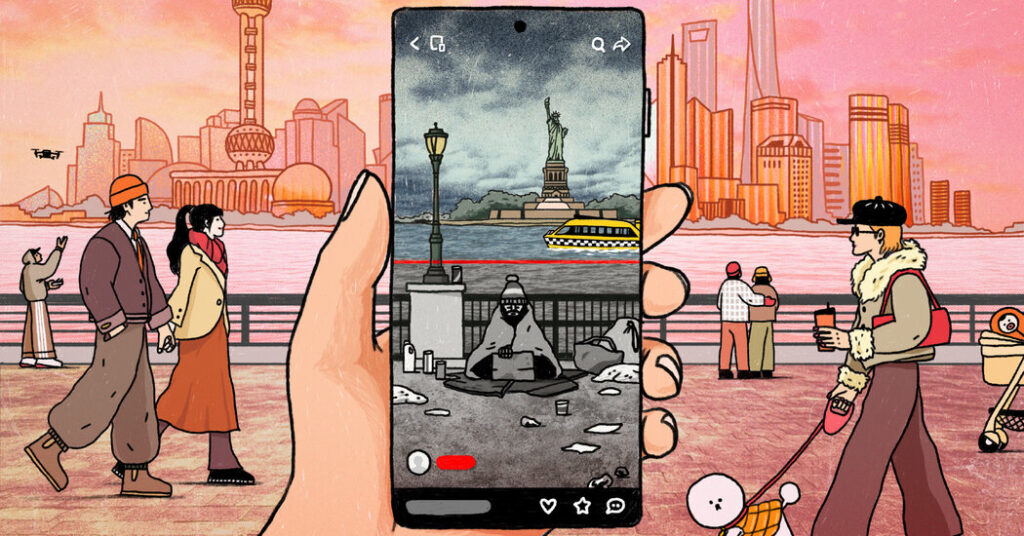
Chinese commentators are talking a lot these days about poverty in the United States, claiming China’s superiority by appropriating an evocative phrase from video game culture.
The phrase, “kill line,” is used in gaming to mark the point where the condition of opposing players has so deteriorated that they can be killed by one shot. Now, it has become a persistent metaphor in Communist Party propaganda.
“Kill line” has been used repeatedly on social media and commentary sites, as well as news outlets linked to the state. It has gained traction in China to depict the horror of American poverty — a fatal threshold beyond which recovery to a better life becomes impossible. The phrase is used as a metaphor to encompass homelessness, debt, addiction and economic insecurity. In its official use, the “kill line” hovers over the heads of Americans but is something Chinese people don’t have to fear.
The depiction of the United States as a place where economic hardship is deep and widespread has been a go-to of official Chinese messaging for years. But the use of the “kill line” phrasing and imagery is new. The power is in the simplicity of what it describes: an abrupt threshold where misery begins and a happy life is irreversibly lost. The narrative is meant to offer China’s people emotional relief while attempting to deflect criticism of its leaders.
The worse things look across the Pacific, the logic of the propaganda goes, the more tolerable present struggles become.
It’s not a coincidence that there is a swell of these messages now. China’s economic growth is half what it once was. Youth unemployment is high. Familiar paths to security — stable jobs, rising property values, steady upward mobility — have become less predictable. For many families, the margin for error feels thinner than it once did.
In an essay published online in late December, the legal blogger Li Yuchen argued that the appeal of the “kill line” idea was its convenience. It allowed Chinese people to condemn a distant system while avoiding uncomfortable questions about their own lives, he wrote.
The term “functions less as an analytical tool than an emotional interpreter,” he wrote. His essay was removed by censors, joining a long list of content erased for questioning official economic narratives.
The fact is that societal inequality is a problem in both China and the United States. And the American economy no doubt leaves many people in fragile positions. The causes are complex.
Yet in China, poverty is experienced and perceived differently. In most Chinese cities, street begging and visible homelessness are tightly managed, making them far less prominent in daily life. Many urban residents encounter such scenes only through foreign reporting, rebroadcast by Chinese state media, about the United States and other places.
Economic insecurity remains widespread in China. Some 600 million people, or about 40 percent of the population, make about $1,700 a year. Rural pensions often amount to only $20 or $30 a month, and a serious illness can send families into a financial crisis. That fear of running out of money is one reason China has among the world’s highest household savings rates. But such pressures are portrayed as part of a culture of endurance and responsibility that leaves families prepared to overcome unpredictable life events.
For older Chinese, the enlistment of American poverty in service of domestic politics is familiar. During the Cultural Revolution, a famous slogan proclaimed that “happy Chinese people deeply cared about the American people living in misery,” even as most Chinese themselves were living in poverty.
When I was growing up in China in the early 1980s, my family subscribed to China Children’s News, which ran a weekly column with a simple slogan: “Socialism is good; capitalism is bad.” It described seniors in American cities scavenging for food, and homeless people freezing to death. Those stories were not invented, but they lacked context and were presented as the dominant experiences in American society. Much of Chinese society was still closed off from the world, and reliable information was scarce.
That many people accepted such narratives was hardly surprising. What’s striking is that similar portrayals continue to resonate today, when access to information is relatively much greater despite state control.
The formula is simple: magnify foreign suffering to deflect from domestic problems. That approach is taking shape today around the “kill line” metaphor.
The phrase is believed to have been first popularized in this new context on the Bilibili video platform in early November by a user known as Squid King. In a five-hour video, he stitched together what he claimed were firsthand encounters of poverty from time he spent in the United States. His video used scenes of children knocking on doors on a cold Halloween night asking for food, delivery workers suffering from hunger because of their meager wages and injured laborers discharged from hospitals because they could not pay.
The scenes were presented not as isolated cases but as evidence of a system: Above the “kill line,” life continues; below it, society stops treating people as human.
The narrative spread beyond the Squid King video, and many people online repeated his anecdotes. Essays on the nationalist news site Guancha and China’s biggest social media platform, WeChat, described the “kill line” as the “real operating logic” of American capitalism.
Others cited examples of Western journalism that they felt presented the America-China contrasts. A Financial Times article published on Dec. 24 about Connecticut’s wealth gap — affluent Greenwich, struggling Bridgeport — was recast in Chinese media. Even a modest financial shock, such as a missed paycheck, the loss of health care benefits or a sudden expense, can trigger a rapid downward spiral.
Another widely circulated example drew on “Hillbilly Elegy,” the 2016 memoir by Vice President JD Vance. People online highlighted his account of selling plasma while struggling with student debt. If even a future national leader had to drain his body to stay afloat, Chinese commentaries asked, what chance does an ordinary American have?
By late December, the “kill line” framework had gained official momentum. Beijing Daily and Southern Daily, both state-run outlets, launched several “hot topics” on the Weibo platform that usually help draw wider attention. Guancha published more than a dozen commentaries in less than two weeks applying the metaphor to American poverty, health care and working conditions. The site later included “kill line” in its roundup of the year’s top news, linking it to critiques of President Trump’s first year back in office.
In early January, Qiushi, the Chinese Communist Party’s leading theoretical journal, published a commentary addressing the “kill line” as a structural feature of U.S. capitalism. A term borrowed from gaming culture had entered sanctioned political language.
In many of the commentaries, anecdotes about Americans experiencing abrupt financial crises are followed by comparisons with China. Universal basic health care, minimum subsistence guarantees and poverty alleviation campaigns are cited as evidence that China does not permit anyone to fall into sudden distress.
“China’s system will not allow a person to be ‘killed’ by a single misfortune,” one commentary from a provincial propaganda department states.
Many readers expressed shock at American poverty and gratitude for China’s system. “At least we have a safety net,” said one commenter.
Not everyone has accepted the narrative. Some commentators even applied the “kill line” language to domestic policies, including local actions in northern Hebei Province that sharply raised winter fuel costs for rural households.
“A topic does not gain traction simply because people are foolish,” one person wrote on WeChat. “Often, it spreads because confronting reality is harder.”
The title of the article: “The American kill line is not about America.”
Li Yuan writes The New New World column, which focuses on China’s growing influence on the world by examining its businesses, politics and society.
The post Why China Is Suddenly Obsessed With American Poverty appeared first on New York Times.