The Trump administration’s first deadly strike on an alleged drug smuggling boat, in early September, was conducted by a secretive military aircraft painted to look like a civilian plane, multiple officials confirmed to The Washington Post on Monday.
The crewed aircraft did not have any weapons showing when the attack occurred, two officials said, speaking, like some others, on the condition of anonymity to discuss a sensitive matter. Instead, the munitions were fired from a launch tube that allows them to be carried inside the plane, not mounted outside on the wing.
Use of the plane prompted legal debate after the Sept. 2 operation over whether the concealment of its military status amounted to a ruse that violated international law, according to current and former officials familiar with the matter. Eleven people were killed, including two who survived an initial attack by U.S. forces but died in a controversial follow-on strike.
Feigning civilian status and then carrying out an attack with explicit intent to kill or wound the target is known as “perfidy” under the law of armed conflict, a war crime, according to legal experts.
“If you arm these aircraft for self-defense purposes, that would not be a violation” of the law of war, said Todd Huntley, a former military lawyer who advised U.S. Special Operations forces for seven years at the height of the Pentagon’s counterterrorism campaign that followed 9/11. “But using it as an offensive platform and relying on its civilian appearance to gain the confidence of the enemy is.”
The Trump administration has claimed that its lethal strikes on alleged drug boats in the waters around Latin America are lawful because President Donald Trump has determined the United States is in an “armed conflict” with drug cartels. That contention is widely disputed by legal experts, who say the U.S. is not at war with drug traffickers and that killing suspected criminals in international waters is tantamount to murder. Several analysts and former national security officials have said the entire campaign is, at its foundation, unlawful.
“This isn’t an armed conflict,” said Huntley, director of the national security law program at Georgetown Law. “But what makes this so surprising is that even if you buy their argument, it’s a violation of international law.”
The Pentagon did not immediately respond to requests for comment. A spokesperson for U.S. Special Operations Command, which carried out the Sept. 2 operation, declined to comment.
The New York Times first reported the plane’s civilian paint scheme earlier Monday.
The Sept. 2 military strike was the first of almost three dozen to date. The attacks have killed more than 100 people.
The initial strike raised questions — among Democrats and law of war experts, principally — about whether a crime was committed when U.S. forces returned to the boat wreckage after the first strike to fire again and kill the two survivors as they clung to the hull.
While the “double tap” to kill the survivors has drawn scrutiny on Capitol Hill, the military has closely guarded specifics of the aircraft involved in the operation.
According to multiple officials, the plane is part of a fleet of crewed U.S. Air Force aircraft painted in civilian schemes and used in situations where it would not be advantageous for the military’s typical gray paint scheme to be seen. One official said the plane was already painted to look like a civilian aircraft before the Sept. 2 operation — it was not painted specifically for the boat strike, this person said.
Firing on the alleged drug boat from an aircraft that looked like a civilian plane and had no visible weapons on it raised debate among some Pentagon officials after the strike, as well as concern that a classified capability was being “burned” in an operation targeting “civilians in a boat who pose no threat,” a former official said.
“It’s not like they’re infiltrating downtown Tehran to kill some IRGC leader or something,” said the former official, referring to Iran’s military, the Islamic Revolutionary Guard Corps.
Those familiar with the matter said the aircraft was broadcasting as a military aircraft. However, unless the men on the boat had technology on board to receive those transmissions, they would not have known it was a U.S. military plane.
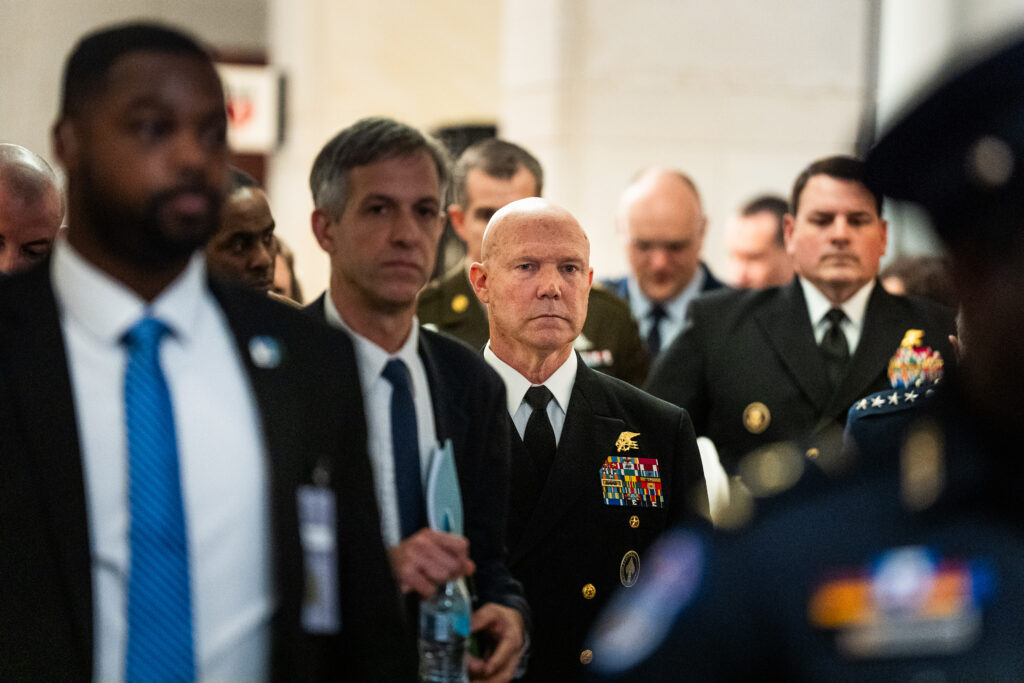
The Post reported late last year that Defense Secretary Pete Hegseth gave his approval ahead of the Sept. 2 operation to kill the passengers, sink the boat and destroy the drugs it was suspected of carrying. As the two survivors clung to the wreckage, Adm. Frank M. Bradley, the strike commander, determined they were still viable targets and, after consulting with a military lawyer, ordered a second strike that killed them, people familiar with the matter said.
Shortly before the second strike, real-time surveillance video showed the two men waving their arms and looking skyward, people who saw the footage told The Post in December. But Bradley explained to lawmakers scrutinizing the operation that it was unclear why they were doing so, people familiar with his account said then.
During multiple meetings with lawmakers after news of the double tap surfaced, Bradley said he looked for signs the men were surrendering, such as waving a cloth or holding up their arms, people familiar with his account have said. The admiral noted that he saw no such gesture, and did not interpret their wave as a surrender, people familiar with his interviews have said.
Alex Horton and Dan Lamothe in Washington contributed to this report.
The post U.S. plane used in boat strike was made to look like civilian aircraft appeared first on Washington Post.