As nationwide protests shake Iran and security forces respond with lethal force, U.S. President Donald Trump has raised the prospect of American intervention, reviving a familiar question in Washington: what, exactly, would U.S. action in Iran look like—and to what end?
Publicly, the Administration has kept its options deliberately broad. The White House has suggested that diplomacy remains the President’s preferred path, but officials acknowledge that he has been briefed on military and nonmilitary alternatives, from cyber operations to targeted strikes.
[time-brightcove not-tgx=”true”]
Trump told reporters on Sunday that “the military is looking” at “some very strong options” and that if Iran does retaliate, “we will hit them at levels that they’ve never been hit before.” He added that Iran’s leaders called him and “they want to negotiate” but that “we may have to act because of what’s happening before the meeting.”
Despite the bellicose rhetoric, the Pentagon has not surged aircraft carriers or strike groups into the region. Gulf allies, still wary after Iranian missile strikes during last year’s brief war with Israel, have also shown little appetite for hosting American attacks on Iran.
“This is another example of the United States inserting itself into something happening in the Middle East with no clear end game,” warns Jon Hoffman, a Middle East expert at the Cato Institute. “Is a single strike going to overthrow the regime? I don’t think so. And clearly that’s going to lead to further calls for more activity.”
Full push for regime change unlikely
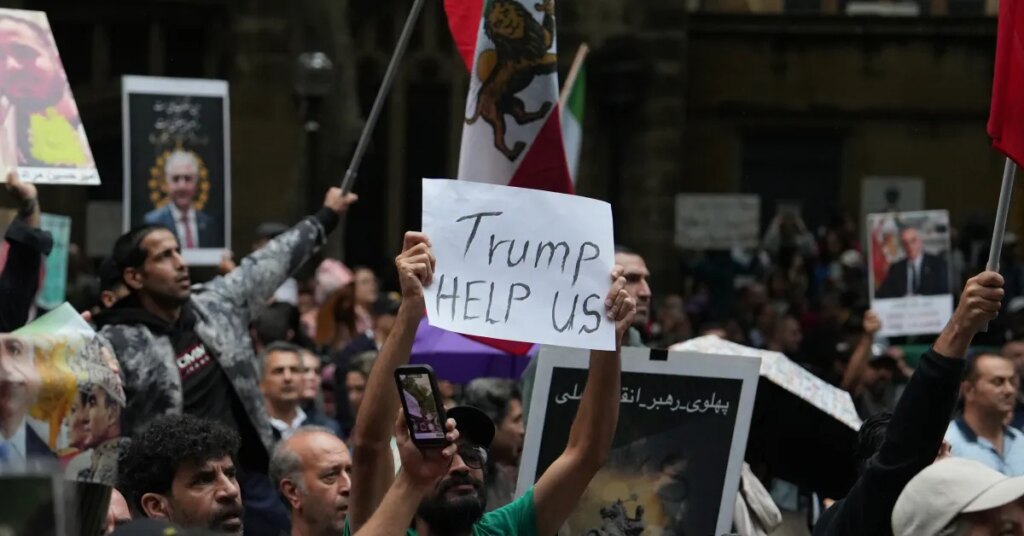
The unrest inside Iran is among the most serious challenges the clerical system has faced in decades. What began in late December as protests over soaring prices and a collapsing currency has spread nationwide, evolving into direct calls for the fall of the Islamic Republic. Human rights groups say thousands of protesters may have been killed, though those figures cannot be independently verified amid an internet blackout imposed by the government.
Iranian leaders insist the situation is under control. Abbas Araqchi, the foreign minister, blamed foreign interference for the violence and warned that any attack would be met with retaliation against American and Israeli targets. At the same time, he has confirmed that communication channels with the White House remain open, even as Iran decries U.S. threats as incompatible with diplomacy.
“The most likely scenario that would push the U.S. to become engaged militarily would be if it became irrefutably apparent that massive numbers of protesters were being killed by the regime,” says Mona Yacoubian, director of the Middle East Program at the Center for Strategic and International Studies (CSIS). Trump himself has framed lethal repression as a potential trigger for action, but Yacoubian cautioned that the lack of verifiable information makes such a determination difficult.
Absent that threshold, she said, Washington may see more value in continuing to weaken Tehran’s position short of war. “If the Trump Administration felt there was a way to sufficiently weaken the Iranian regime such that it is compelled to come to the table on U.S. terms,” she said, “that might be another driver.”
What seems less likely, several experts said, is a full-throated American push for regime change. Yacoubian argued that military overthrow runs counter to how Trump approaches Iran. Given its position in the Middle East, she noted, Iran is a vastly more complex case than, say, Venezuela, and lacks a unified, organized opposition capable of governing. “An effort to decapitate the regime leads to some level of chaos. And I think the Trump Administration is wary of getting enmeshed in that level of chaos and unpredictability,” Yacoubian says.
“Is the President seeking regime change?” asks Behnam Ben Taleblu, senior director of FDD’s Iran Program. “I would say, thus far, the President has not articulated what he’s seeking.”
That absence weighs heavily on the military options under consideration. A limited strike—perhaps against an Islamic Revolutionary Guard Corps facility, an intelligence ministry building or a command center—could be designed to signal resolve without igniting a broader conflict. But such strikes risk rallying nationalist sentiment around the regime and foreclosing the possibility of defections within the security forces.
“By attacking those security elements themselves, it’s hard to see how that would push [the Iranian regime] toward dropping their weapons and joining the protesters,” Yacoubian said. “It would likely have the opposite effect.”
Any strikes would likely be carried out in a way that helps protesters rather than drive them back into their homes, Taleblu says. “All eyes should be on the repression apparatus,” he says. “The layered security force structure of the Islamic Republic, as well as the systems, the command and control, the infrastructure of the regime’s repression apparatus and what they’re doing to throttle the internet.”
Other options
Officials have also discussed less combative measures, such as cyber operations against Iranian military and government networks, covert action and efforts to restore internet access inside the country. Trump has publicly floated the idea of helping Iranians get online, even suggesting outreach to Elon Musk, whose Starlink service has been partially jammed by Iranian authorities.
Read more: Starlink’s Quiet Role in Venezuela’s Political Crisis
Sanctions, long a staple of U.S. policy toward Iran, offer diminishing returns, analysts say, given the breadth of existing restrictions. More discreet measures, including cyber intrusions, intelligence operations or actions with plausible deniability, could allow Washington to apply pressure without forcing Tehran into a direct military response.
The Administration’s internal debate reflects broader tensions in Trump’s foreign policy. After campaigning on restraint and skepticism of “forever wars,” the President has increasingly leaned on threats, coercion and displays of force, even as he insists he wants to avoid major conflicts. The result, analysts say, is an approach that is unpredictable.
“The greatest risk is an actual military strike on Iran,” Hoffman said, describing an administration pulled between hawks urging decisive action and officials wary of another Middle Eastern entanglement. “This is another example of the United States inserting itself into something with no clear endgame.”
For now, that ambivalence is reflected in Washington’s posture. Military assets have not surged toward Iran. Diplomatic channels remain open. And the menu of options remains just that: options.
“Israel and the United States would rather see a collapsed, dysfunctional, ruined Iran than the current regime, because they view that as less threatening to their interests,” Hoffman says.
The post Will the U.S. Strike Iran? The Factors Shaping Trump’s Decision appeared first on TIME.