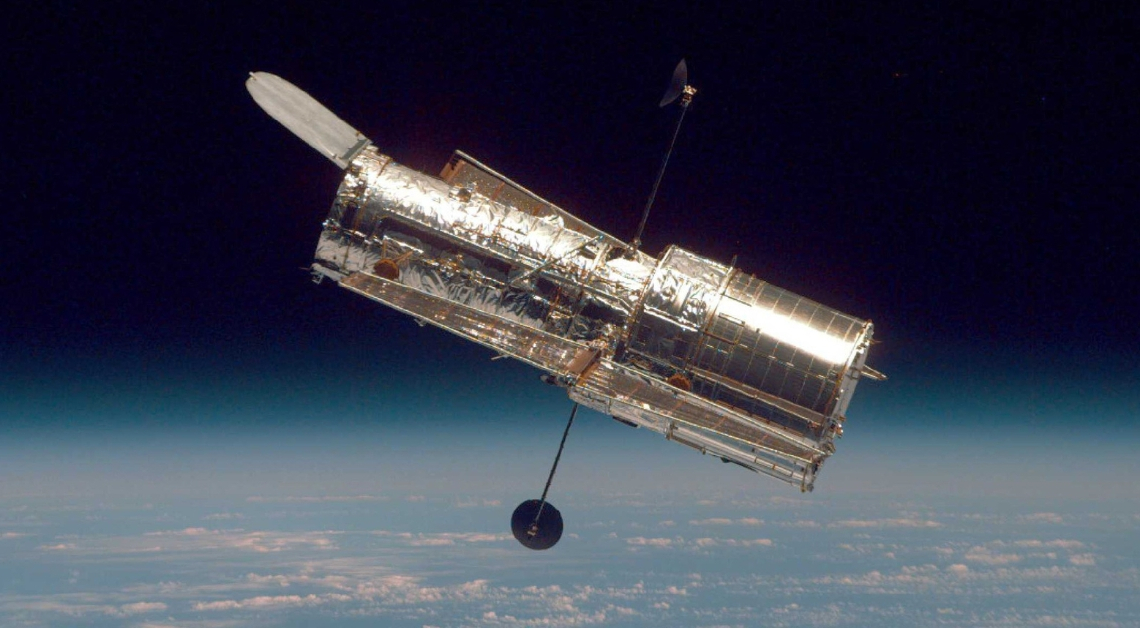
The Hubble Space Telescope has been our most reliable eye in the sky, allowing us to peer deep into the inky cosmic void like never before. Unfortunately, it’s getting a little long in the tooth. And we might be just a handful of years away from having to forcibly retire one of the most important tools for space research ever created.
Launched in 1990, the Hubble Space Telescope showed us that the universe is a crowded, sprawling mix of galaxies, stars, black holes, and mysteries we’re still trying to explain. Scientists presenting new data at the American Astronomical Society meeting estimate that Hubble could reenter Earth’s atmosphere around 2033.
That flyby comes with a major risk: there’s a one in ten chance that it burns up as early as 2029.
Hubble Could Fall Into Earth’s Atmosphere Within 3 Years, Scientists Say
The Hubble is doing fine considering its age. It’s not suffering from mechanical failure and doesn’t seem to have any problems to speak of. Its biggest antagonist right now is gravity. Atmospheric drag has been steadily pulling this telescope lower, down from its original orbit of about 360 miles above the Earth to roughly 326 miles as of today.
NASA has boosted its orbit several times in the past to keep it up, but with the space shuttle retired, those options are limited. A 2022 feasibility study with SpaceX explored a potential re-nudge mission to raise the Hubble to a safer orbital altitude, but no plans have materialized.
The sun has only made matters worse. Increased solar activity has puffed up Earth’s upper atmosphere. If the telescope drops to an altitude of around 248 miles, scientists estimate it would have less than a year before reentry. That means less than a year before it breaks up into a bunch of fire-y bits that would look pretty from the ground, but those streaking flames would represent the destruction of one of the greatest tools humanity has ever created.
The Hubble has helped us determine the age and expansion rate of the universe, find dark matter, and confirm the existence of countless black holes. Its impact on our knowledge of our celestial neighborhood and beyond, and our place in it all, is immeasurable, and its loss would be devastating. However, a successor could be waiting in the wings.
Former Google CEO Eric Schmidt and his wife, Wendy, are funding Lazuli, a privately built space telescope with a mirror comparable to Hubble’s and outfitted with modern instruments. It is currently being planned for launch in 2028. If that happens and NASA chooses to use it as its Hubble replacement, they could mark a major turning point, with billionaires, not governments, determining how we look at the stars.
The post Is the Hubble Telescope Going to Die Soon? appeared first on VICE.