With its Iron Age hill fort, medieval abbey ruins and 19th-century castle, Margam Country Park in Wales offers plenty of history for its regular stream of visitors.
But the most spectacular relic of all appears to lie around three feet below ground.
Archaeologists announced on Monday that they had detected the outline of the largest stand-alone Roman villa structure to be uncovered in Wales.
It appears to be particularly well preserved because it lies beneath a deer park that was never disturbed by cultivation or construction.
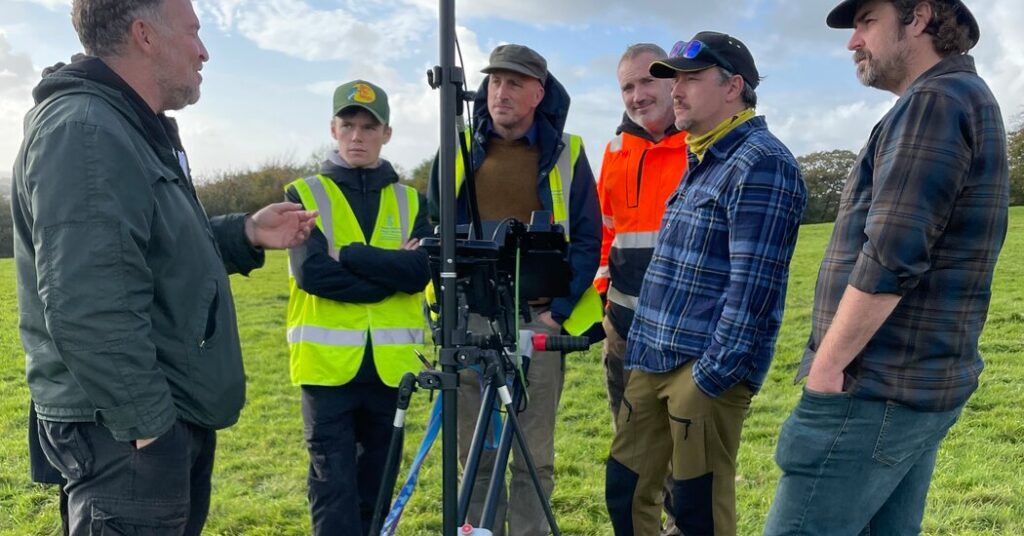
The discovery was made using geophysical surveys, which use high-resolution magnetometry and ground radar data to detect objects below the surface. Although excavation has yet to begin, Alexander Langlands, an associate professor at Swansea University who is leading the project, describes the discovery as the “Pompeii of Port Talbot” — referring to one of the world’s most famous archaeological sites and to a nearby Welsh town that is famous for its steelworks.
“It was like being a 12-year-old all over again,” he said, recalling his first sight of the images. “I was really, really excited.”
More structures are likely to be buried nearby, Dr. Langlands said in a phone interview, including a possible Roman bathhouse.
The surveys show that the villa occupied an enclosure spanning roughly 43 meters by 55 meters, or 141 feet by 180 feet. Its fortified structure suggests that it was equipped for defense against aggressors from the east and west. That was often necessary in the unstable years toward the end of the Roman occupation of Britain, which began in A.D. 43 and lasted until the fifth century.
During this time, the Romans conquered most of Wales despite resistance from Indigenous tribes. Most Roman remains that have been excavated in Wales are from military fortifications or marching camps.
That makes the discovery of a villa — of a size and scale that would not seem out of place in the center of Roman England — particularly significant, Dr. Langlands said. It could show that Wales was not a “kind of liminal borderland” region, he added, but “just as Roman as anywhere else we’ve got in the heartlands of the province of Britannia.”
The geophysical surveys revealed a substantial aisled building southeast of the main villa. This is believed to have been either a large agricultural storage facility or a structure dating from the later history of the site, possibly a meeting hall for post-Roman leaders and their followers.
“The surveys went exceptionally well,” said Christian Bird, the technical director of TerraDat UK, the company that undertook the survey of around 30 to 40 hectares of land. In a statement, he added that the “data are remarkably clear, identifying and mapping in 3-D the villa structure, surrounding ditches and wider layout of the site.”
More precise information about when the villa was built and how it was used will likely be revealed only through excavation, however.
Of particular interest to researchers is whether the settlement collapsed in the late fourth century, alongside some other Roman villas around that time, or whether it continued into the fifth century, perhaps becoming a center of Christianity. That could connect the history of Margam Park to its medieval development as a place of Christian worship.
With its Bronze and Iron Age relics, the park can trace its origins to prehistoric times, but the area also includes the ruins of an abbey that was founded in the middle of the 12th century.
After Henry VIII dissolved the country’s monasteries, a succession of different structures were built on the site, including Margam Castle in the early 19th century.
The archaeological project that uncovered the Roman villa was a collaboration between Swansea University’s Center for Heritage Research and Training, Neath Port Talbot Council, which owns Margam Country Park, and Margam Abbey Church.
Whether and when excavation can begin is unclear and, in the first instance, Dr. Langlands hopes the survey area can be extended to reveal more of what lies beneath the Welsh landscape.
For the time being, the villa is destined to remain undisturbed as it has for centuries. Because of the risk to the site from rogue metal detectors searching for artifacts, its precise location is being kept secret.
Stephen Castle is a London correspondent of The Times, writing widely about Britain, its politics and the country’s relationship with Europe.
The post Archaeologists Find Large Roman Villa Under Deer Park in Wales appeared first on New York Times.