If you think you know David Byrne from just listening to Talking Heads, you’re missing out on an entire world of artistic expression that goes way beyond funky dancing in a big suit. Speaking with Artnet in January 2026, Byrne shared anecdotes about dropping out of art school (twice), how his music and studio art influence each other, and his interpretation of avant-garde.
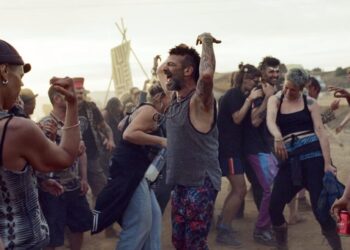
Currently, his drawings are on display in the stairwells of New York’s Pace Gallery. But starting in March, the immersive exhibition Theater of the Mind will run at Chicago’s Goodman Theatre until May 2026. Byrne first produced a similar project, Neurosociety, alongside his now-wife, Mala Gaonkar, in 2016. In 2022, Theater of the Mind debuted at the Center for the Performing Arts’ Off-Center in Denver. Based loosely on Byrne’s psyche, the project used light, sound, space, and science to create reality-bending experiences as viewers traveled through seven connected rooms.
Immersive exhibitions and new wave post-punk hits aside, David Byrne has dabbled in a little bit of everything. Drawing, photography, writing, music, theater, and more, picking up any technical skill he could while attending the Rhode Island School of Design and later the Maryland Institute College of Art. However, he dropped out of both art schools in the 70s.
David Byrne Talks Intersection of Music and Studio Art
“I was talking to Lauren Boisvert Dave Eggers recently, and he mentioned that he felt too many art schools teach theory along with some history, but very little about how to make stuff and the various techniques involved,” said Byrne when asked about his art school experience. “I attempted to work around that by taking classes in a variety of disciplines and media—printmaking, photography, video.”
He continued, “I wanted to learn how these things were done. Unfortunately, one couldn’t get a degree unless one specialized.”
As for his creative practices, David Byrne revealed that his studio art parallels his music creation, and vice versa. First, he stated that drawing has a certain immediacy he enjoys, and editing and reworking a piece can diminish its raw urgency.
“There are parallels in the creative process, no matter what the medium,” he said. “A song can also start with a very roughly sketched idea and can similarly lose its immediacy if it’s overworked afterwards.”
When asked about his interpretation of “avant-garde” art, Byrne spoke about the risk and reward inherent in creation. Does avant-garde immediately mean something has more worth? Or is the avant-garde artist simply a romanticized idea?
“I find work of all kinds that pushes boundaries is worth paying attention to,” said Byrne. “Sometimes it’s not fully realized, sometimes it’s nonsense puffed up by verbiage, but sometimes it’s brilliant, inspiring, revolutionary. In other words, it’s worth the risk.”
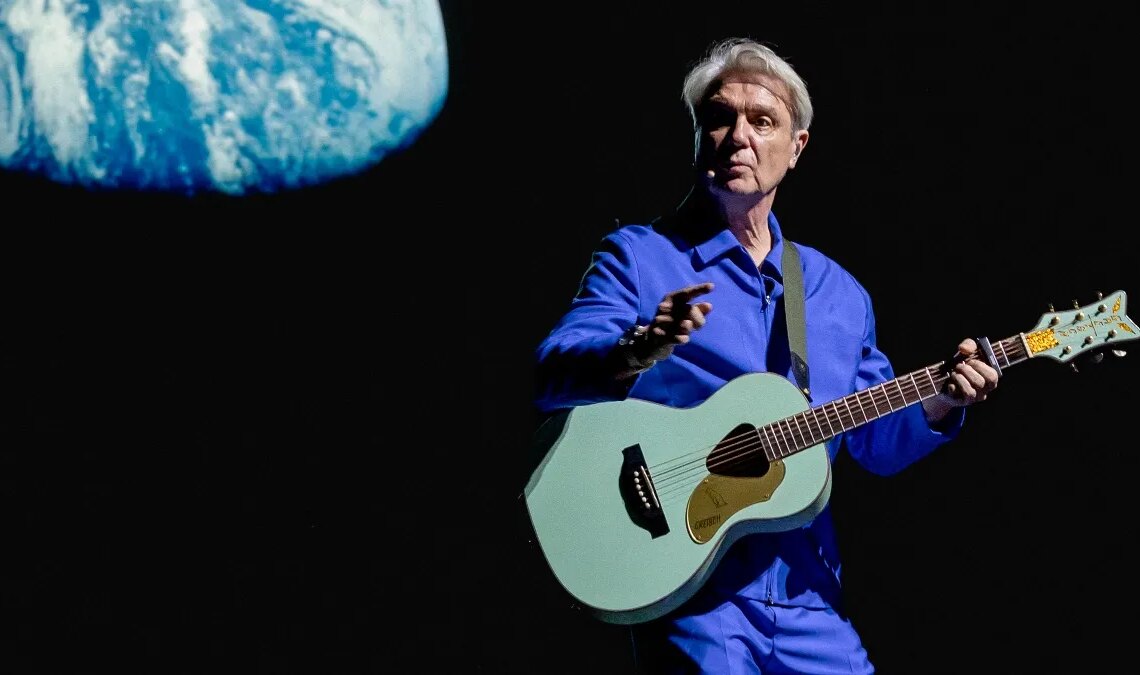
Photo by Griffin Lotz/Rolling Stone via Getty Images
The post David Byrne on Art, Experimentation, and the Pitfalls of the ‘Avant-Garde’ appeared first on VICE.