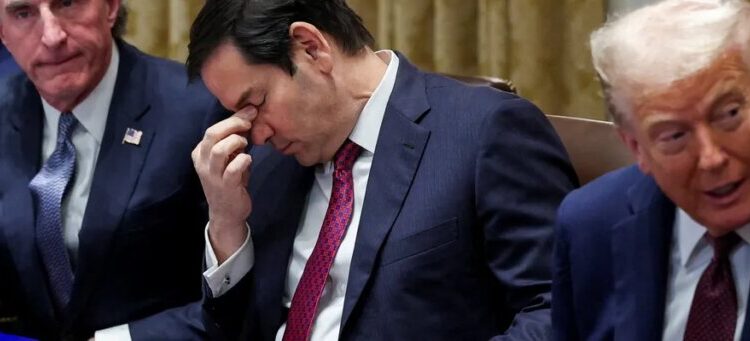
President Trump is exploring options for diplomacy with Iran even as he weighs whether to attack the country to try to deter its leaders from killing more protesters, U.S. officials said on Monday.
The White House press secretary, Karoline Leavitt, said that airstrikes were “one of the many, many options that are on the table,” but that “diplomacy is always the first option for the president.”
“What you’re hearing publicly from the Iranian regime is quite different from the messages the administration is receiving privately,” she added, “and I think the president has an interest in exploring those messages.”
That suggested that the private missives the administration has received were less fiery than the Iranian government’s bellicose public messages about the United States since Mr. Trump’s initial threats of a new attack.
Mr. Trump told reporters on Sunday night that it appeared that Iran had crossed his red line, after he said this month that he would come to the aid of protesters if the Iranian government used lethal force against them.
“There seems to be some people killed who weren’t supposed to be killed,” he said. “These are violent — you can call them leaders, I don’t know if they’re leaders. I guess they rule with violence. But we’re looking at it very seriously; the military’s looking at it. And there’s a couple options.”
On Monday afternoon, Mr. Trump issued a new threat, saying in a social media post that the United States would impose a tariff of 25 percent on “any and all business” done with the United States by countries that are also engaged in commerce with Iran. It is unclear how or whether this would be enacted.
India, Turkey and Middle Eastern nations could be affected, as well as China, which is the biggest buyer of Iranian oil. But Mr. Trump and China’s leader, Xi Jinping, agreed to a truce last fall in their trade war, and the American president has aimed to keep relations stable in order to ensure a planned April summit with Mr. Xi in Beijing stays on track.
On Monday, Iranian officials appeared to temper some of their anti-American rhetoric of recent days by saying they were ready to talk with the Trump administration again. “We are not looking for war, but we are prepared for war — even more prepared than the previous war,” Abbas Araghchi, the foreign minister, told a conference of foreign ambassadors in the capital, Tehran, broadcast by state television.
He appeared to be referring to the 12-day war with Israel in June, during which the United States joined Israel to bomb Iran’s nuclear facilities.
“We are also ready for negotiations, but negotiations that are fair, with equal rights and mutual respect,” Mr. Araghchi added.
Iran also said on Monday that communication channels were open between Mr. Araghchi and Steve Witkoff, a top envoy for Mr. Trump who led U.S.-Iran talks last spring. “Iran has never left the negotiating table, but it will not engage in one-sided negotiations,” Esmail Baghaei, a foreign ministry spokesman, said at a news conference on Monday. Mr. Witkoff did not respond to a request for comment.
It was not clear on what topics the Iranian government was willing to negotiate with the United States. The two nations held talks last spring over Iran’s nuclear program, which the country’s leaders say is for civilian use. American and Israeli officials, however, fear it could be used to make nuclear warheads.
The Obama administration had negotiated an agreement to limit the program, but Mr. Trump withdrew from the pact in his first term. Iran then increased its uranium enrichment, bringing the material closer to weapons-grade, though as of June the country’s leaders had not made a decision to pursue nuclear weapons, according to U.S. intelligence assessments.
The talks between the Trump administration and Iran ended with the U.S. strikes on the country’s nuclear sites in June. Iranian officials made some overtures after that, but American officials did not engage.
Iran’s new diplomatic outreach comes at what might be the greatest moment of crisis the government has faced in years, more so than even during the 12-day war.
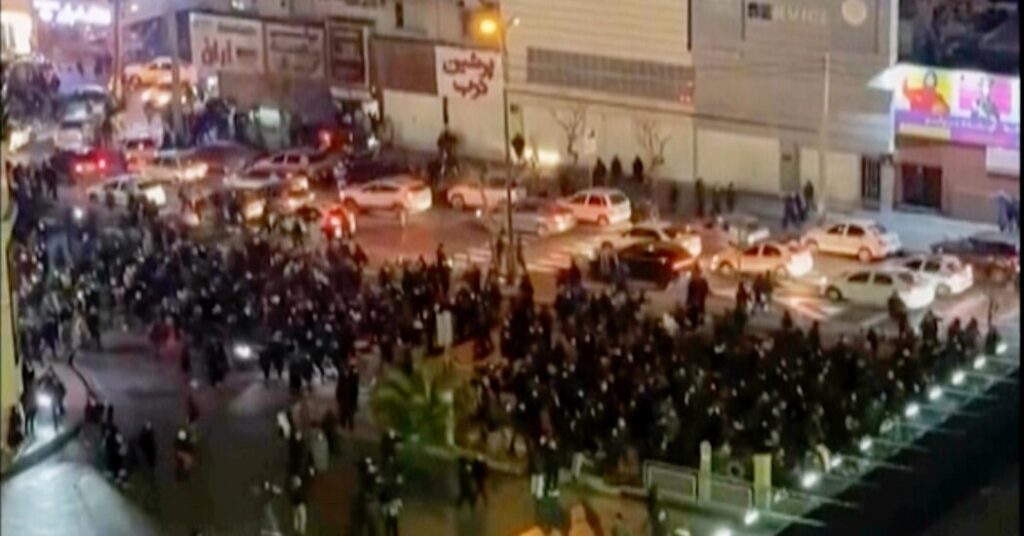
The supreme leader, Ayatollah Ali Khamenei, and his allies are trying to quell mass protests that have spread across the country. They began in late December over dissatisfaction with the economy and a currency crisis, but in reality are the result of years of discontent with the government. The protesters are calling for expansive changes to the government, and while top officials have acknowledged the need to address problems, they are intent on not giving up power.
Iranian security forces armed with tear gas rifles and long guns have fired into crowds, and videos of gunfire and people yelling have circulated widely, according to an analysis of the videos by The New York Times. The forces have killed scores of Iranian civilians and injured many more, according to estimates from human rights groups.
“Iran is dangling talks and deals to dissuade Trump from using military force against them,” said Karim Sadjadpour, a senior fellow at the Carnegie Endowment for International Peace who studies Iran and its foreign policy. “It’s not clear what they would be offering as concessions given the destruction of much of their nuclear program and regional proxies.”
Vali Nasr, a scholar of Iran at Johns Hopkins University, said that the Iranian government was taking a pragmatic approach and not just trying to buy time, but that it had less leverage now in negotiations because its nuclear program has been at a standstill since the June war.
“Iran’s objective is they don’t want any war with the United States, and they want the United States to prevent Israel from attacking Iran,” he said.
Israeli officials have been stressing the dangers of Iran’s ballistic missile program, but Mr. Nasr said the top commanders of the Islamic Revolutionary Guards Corps, the major power center in Iran’s military, would be reluctant to allow Iranian diplomats to negotiate over that. There is a view in Tehran that Iran’s ballistic missiles are the country’s most important form of deterrence, he said.
Mr. Trump has threatened since Jan. 2 that he would attack Iran if the government killed protesters. “We are locked and loaded and ready to go,” he wrote that day in a social media post.
It is unclear what, if any, legal justifications under U.S. law and international law the Trump administration would cite for such an attack. Two days after ordering the June 21 attack on Iranian nuclear sites, Mr. Trump sent a letter to Congress that said the action was done to advance a “vital” national interest and to defend an ally, Israel.
Mr. Trump was recently briefed by the Pentagon on options for a new strike on Iran, The Times reported on Saturday. The strike could take aim at targets in Tehran, including ones associated with domestic security forces that U.S. officials deem to be responsible for attacks on protesters, including the state-backed Basij militia. American officials said such targets were more likely than ones that are part of Iran’s nuclear or ballistic missile programs.
A U.S. strike would be aimed at sending a message to the ayatollah about killing protesters and not intended to lead to a direct overthrow of the government, officials said.
Secretary of State Marco Rubio and other aides have been keeping Mr. Trump apprised of the protests, and he has also been tracking news coverage about them.
Ellie Geranmayeh, the deputy head of the Middle East and North Africa program at the European Council on Foreign Relations, said in an interview on Friday that there had been signs late in the week that the Iranian government could be having security agencies hold back on unleashing their most repressive actions in order to avoid giving Mr. Trump a rationale to attack.
“The Islamic Republic of Iran is now facing an unprecedented bottom-up pressure, as well as a top-down pressure,” she said. “Usually they’ve only had to confront one or the other. And they are masters at survival, by the way.”
However, the security agencies intensified their crackdown over the weekend, leading to what Ms. Geranmayeh said on Monday was a “very bleak turn.”
The intensifying violence has fueled more vocal threats against Iran from Mr. Trump, even as he has denounced protesters in the United States who criticize his policies.
“The president has shown he’s unafraid to use military options if and when he deems necessary,” Ms. Leavitt said on Monday, “and nobody knows that better than Iran.”
Katrin Bennhold and Sanam Mahoozi contributed reporting from London, and Aurelien Breeden from Paris.
Edward Wong reports on global affairs, U.S. foreign policy and the State Department for The Times.
The post Trump Explores Diplomacy With Iran While Weighing Strikes, Officials Say appeared first on New York Times.