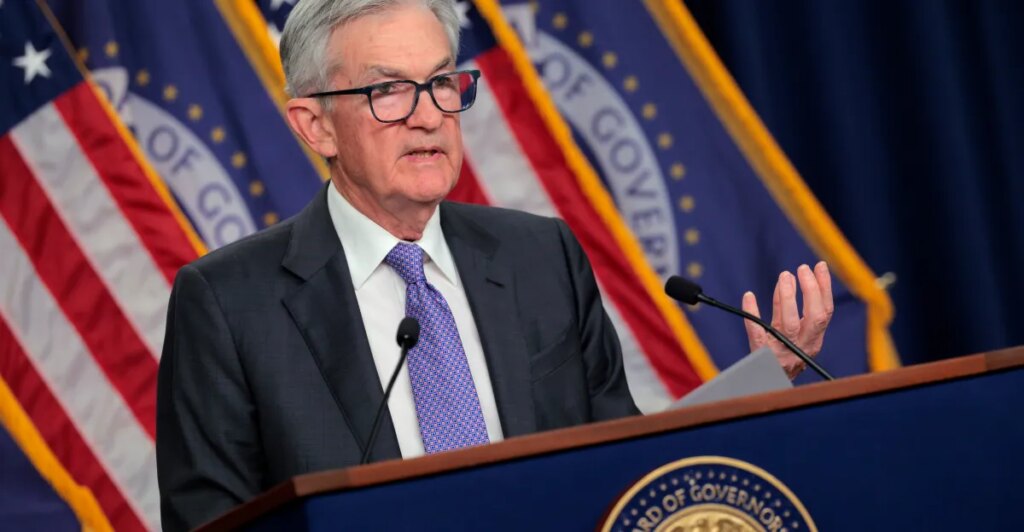
Sunday evening, Federal Reserve Chair Jerome Powell posted an unusual video message to the nation, revealing that the Trump administration opened a criminal investigation into him — ostensibly because of a dispute over renovations to a Federal Reserve building.
In reality, this investigation is almost certainly a pretext seeking to hound Powell out of office. President Donald Trump has criticized Powell for not lowering interest rates as quickly as Trump would prefer, and he’s threatened to fire Powell — something Trump is not allowed to do under federal law without sufficient cause. So, the criminal investigation into Powell appears to be a bad faith effort to gin up charges that could supply such cause.
Indeed, one reason why the Trump administration’s investigation of Powell is so suspicious is because this isn’t the first time this administration has levied spurious charges against one of the Fed’s leaders in an effort to push them out of office. Next week, the Supreme Court plans to hear Trump v. Cook, which involves a nearly identical effort to push out one of Powell’s colleagues on the Fed’s Board of Governors.
As a general rule, the Supreme Court’s Republican majority believes that President Donald Trump should have sweeping authority to fire government officials who don’t work in Congress or the courts.
Later this term, in Trump v. Slaughter, the Court is widely expected to overrule 90 years of precedent establishing that Congress may create “independent” federal agencies whose leaders may only be fired by the president for cause. Last July, the Court’s Republicans also permitted the Trump administration to fire nearly half of the Department of Education’s employees.
In May, however, the Court signaled that the leaders of one federal agency, the Fed, are special. Admittedly, the Court’s explanation of why they are special, which came in a decision called Trump v. Wilcox, is gobbledygook. But it ultimately does not matter very much why the justices decide to do something if they are committed to it. And this Court does appear committed to the idea that Trump cannot fire members of the Fed’s Board of Governors.
Which brings us to Cook, a case the Court will hear on January 21, which tests whether the justices will actually let Trump fire a Fed governor and get away with it. Unlike Slaughter, however, where Trump’s lawyers claim that the Constitution gives the president inherent authority to fire federal agency leaders, Cook does not present this constitutional question.
Instead, the entire case more or less boils down to whether Trump is able to make up a defamatory allegation against one of the Fed’s leaders, use this false allegation to justify firing them, and then force the Court to swallow his lie.
So, how did Cook wind up before the Supreme Court?
The Federal Reserve has an extraordinary amount of influence over the US economy. When it lowers interest rates, that makes it cheaper for businesses and consumers to borrow money, and that results in more purchases, more hires, and faster economic growth — but also higher inflation. When it raises rates, the opposite is true. The economy slows down, but inflation is also reduced.
For this reason, the Fed is supposed to be run by economists and other technocrats who can strike the right balance between economic growth and low prices. If they raise interest rates too high, growth is cut off, and the economy can fall into a recession. If they lower them too much, inflation can spiral out of control. The goal is to maintain the proper balance, and this requires a great deal of careful monitoring and expertise.
By law, members of the Fed’s board may only be removed by the president “for cause.” This is to prevent the president from pressuring the Fed into making decisions that will stimulate the economy in the short term, but with far more negative consequences down the road.
In advance of his 1972 reelection fight, for example, President Richard Nixon successfully pressed then-Fed Chair Arthur Burns to lower interest rates. The economy boomed in that year, and Nixon won in a landslide. But Burns’ decision is also often blamed for years of “stagflation,” slow economic growth and high inflation, during the 1970s.
Similarly, if Trump gained the power to fire Fed governors, he could remove governors who refuse to make decisions that benefit him politically, even if those decisions could lead to great economic misery down the road.
And yet, if you accept the Republican justices’ overarching view of presidential power, then there’s little question that Trump should be allowed to fire the Fed’s leaders. Those justices subscribe to a theory known as the “unitary executive,” which holds that the president must have the power to fire federal agency leaders. The Court’s Republican majority has spent the past two decades implementing this theory. And the Slaughter decision, which was argued last December, is likely to overrule a seminal 1935 Supreme Court decision permitting Congress to create independent agencies whose leaders enjoy some protection from presidential firing.
Nevertheless, in its Wilcox decision last May, the Court indicated that this unitary executive theory does not apply to the Fed, because “the Federal Reserve is a uniquely structured, quasi-private entity that follows in the distinct historical tradition of the First and Second Banks of the United States.” As I explained when Wilcox was handed down, this sentence is word salad, and the Republican justices offered no explanation of why a “quasi-private” entity with a “distinct” tradition is different from any other federal agency.
Still, poorly reasoned Supreme Court decisions are the law even if they make no sense at all. And that means that, unless the justices overrule Wilcox, Trump cannot fire the Fed’s leaders simply because he wants to or because he disagrees with their decisions. He must point to a valid cause such as malfeasance in office.
And that brings us back to the specific dispute in Cook. Rather than arguing that Trump has the constitutional authority to fire Fed governors under the unitary executive theory, the Trump administration appears to have fabricated a pretextual reason to fire a member of the Fed’s board. And then Trump relied on this pretext to justify an illegal firing.
The pretext Trump relied on to to fire Lisa Cook
Lisa Cook is a Biden appointee to the Federal Reserve’s board who Trump wants to remove and replace. He claimed that he is allowed to fire her because Cook allegedly “made contradictory representations in two mortgage agreements a short time apart, claiming that both a property in Michigan and a property in Georgia would simultaneously serve as her principal residence.” Trump claims that this supposed misrepresentation “calls into question [her] competence and trustworthiness as a financial regulator.”
But Trump’s claim that Cook claimed two properties as her “principal residence” appears to be made up. Last September, Reuters reported that lending documents associated with her purchase of the Georgia property reveal that she “told the lender that the Atlanta property wouldn’t be her primary residence” and that she declared it as a “vacation home.”
Cook does appear to have signed a boilerplate document which stipulates that the Georgia property will be used as a “primary residence,” but that document stated that this stipulation is only true “unless the Lender otherwise agrees in writing.” A separate document prepared by the lender stated, “Property Use: Vacation Home.” So the lender appears to have agreed in writing that the Georgia property will not be her primary residence.
Rather than rebutting this evidence that Cook is innocent, Trump’s lawyers spend the bulk of their brief proposing various reasons why the courts are not allowed to examine the evidence against Cook or otherwise second-guess Trump’s allegations against her.
Among other things, they claim that Trump’s decision to remove her is “committed to the unreviewable discretion of the President,” that federal officials are not entitled to due process if they are illegally fired, and that Cook received adequate process because Trump called for her resignation and then waited five days before he fired her.
None of these arguments should withstand legal scrutiny. The Supreme Court said in Marbury v. Madison (1803), a famous case that is often the very first opinion taught to first-year constitutional law students, that the question of whether someone has a “legal right” to a federal job is “a question examinable in a court.” And Trump’s claim that due process is satisfied if he merely waits a few days between announcing that he intends to fire someone and then firing them is self-refuting.
That said, the Court’s Republicans often permit Trump to take questionably legal actions by imposing procedural barriers on plaintiffs who seek to challenge those actions. In National Institutes of Health v. American Public Health Association (2025), for example, the controlling opinion requires plaintiffs, who challenged the Trump administration’s allegedly illegal decision to cancel several public health grants, to navigate a convoluted maze of legal procedures in two separate courts — a process that is likely to take years to resolve.
Similarly, in Department of Homeland Security v. D.V.D. (2025), the Republican justices permitted Trump to effectively nullify the Convention Against Torture — a treaty that forbids the United States from deporting people to countries where they may be tortured — by not informing an immigrant that he may be deported to a particular country until after a hearing that is supposed to determine where he may be sent has already concluded.
Still, given the Wilcox decision, it seems unlikely that a majority of the justices will conclude that Trump can fire Cook based on a fabricated allegation, and that Cook is not, at least, entitled to a hearing to determine if this allegation has any merit. What is the point of creating a special, Federal Reserve-only exception to the unitary executive if no court can actually enforce the Supreme Court’s decision in Wilcox?
Wilcox strongly suggests that, regardless of what they ordinarily think about presidential power, most of the justices understand that giving Trump the power to fire Fed governors would be too dangerous, and that it would allow him to damage the US economy in much the same way that Nixon did in the 1970s.
But, of course, we won’t actually know if these justices will adhere to their decision in Wilcox until after Cook is decided. And, if Trump is allowed to gin up a pretext and use it to fire Cook, he will almost certainly be allowed to do the same to Powell.
The post Trump’s war on the Federal Reserve heads to the Supreme Court next week appeared first on Vox.