MINNEAPOLIS — In the volatile hours after an ICE officer shot and killed a woman in her vehicle last week, state Sen. Zaynab Mohamed stood shoulder to shoulder with the chief of police as they moved through the crowd near the scene. Tensions were high, and both the law enforcement veteran and the woman 18 years his junior were concerned that rippling anger could ignite into something dangerous.
That’s when Chief Brian O’Hara asked Mohamed and the small group of young, female elected officials she was with to help convince the crowd that Minneapolis police weren’t there to work with ICE.
“They’ll listen to you guys,” Mohamed recalled him saying.
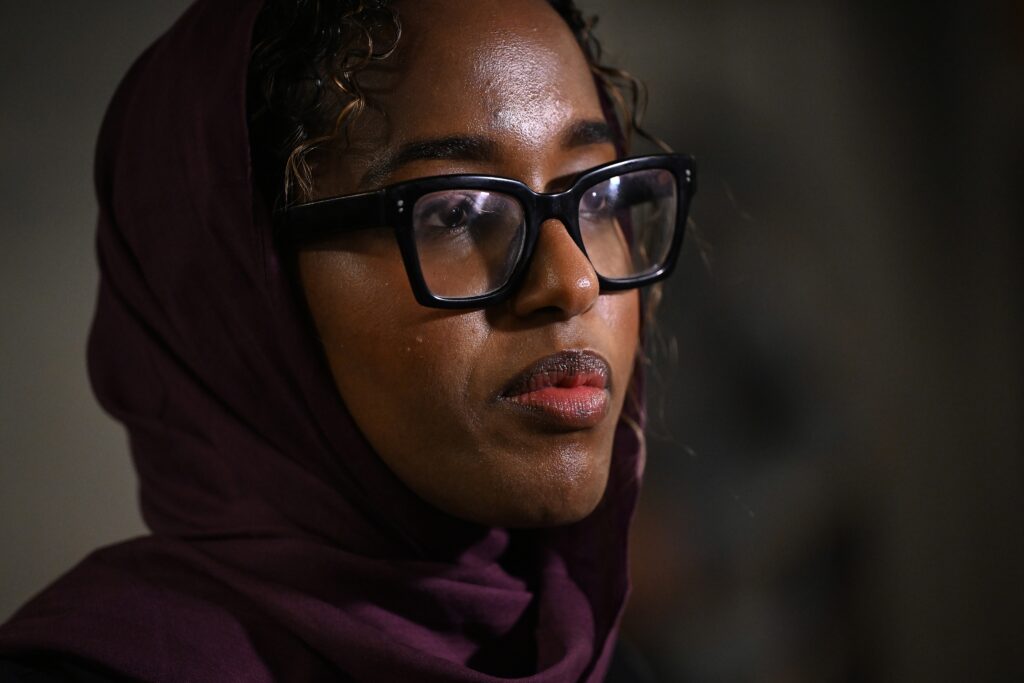
Mohamed, 28, is an increasingly high-profile lawmaker with an expanding social media reach whose family fled Somalia nearly 20 years ago in hopes of leaving political violence behind. Over the past half decade, her adopted hometown has suffered searing local traumas that reverberated nationally: police killings, political assassinations and now a fatal immigration crackdown. These events bruised the collective psyche of this deeply purple state while molding Mohamed’s life as Minnesota’s youngest state senator.
She says she has tried to maintain focus on serving her constituents directly and communicating with the public transparently and believes action is the antidote to the kind of despair that can seep in after shared crises. For her, that means organizing food drives, delivering diapers to immigrant families, attending protests and documenting it all on Instagram and TikTok — while also speaking at news conferences, and carrying out her legislative duties.
“For the first time, I feel the weight of the job,” Mohamed, a Democrat, said Thursday during a break between protests over the ICE shooting of Renée Good. “I have to work on policies that bring trust back to the system and integrity. I have to work hard to make sure Democrats win Minnesota, because that’s important to me. And I have to fight for community, and be a person young people can look at who is comfortable in her own skin. I have to be strong for them.”
“It’s been a difficult few years,” she continued. “Let’s hope this is the last tragedy.”
‘People were just angry’
Mohamed came to the U.S. in 2007 when she was 9 years old, along with nine brothers and sisters, fleeing a civil war that had ravaged their East African country. She learned to read English and Somali alongside her mother, who never went to school. Her father’s job is setting up for events at hotels; her mother has worked in the same mashed potato factory since she arrived.
In high school, an internship program started by a former Minneapolis mayor helped Mohamed land a gig at U.S. Bank. She was drawn by the idea of a job where hard work would correspond with regular raises and promotions.
Then, in May 2020, George Floyd was killed. Mohamed still remembers watching the video on her phone in bed: “The human part of him screaming, screaming for his mom.”
She spent much of that summer in the streets, marching, and got a job with the Council on American-Islamic Relations helping coordinate rallies, print fliers and convene news conferences. “People were just outside, angry,” she recalled.
When she was first asked to run for office at the end of that year, she demurred. But she was frustrated by what she saw as the lack of communication between institutions and the community, and the lack of transparency from people in power. And the tragedies kept coming: Daunte Wright was shot and killed by a police officer in Brooklyn Park, Minn., in April 2021, then a protester died in car ramming incident in June, the same month police shot and killed Winston Smith on the roof of an Uptown parking garage.
When a state senator representing the south side said she wouldn’t seek reelection in 2022, Mohamed decided it was time. She and two other candidates became the first Black women elected to the Minnesota state Senate.
The first two years of her term were a period of relative calm for the city. That ended in June 2025 when a man in a fake police uniform shot two Minnesota lawmakers and their spouses, killing state Rep. Melissa Hortman, her husband, Mark, and their dog.
The killer, police later learned, had plans to shoot dozens of other public figures, including Mohamed. A call from police woke her at 4 a.m. that day. “You’re told, ‘Don’t leave your home, don’t open the door, even if it’s a police officer,’” she recalled.
Then, just two months later, another shooting, this time in her district, killed two children at Annunciation Catholic Church and injured more than a dozen others. Speaking to reporters, Mohamed addressed the onslaught of gun violence, saying, “Yesterday it was kids in church. Who will be tomorrow?”
Mohamed has written a bill banning assault rifles and high-capacity magazines she hopes to pass this year. It faces long odds in a purple state with vast rural districts where some state legislators carry firearms to work in the state capitol.
She knows she will also have to reckon with a massive fraud scandal in her state, which involved child care providers from the Somali community and has triggered weeks of criticism from President Donald Trump and the Republican Party. Gov. Tim Walz, a fellow Democrat, said last week that he would not seek reelection, in part because of conservative attacks on him for not doing more, sooner to address the misuse of federal funds.
“There are clear loopholes in the agency,” said Mohammed, who sits on the Health and Human Services Committee in the state Senate, “and I think next session we have a lot of work to do in closing some of those.”
Mohamed, who says she has no aspirations for higher office, faulted Trump for deriding all Somalis as “scammers” and saying they should “go back to where they came from.”
“When he does that, he taps into an audience that doesn’t really know anything about us,” Mohamed said. “A lot of people would never even meet a Somali person, and their only perspective on the community is exactly what he says. It’s very harmful.”
In early December, Trump ordered an ICE surge to Minneapolis, ostensibly to round up undocumented Somalis even though the vast majority of the 80,000 Somalis in Minnesota are U.S. citizens or permanent legal residents. Somali, Latino Lao and Hmong immigrants without legal status have been arrested.
Mohamed has marched in opposition to ICE’s operations, which, according to DHS have resulted in the arrests of 1,500 people. As in other cities, the operation led to clashes between observers and law enforcement. One video from December shows an ICE agent pushing a woman to the ground in the snow face first, then dragging her by the hood of her jacket.
Then came the shooting of Renée Good.
‘Things could always be worse’
Before last week, Mohamed was mostly focused on mundane but essential services for her constituents: delivering Cheerios and water to immigrant families, tracking reports of ICE activity and organizing a food drive at a local high school. She documented her efforts through daily TikTok updates.
“Hey y’all, it is 1 p.m., and this is your update of the day,” she said breezily one day in December, before turning the camera on volunteers pouring beans, bagging rice and stacking diapers.
Some, she said, needed the food because their family’s breadwinner had been arrested, others because they were skipping work to avoid ICE. Many were simply afraid to go to the grocery store. “Beneath all the problems coming from Washington, people here just want to help their neighbors,” she said, “and I’ve just been leaning into that with my videos.”
Her focus shifted dramatically on Wednesday when Mohamed first heard about Good’s shooting from her cousin, a police officer. In the hours that followed, she urged protesters to remain calm and counseled not to send the state National Guard to the city, which she feared would only anger residents further.
At City Hall on Friday morning she praised Good, 37, for her “humanity and compassion” and emphasized the need for a fair investigation of the shooting that has divided the nation and pitted federal law enforcement against state and local officials.
“This federal government has given us too many reasons to not trust them to do the right thing,” Mohamed said. “Leaders have used every opportunity since this tragedy to lie about the facts, to lie about Renée and to blame her for her own murder.”
Once again she finds herself addressing a national audience on a tragedy that hit too close to home. But as dark as the past year has been, she reminds herself: “Things could always be worse.”
“A lot of my childhood memory is my family going to village trying to escape a civil war,” she said. She counts herself lucky to have found a legal path to U.S. citizenship, and feels an obligation to help those who weren’t as fortunate.
“I could sit around and worry how tough life has been this past year,” she said. “But I’m healthy and young and privileged to help people. That’s my purpose.”
The post A young lawmaker comes of age in Minneapolis, a city that keeps grieving appeared first on Washington Post.