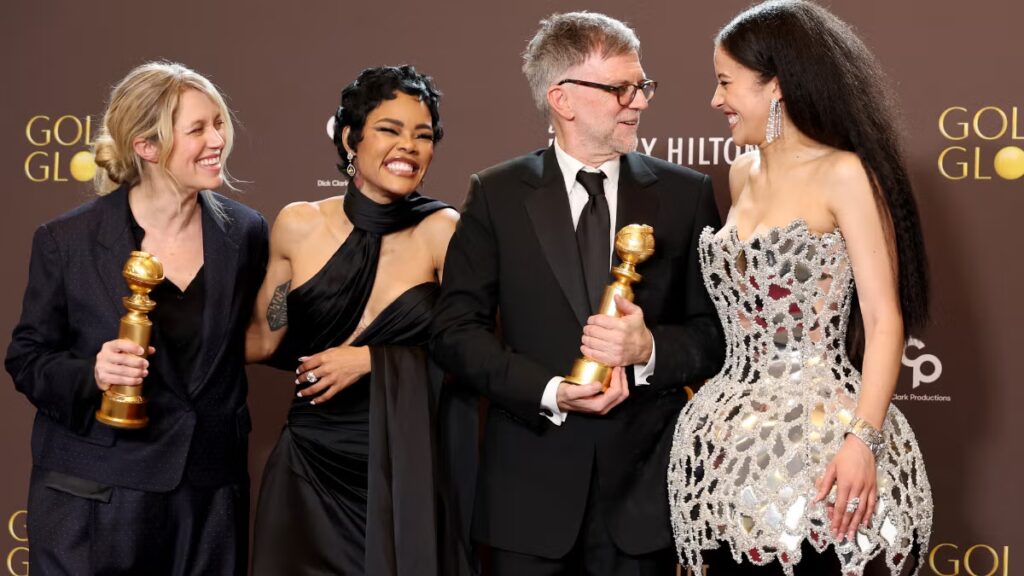
The Golden Globes set the agenda on Sunday with the first award of the night, which went to Teyana Taylor for “One Battle After Another” over what could be perceived as a more starry win by fellow nominees Emily Blunt or Ariana Grande.
They stuck with it for the rest of the show, but ended the night with the distinct feeling that the Globes’ attempted makeover — which aims to be more judicious in what’s nominated and who wins — is confusing at best.
Sure, it’s hard to argue with Paul Thomas Anderson’s “One Battle” being the big winner, with Globes for Anderson’s direction and screenplay, Taylor’s supporting performance and Best Motion Picture – Musical or Comedy. And the same could be said for Chloe Zhao’s “Hamnet” winning Best Motion Picture – Drama, a point underlined by the strong and moving speeches by Zhao and by drama actress winner Jessie Buckley.
Those were entirely credible films to be rewarded in this time of turmoil and trauma, emblematic of a roster of winners that stuck with the favorites almost all of the time and never seemed to be trying to award star power, the way the old-school Globes had been known to do.
But after new ownership dramatically overhauled the roster of voters in a desperate attempt to gain some of that credibility, you got the sense that the new Globes and the resulting telecast wanted to have its cake and eat it, too – to have the show be as loose, boozy and fun as it sometimes was when the voters were suspect and the stakes weren’t very high.
And it wasn’t that, except in its most forced and awkward moments.
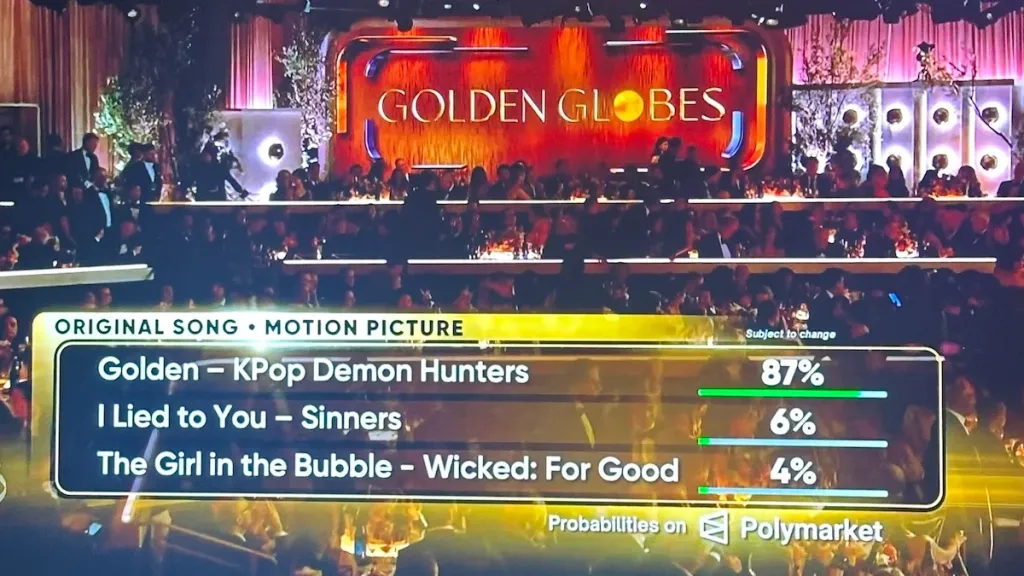
Surrounding a good group of winners was the inconsequential, three-year-old Best Cinematic and Box Office Achievement award, a category that now seems to have become a consolation prize for big movies that aren’t going to win many other awards. (“Barbie” won it, then “Wicked,” then “Sinners,” which was expected to do better than it did.) And a new podcast category that was introduced by a film clip that essentially said “movies are dying, so this is what we’ve gotta salute now.” And a standup comedy category that for two out of its three years has gone to Ricky Gervais, the guy who’s best known for savaging the Globes when he hosted them in the past. And constant callouts to the Polymarket prediction market, a Globes partner.
On a night when many of the winning films were timely examinations of loss and brutality, the show tried to cut the other way and looked silly doing it.
After losing their NBC deal to scandal and boycott, the Globes spent a couple of years coming up with a new model and a new crop of voters: In place of 90-odd full- and part-time journalists based in Los Angeles but writing for international publications, the new Golden Globes are made up of 399 critics, almost 90% of them based outside the U.S.
There’s more transparency around this group of voters, all of whom have their names, credits and bios available on the Globes website. But they’re international movie critics and journalists who don’t depend on L.A. junkets for their livelihood, so their votes often go to critics’ favorites instead of movies that’ll draw the biggest stars to the Beverly Hilton.
So in the Best Motion Picture – Drama category, an unprecedented three of the six nominees were non-English-language films, with “It Was Just an Accident” (Iranian) “Sentimental Value” (Norwegian) and “The Secret Agent” (Brazilian) all making the cut; in Best Motion Picture – Musical or Comedy, the South Korean “No Other Choice” and the French-language “Nouvelle Vague” took two of the six slots.
The international films didn’t dominate Sunday’s list of winners, apart from “The Secret Agent” star Wagner Moura winning Best Drama Actor over Michael B. Jordan for “Sinners,” a slight upset that recalled last year’s victory by another Brazilian, Fernanda Torres, for Best Drama Actress. (Note: The new Golden Globes roster of voters includes a lot of South Americans, particularly a lot of Brazilians.)
But they were similar to last week’s Critics Choice Awards in the film categories and similar to last September’s Emmy Awards in the TV categories. Nothing different, nothing truly surprising and, honestly, not much reason to think that this show, remade with this group of voters, is what CBS was looking for when it signed on to broadcast the show at a reduced rate through 2029.
Still, the Globes telecast could have minor repercussions as Oscar voters get ready to cast their ballots this week. Jessie Buckley’s speech was warm and charming, making up for the fact that the show played Stevie Wonder’s “Isn’t She Lovely” as she walked to the stage. (It’s a terrific song, of course, but while its title may be accurate, it’s also one of the least germane parts of her fierce, feral performance.)
“The Secret Agent” may well get a few more views from Oscar voters who may not be casting ballots in the Best International Feature Film category; ditto “Sentimental Value,” though one would hope both of those films are in every conscientious voter’s viewing queue already.
In the TV categories, meanwhile, there’s almost no way to tell that most of the voters are based outside the U.S., because they continually go for the same things that Television Academy voters do: In the 11 Globes TV categories that were also presented at the Emmys, nine went to the same people or shows that won Emmys four and a half months ago.
The winners were deserving. The show was mostly clunky and a little frantic. The surprises were minimal.
If you’re the Globes, where do you go from here?
The post In a Time of Turmoil and Trauma, the Golden Globes Didn’t Read the Room appeared first on TheWrap.