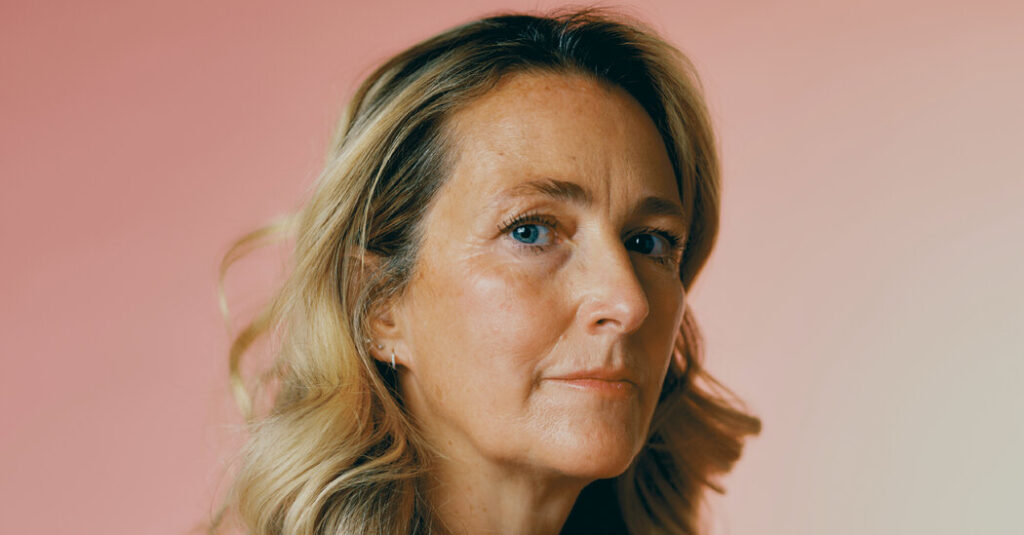
Late at night, in the summer of 2023, Belle Burden sat alone in her house on Martha’s Vineyard, refreshing a page on her laptop. A year earlier she had submitted an essay to The New York Times’s Modern Love column and now the essay, her first published piece, was due to run. Finally, at midnight, the page loaded with her article at the top. Her first thought, she recalled, was, “What did I do? What have I done? Like, there’s no going back from this.”
Burden, 56, told me this story on a December morning at a coffee shop not too far from her TriBeCa apartment. That essay, “Was I Married to a Stranger?,” details the abrupt end of her nearly 21-year marriage in the early weeks of the coronavirus lockdown. The piece’s honesty and tone, both warm and cool, attracted interest from book editors. After fielding multiple bids, Burden signed a contract for a full-length work: “Strangers: A Memoir of a Marriage,” which Dial Press is publishing on Tuesday.
Writing the book allowed her to reframe her life story and to better understand herself, which felt productive and steadying. It also felt, she said mildly, over a cup of herbal tea, like throwing herself from a cliff.
Publication, which on that morning was about four weeks away, will be another cliff, a higher one. The public-facing aspects — talks, readings, interviews like this one — terrified her. She was doing her utmost to stay off Goodreads and to gird herself for published reviews. Still, she felt ready to absorb the landing.
“We’re only here for a short time,” she said. “So why not go for it?”
Until recently, Burden was not the go-for-it type. The granddaughter of the socialite Babe Paley and the daughter of Amanda M. Burden, a prominent city planner, Burden descends, she said, from a long line of women who valued reserve, especially when it came to protecting the men in their lives.
“This is a rebellion against that,” Burden said of her book. She said it softly.
Though “Strangers” is not a work of reprisal, it is unsparing in its description of the emotional damage her former husband inflicted when he admitted to an affair and told her, early the next morning, that he was leaving her. Later that day, he renounced any interest in the custody of their three children.
In the memoir, she records him saying, “I thought I wanted our life, but I don’t.” Then she details her response — the crying, the begging.
In person, Burden is not given to strong emotion. Her affect is warm and composed, her speech so precise (a quality she likely honed in her years in corporate law) that one has to listen closely to hear the feelings under it. Her clothes that morning — black, dark blue — seemed to have been chosen with an eye toward urban camouflage.
The only idiosyncrasy was a Greek coin she wore around her neck, a long ago gift from her father, Carter Burden, a philanthropist and one-time city councilman. (Interviews make her nervous, she confessed. The talisman helped.)
Divorce memoirs aren’t uncommon. Recent years have brought bruising works like Hannah Pittard’s “We Are Too Many,” Maggie Smith’s “You Could Make This Place Beautiful” and Leslie Jamison’s “Splinters.” Burden seems among the least likely women to have written one.
“It’s strange, because I am a shy person,” she said. “I don’t generally reveal that much. But I have revealed everything.”
It felt strange to others, too, like Graydon Carter, the former editor of Vanity Fair, who has known Burden since their children attended the same Manhattan school.
“Belle is about as private as private gets,” he wrote in an email. “I was surprised when she first mentioned the article and then the book.” He read a galley, and while he isn’t given to what he described as “marital spat lit,” he found he couldn’t put it down.
That’s less surprising. The book, a work of plain-spoken devastation and emotional acuity, reads like a love story and a horror story and, in one nail-biting section, like a financial thriller. (I will confess to having flipped ahead to see if an oppressive prenup would be enforced.)
The actress and writer Isabel Gillies, the author of the 2009 divorce memoir “Happens Every Day,” was sent an advance copy. She is often sent divorce memoirs —“sadly,” she said. But Burden’s stood out. “She’s just clear and elegant and has a very straightforward way of telling the story,” Gillies said in a recent phone conversation.
The story, as Burden understands it, is this: Early on the morning of March 22, 2020, her husband, Henry Patterson Davis, an executive at a hedge fund, told her that he wanted a divorce. (Burden does not name him in the book, but he is easily Googled.) Then he left. Burden renders this coolly: “He said, ‘You’ll be fine. You’re still young.’ I was 50.”
The book moves backward in time, exploring Burden’s upbringing and the couple’s precipitate courtship. It moves forward, too, through the machinations of the divorce and the ways — generous, callous, wary — that friends and acquaintances behaved around the newly single Burden. It also deals, delicately, with the experiences of their children, now 18, 21 and 23. Davis, contacted through his company, did not respond to an interview request.
Before her divorce, Burden would not have described herself as a writer, though she wrote all through her childhood and won prizes for short stories at her boarding school, Phillips Exeter. But an upsetting feedback session in a first-year seminar at Harvard dissuaded her from a concentration in creative writing, so she pursued a career in law instead, then stepped away to raise her children. (Working with another lawyer, she takes on occasional immigration cases, pro bono.)
And for two decades she doubted she had much to tell. She understood the story of her marriage as a simple one: She and her husband fell in love, they married, they would stay married.
But that story wasn’t true. And her first attempts at writing, in the months after her marriage’s dissolution, were an attempt to understand the real one, to assemble the facts of their shared life. “I was really trying to process it and figure out what I thought,” she said.
At a friend’s urging, she signed up for an online memoir workshop, taught by Lizzie Simon. She attended the workshop once, just listening, declining to share her work. Then she took it a second time, working up the courage to read what would become her essay. Simon, who had barely registered Burden, regarding her only as a “polite, silent person,” was startled by the quality of the writing.
“When she started reading, I was like, ‘Whoa, OK,’” Simon recalled in a recent phone conversation. “That’s a voice I would follow.”
With the essay complete, Burden sent it to The Times. She didn’t really believe it would be selected and hadn’t thought through the ramifications. But she was proud of it. “This was the first time that I was like, OK, I’ve actually done something — not in retribution, not in revenge, but to be myself and to own the story,” she said.
Having metabolized the publicity the piece generated, Burden decided that she had more to say, even though she felt, as she writes in the memoir, that in acknowledging the mess of her divorce, she was controverting a family legacy.
“I was refusing something — the cleaning up, the grace,” she writes.
She intuited that some readers might be helped or comforted by that refusal, that they might relate.
What was perhaps less relatable was the privilege that Burden enjoyed — the schools, the summer homes, the cushy life of a hedge fund spouse. That stressful prenup concerns the distribution of a luxury apartment and an upscale vacation home; there are some tasty throwaway lines like, “I wore a slinky satin dress designed by Calvin Klein at my mother’s request as she was friendly with him.”
In the memoir, Burden had to walk the line of acknowledging how this made many aspects of divorce easier without overstating or overapologizing for family wealth. If anything, the book underlines how devastating divorce can be, even when financial worries are mostly, if not entirely, off the table. (Burden does not expect to remarry. “I do not want to be tied financially to someone ever again,” she said.)
Even now, she questions her impulse to tell the story at all. “I still feel a rush of shame when I think about how I was left by my husband,” she said. The book has made that leaving public. But it has offered her a new identity as a writer, and given her the joy of creating a work that people will soon hold in their hands.
“As someone who existed quietly below the radar for 50 years, it’s quite a thing to feel that,” she said.
Still, writing “Strangers” has allowed her to appreciate her divorce.
“I don’t think I was a fully realized person when I was married,” she said. “And I never would have left. So in the end, it sounds crazy, and I wouldn’t have said this a couple years ago, but I’m glad it happened.”
Alexis Soloski has written for The Times since 2006. As a culture reporter, she covers television, theater, movies, podcasts and new media.
The post Her Gilded Marriage Imploded. Now, She’s Ready to Tell All. appeared first on New York Times.