According to the French music streaming service Deezer, there are about 50,000 fully AI-generated songs uploaded to its platform every day. Many of these songs won’t reach a wide audience, but over the past year, a few have gained millions of listens.
Which raises the question: If our future is going to be filled with this kind of AI music, what does that future sound like?
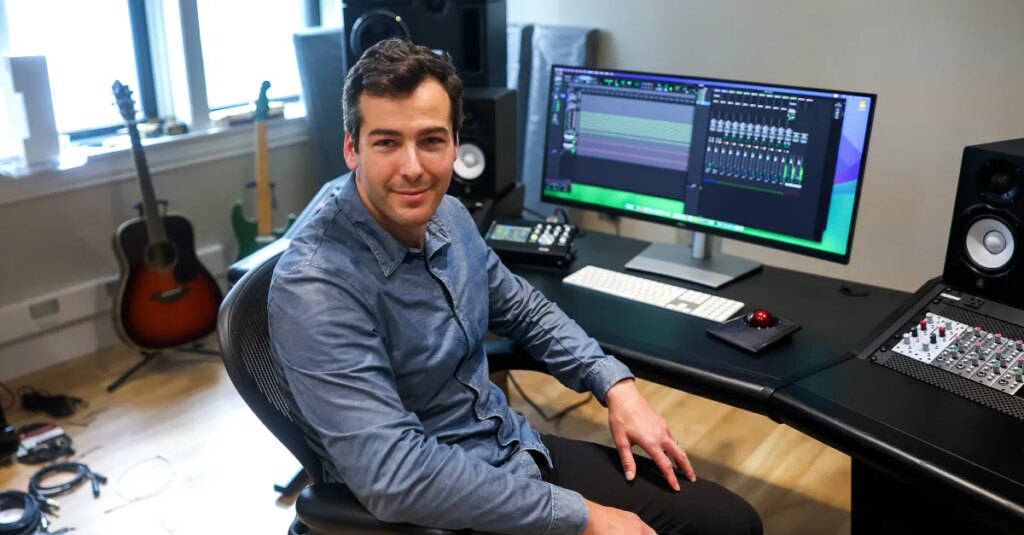
Deni Béchard is the senior science writer at Scientific American. For the better part of a month, Béchard has only allowed himself to listen to his own AI-generated music using the AI music app Suno. He says the experiment is an attempt to think more critically about how we might engage with this kind of music in the future.
Béchard spoke with Today, Explained host Noel King spoke about what he’s learned so far and how his AI creations stack up to human-made music. The conversation has been edited for length and clarity.
There’s much more in the full podcast — including snippets of Béchard’s songs — so listen to Today, Explained wherever you get your podcasts, including Apple Podcasts, Pandora, and Spotify.
Alright, so you’re using Suno, you said, to create the songs.
I come up with a prompt and I’ll plug it in, and each prompt makes two songs, and I’ll try to be as creative as possible. I’ll usually plug it in two or three times and vary it, add different kinds of instruments or different kinds of vocals, and just plug a bunch of those in. One that made me laugh was a song called “Organ Trafficking.” I had asked for a contemporary rap song with female vocals, and I had asked for playful, ironic lyrics, and it comes up with this song, where organ trafficking is kind of the central metaphor. I was pretty surprised.
I think one of the things I’ve realised is that a lot of the music I listen to that is mainstream is, I would consider, heavily processed music — music that’s designed to have a large market. And it doesn’t feel very personal to me anyway, so I realized that in that particular context, [the music I made with AI] didn’t feel very different a lot of the time.
Do you think if someone had handed you a playlist of 10 songs, five are AI, five are not, do you think you’d be able to tell the difference?
No, I don’t think so.
Wow. And what does that tell you?
I mean, it tells me that the AI is getting very good.
One thing I noticed during this process was that a lot of the AI music that is popular, that people are listening to on Spotify that has millions of listeners [are] songs that are very soulful, very gritty.
It’s like Xania Monet or Solomon Ray or Cain Walker’s “Don’t Tread on Me” — and Cain Walker’s not a person. It’s an AI avatar, right? Or Breaking Rust’s “Livin’ on Borrowed Time.” Those songs all feel just really authentic. This person really suffered through these things and felt these things. That’s how they come across.
I think that AI tends to work best when it just leans into that authenticity because it kind of helps overcome the cognitive dissonance that we’re thinking, This isn’t really a deeply felt song, and it moves away from mainstream human-generated music — human-made music — which is often very heavily designed to be a summer hit or to go viral in some way. And it often doesn’t have that level of authenticity, that feel of authenticity. I think when AI replicates that, we’re more aware of it being superficial or artificial, because there’s already an element of artificiality there.
Do you think when your experiment is done, you’re going to keep making AI music?
I think I probably will.
Oh my god, you love the power.
I think, you know, what has surprised me with it is, I’ll be walking somewhere, and I’ll think, “What if I were to ask it to combine these styles or put a banjo with a hip hop track and add this kind of vocals? What would I get?” I get curious now.
I would say now I’m at the point where I don’t worry about the connection to the human. I did in the beginning. In the beginning, I was really like, “Who’s this person?” When you’re reading a book and you’re halfway through the book and you think, “What human mind did this book come out of?” And you turn the book over and you look and see who the author was, and you Google them and you’re like, “How in the world did they think of this?”
I just had that impulse so often in the beginning to want to know who felt this, who thought this. I just would have cognitive dissonance. I’d be going, “This is a machine. This machine did not fall in love. This machine did not suffer these experiences. This machine did not wake up at two in the morning and write this song just needing to express itself.” It was actually really bothering me. It kind of would block me from being able to enjoy the song.
And I thought, “Well, if somebody created an AI avatar and gave it a personality and they were a fictional character that existed in the Metaverse, and that AI avatar was a songmaker and it was singing this song, would that make it easier?” And weirdly, it would. It would make it a little easier. And so I kind of was just imagining these AI avatars, and I’m like, “Okay, I’m imagining a fictional character singing this song.” And that lasted maybe four or five days, and then I just got used to listening to the music, and I stopped thinking about it.
Does doing this experiment and seeing how you’re reacting to this music change how you think about AI at all?
I think my conclusion from this is that in 10 or 15 or 20 years, there are going to be a lot of teenagers who look at the discussions we’re having right now and go, “What are these people talking about? This is totally normal. Why would anybody feel so conflicted about this?”
I think we’re going to adapt to it pretty quickly. That is my gut feeling. There are a lot of big questions around the creators and protecting artists and what it means to be an artist. There are a lot of questions that are going to come out of this, and I really hope that artists are as protected as possible and remunerated properly. But I think this is going to fit into our lives a lot more smoothly than I think we’re realizing at the moment.
The post We’re probably going to learn to live with AI music appeared first on Vox.