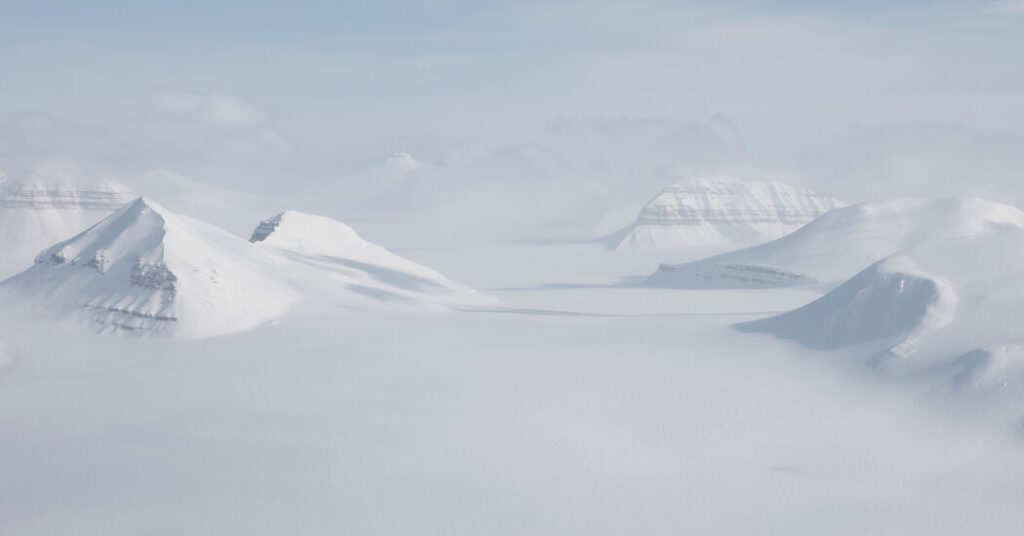
High up in the Arctic, near the North Pole, Svalbard stands alone as a geopolitical unicorn. The cluster of islands is a part of Norway, but is also governed by a unique treaty dating from World War I. It allows just about anyone to take up a life there, visa-free.
For decades, scientists from across the globe alighted at Svalbard’s international research station, set on a dreamy fjord bordered by sharp-toothed mountains. Chinese students zoomed off on snowmobiles with European classmates. Norwegians and Russians held chess tournaments and slurped borscht together when the matches were done.
But today, Norway is pushing to more firmly assert its sovereignty over Svalbard and fend off foreign influence. It is stripping voting rights from foreigners on Svalbard. It has blocked land sales to foreign buyers. It is tightening its grip on foreign researchers and claimed the seabed for hundreds of miles.
Norway’s campaign is scrambling years of international comity and sweeping through the lives of Chinese scientists, Russian coal miners, wealthy Norwegian property owners and longtime immigrants. Among them is a pair of brothers from Thailand who have spent nearly their entire lives on Svalbard and now worry about their future.
“I think about it constantly,” said the elder brother, Nathapol Nanthawisit, 30.
The tougher line is part of a new era of elbows-out geopolitics as a warming planet and the fight for resources intensifies, and as the jockeying between the great powers reaches the Arctic Circle.
President Trump’s threat to take control of Greenland is attracting the most attention. On neighboring Svalbard, the Norwegian moves are also raising alarms.
They have drawn strong objections from European and NATO allies and others, who argue the treaty limits Norway’s sovereignty over the islands. Norway insists it has little choice but to safeguard its corner of the Arctic or risk having Svalbard become a launchpad for hostile powers.
The archipelago is one of the best places on earth to download satellite data and monitor missile trajectories. Coveted supplies of rare earth minerals lie beneath its surrounding seas. It is about as far north as anywhere humans live.
Whoever controls Svalbard gains a perch toward dominance over the Arctic, an increasingly important arena for the security of Europe, North America and Asia.
American officials accuse Chinese researchers of doing illegal military research there. The Russians are pushing claims to Svalbard with language similar to how they laid claim to Ukraine.
“Norway now finds itself in the most serious security situation since 1945,” Norway’s state secretary at the Ministry of Foreign Affairs, Eivind Vad Petersson, said in a lengthy interview.
“When political attention is raining on Greenland, of course some of it drips on Svalbard,” he said.
Svalbard, he said, has for too long been seen by nations as “sort of a free-for-all, and everyone who wants to can come up and do almost whatever they want.”
“That’s not the fact,” he added, sharply. “This is Norwegian sovereign territory. So we’re making that a bit clearer.”
Not So Remote Anymore
Most people do not think of Norway as the tough guy. It is a rich Scandinavian country synonymous with international diplomacy and hands out the Nobel Peace Prize.
But times are changing. Ask Leif Terje Aunevik, the mayor of Longyearbyen, Svalbard’s biggest town, a tidy grid that looks like a cross between a ski resort and a military base.
Mr. Aunevik, a Norwegian who arrived on Svalbard more than 25 years ago as a dog musher, sits in a cozy office equipped with blazingly fast internet and a polar bear femur mounted on the wall.
Now 58, he remembers being attracted to Svalbard as a younger man because it had the reputation of being this “exotic, weird place.”
“I had this theory,” he said, “that the farther you go north, the wilder the people get.”
Today, Mr. Aunevik conceded, Svalbard is not so wild. Longyearbyen has candlelit restaurants, fancy hotels, daily flights to the mainland and 2,500 people, more than double when he arrived — and from 50 different countries.
Centuries ago, Svalbard was so remote and foreboding that the Norwegians considered it terra nullius — nobody’s land. They referred to it in the starkest terms: sval (cold) and bard (shore).
About the only people braving the winters, when temperatures plunge to minus 30 Fahrenheit, were Norwegian miners and Russian fur trappers.
After World War I, the victors recognized Norway’s claim to the archipelago, but with asterisks. The Svalbard Treaty of 1920 banned any warlike activity and granted all signatories equal access to hunting, fishing, mining and owning land — a rare arrangement anywhere on the globe.
A handful of countries, including Denmark, France, Italy, the United States and Japan, signed right away. The Soviets jumped in soon after. China, too.
Since then, nearly 50 countries, including Afghanistan and North Korea, have added their names, giving them the same access as anyone.
“Look at the place,” Mr. Aunevik said. “It’s a unique infrastructure, an open society, local democracy.” He spoke of a surge in investment, official visits and strategic attention.
Everyone, he said, is now telling themselves, “We should be there.”
The Seabed Battle
One morning this past year, Martinique du Toit, a South African who works as a tourism promoter, walked along Svalbard’s coast. She encountered two dominant colors in different hues: white and blue. They cover the snow and the ice, the sea and the sky.
A great fjord stretched in front of her and the water was deep and gin clear. “There’s a magic here I can’t explain,” she said.
Just as alluring to the nations vying on Svalbard is what lies beneath those waters.
Recent studies have shown that vast amounts of copper, zinc, cobalt, lithium and rare earth elements are buried in the ocean floor, sometimes more than 10,000 feet below the sea’s surface. Such minerals power new technologies like electric car batteries and wind turbines.
And Norway is guarding the trove tightly.
Nearly the whole world has, for a century, understood the Svalbard Treaty as granting signatories rights not just to the archipelago, but also to its surrounding seas and seabed.
In January 2024, Norway’s governing party announced that Norway would pursue deep-sea mineral exploration in an enormous section of its seabed — an area the size of Germany — including waters around Svalbard.
The announcement, one of the first by any nation, raised alarms. At home, environmental groups and left-wing parties opposed the idea, saying it would threaten fragile marine life.
Outside Norway, the move was seen as a land-grab well beyond the limits of the Svalbard Treaty.
“We would like to remind the Norwegian side once again that it does not exercise unconditional sovereignty” over Svalbard, the Russian Foreign Ministry said in a briefing at the time. It denounced the move as “illegal.”
Iceland, usually a reliable ally of Norway’s, agreed with the Russians. In a letter to the Norwegians viewed by The New York Times, the Icelandic government argued that Norway’s sovereignty over Svalbard had “important limitations” that applied offshore.
The European Union weighed in, too. In a three-page letter to Norway’s Foreign Ministry, it characterized Norway’s position on Svalbard’s waters as “incoherent.”
In early December, citing their environmental concerns, left-wing parties in Oslo refused to back the national budget unless the plan was suspended. Cornered, the government agreed to wait four years before issuing seabed mining licenses.
But Norway’s Energy Ministry, made clear in a statement in December that its goal remained the “profitable and sustainable” pursuit of seabed minerals. That included in the waters around Svalbard.
Less Welcome Than Before
Nathapol and Nattanagorn Nanthawisit arrived on Svalbard one December day more than 20 years ago, two little boys from a humid, sunny town near Bangkok.
They were immediately confused about what happened to the sun. Svalbard is so far north that in the winter, it is dark all of the time. They did not see the sun for two solid months.
Still, the Nanthawisit brothers said they adjusted quickly.
Their mother had come here to work as a maid — the family held Thai passports and Svalbard’s rules allow anyone with a valid passport to stay. The pay is good, and people from all over the world come to work in tourism and service jobs. Their mother put them straight into a Norwegian school where they learned the language, made friends and grew to see themselves as a welcome part of society.
“We feel Norwegian,” Nathapol said.
A few years ago, both brothers said, things started to change.
First, police officers stopped a Thai man from driving, declaring Thai driver’s licenses, and some other foreign licenses, invalid on Svalbard. The authorities eventually eased the prohibition, but the Nanthawisit brothers and others interviewed on Svalbard said the event left many foreigners with a lingering sense of vulnerability.
Around the same time, the government changed the rules on who could vote in Longyearbyen’s local elections. Local democracy was introduced in 2001, and for many years, foreigners took part with no problems.
But three years ago, the authorities declared that foreigners living on Svalbard could not vote unless they had lived on mainland Norway for at least three years.
Mr. Petersson, Norway’s state secretary, was unapologetic.
“Should have been done a long time ago,” he said in the interview, adding that other countries do not let foreigners vote. The Svalbard Treaty, he said, guaranteed “equal access, not equal rights.”
For Sale? Not So Fast.
The Norwegian government already controls 99 percent of the land on Svalbard. But even on that last 1 percent, the government is not giving up an inch, documents and interviews show.
For the past decade, a group of private Norwegian landowners has been trying to unload a 20-square-mile plot along a mountainous fjord, one of the last big slices of land for sale so far north in the Arctic.
According to Per Kyllingstad, the lead lawyer for the property, the owners hired a global team of lobbyists and agents to market the land, which is about the size of Manhattan. He said that several buyers, including from the United States and from European countries that have signed the Svalbard Treaty, expressed interest.
King & Spalding, a high-powered Washington law firm, made a snazzy brochure advertising the land as having “environmental, scientific and economic importance” and “uniquely advantageous conditions for satellite communication.”
Svalbard is so close to the North Pole (only about 500 miles away), it is one of the only places on earth to connect constantly with polar-orbiting satellites, which means uninterrupted, clearer feeds and faster downloading speeds than almost anywhere else on Earth.
The world’s largest satellite downloading station, SvalSat, is already based there. Its glowing domes look like Disney’s Epcot Center, times 20. Tom Cruise filmed scenes from a recent “Mission: Impossible” there, calling Svalbard “absolutely remarkable.”
The Norwegian government has been trying to attract more film productions to Svalbard, but it is not enthused about the potential sale of the property along the fjord.
Mr. Petersson told The Times that the land was part of a wider area that had been demarcated as a national park, which means that not much can actually be done with it.
Just to make sure the wrong buyer does not acquire it, the Norwegian government passed a royal decree in 2024 severely restricting the sale on the grounds that it could “harm national security interests.”
The landowners remain on the lookout for a buyer who has, say, 300 million euros ($350 million) to spare. A few years ago, the government made an offer for $2 million.
Mr. Kyllingstad, the lawyer, believes that the government’s position is illegal and that Norwegian officials are trying to eliminate any other buyers and force the owners into giving up the land at a low price.
“What is at stake is Norway’s credibility as a rule‑of‑law state on Svalbard,” he said.
Russian Encroachment
On a bitterly cold day last May, a man wearing a dark cassock and a giant silver cross crunched through the snow to a small wooden church.
As he pulled the ropes of the church bells, they rang clear in the crisp Arctic air.
“It was very hard to find someone for this job,” explained the man, Pyotr Gramatik, a Russian Orthodox priest, when he had finished. “The environment here is harsh.”
Father Gramatik is the local priest of Barentsburg, a Russian colony on Svalbard, and has been living here since last March with his family. He is among the first full-time Russian priests on Svalbard for as long as anyone can remember.
The Russian Orthodox Church is closely aligned with the Russian government, and the church’s leader, Patriarch Kirill, has called Russia’s invasion of Ukraine “a holy war.”
Norwegian officials, including an intelligence officer, said that they saw the patriarch’s new emissary as one of the embodiments of Moscow’s efforts to tighten its ties to Svalbard.
But they also acknowledged that the Russian presence goes back centuries.
Fur traders from the Pomor region, in northwestern Russia, came here at least 300 years ago — Russian officials claim they were here even earlier, before anyone else.
About a century ago, the Soviets established several coal mining towns in Svalbard and signed the Svalbard Treaty. Barentsburg is the last one still working, barely.
This mining town used to be home to more than 1,000 people. Now it is around 300. Barentsburg’s hospital, once a state-of-the-art Soviet facility, is deserted. One of its operating rooms has been turned into a massage parlor.
Still, if anything, the Russians are firming up their claims. One Russian official recently said the archipelago should be renamed the “Pomor Islands.” Another emphasized that Russia had the same obligation to protect Russian speakers on Svalbard as it does in Ukraine.
Ivan Lavrentiev, a scientist at the Russian Academy of Sciences studying glaciers in Barentsburg, said he believed that Russia would never leave Svalbard, even though it already controls more land in the Arctic Circle than any other nation.
Even if the Barentsburg coal mining colony is sputtering, it is Russia’s farthest western point in the Arctic and a strategic asset, Dr. Lavrentiev explained, though he made clear he was just sharing his opinion, not speaking for his government.
“So we’re going to mine forever,” he said.
A Threat from China?
A pair of granite lions, weighing 2,000 pounds each, stands guard outside the Yellow River Station, the building within the international research hub where the Chinese scientists live. They have been sitting there since the Chinese government set up on Svalbard 20 years ago.
Each summer, the research hub, called Ny-Alesund, draws a few visitors who venture this far north. But last July, about 200 tourists from Hong Kong and mainland China marched off a cruise ship and went straight to the Yellow River Station.
They waved Chinese flags and unfurled a banner. One woman in military fatigues posed for pictures in front of the lions.
The Norwegians summoned Chinese diplomats over the episode. The Chinese said that the ship’s passengers were not part of any military delegation.
The Norwegians ordered the Chinese to remove the lions, according to documents seen by The Times, as part of their new plan to exclude symbols deemed incompatible with Norway’s sovereignty over Svalbard.
“This is Norwegian property,” said Lars Ole Saugnes, who until recently served as the director of the government-owned company that runs the research station.
The lions simply “don’t fit,” he said in an interview in his office cabin on Svalbard where the walls are painted with scenes of polar expeditions.
In the U.S. Congress, members of the House Select Committee on the Chinese Communist Party have deeper fears. They believe the Chinese are performing military research on Svalbard, which is not allowed under the treaty.
Chinese scientists have access to a powerful radar system that monitors space weather and the atmosphere. At least three current research projects using data gathered from this equipment have been shared with the China Research Institute of Radiowave Propagation, a Chinese defense organization, according to an online portal. It did not return The Times’s request for comment.
In July, for the first time, the University Center in Svalbard, the archipelago’s only university, which is run by the Norwegian government, barred Chinese students. Norwegian intelligence agencies said the students could be a security risk.
In an email, officials at China’s Embassy in Norway did not directly respond to the accusations of clandestine activities in Svalbard. They called the criticisms of China’s activities “nothing but distortion of facts and groundless speculations.”
As of January, the lions were still standing.
Alina Lobzina contributed reporting.
Jeffrey Gettleman is an international correspondent based in London covering global events. He has worked for The Times for more than 20 years.
The post The Tug of War at the Top of the World appeared first on New York Times.