President Trump has found a powerful but obscure bulwark in the appeals court judges he appointed during his first term. They have voted overwhelmingly in his favor when his administration’s actions have been challenged in court in his current term, a New York Times analysis of their 2025 records shows.
Time and again, appellate judges chosen by Mr. Trump in his first term reversed rulings made by district court judges in his second, clearing the way for his policies and gradually eroding a perception early last year that the legal system was thwarting his efforts to amass presidential power.
When Mr. Trump criticized a ruling from a so-called “Obama judge” in 2018, Chief Justice John G. Roberts Jr. responded that “we do not have Obama judges or Trump judges, Bush judges or Clinton judges.”
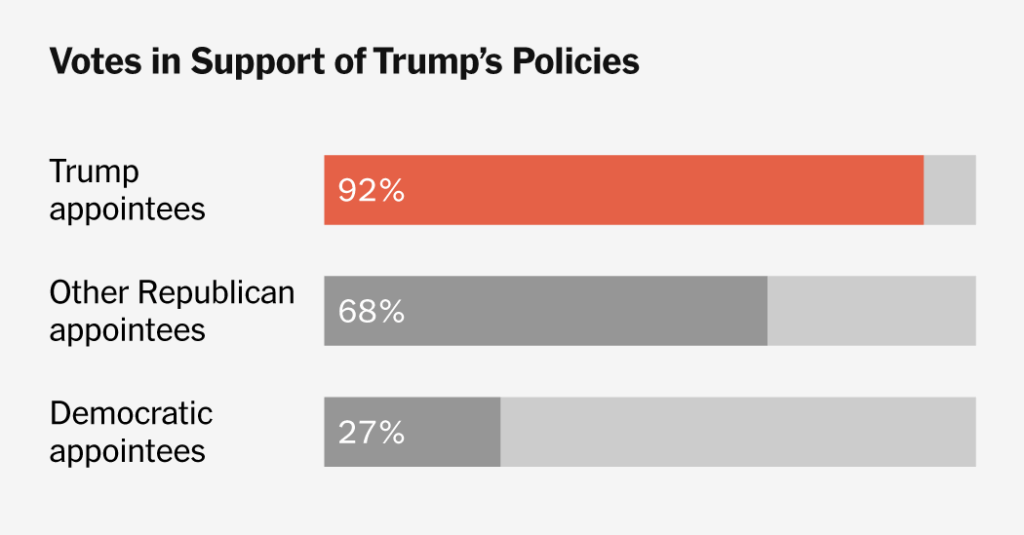
But the data suggests that in the 13 appellate courts, there is increasingly such a thing as a Trump judge. The president’s appointees voted to allow his policies to take effect 133 times and voted against them only 12 times. Ninety-two percent of their total votes were in favor of the administration. That figure far outstrips support for Mr. Trump’s agenda from appeals court judges appointed by other Republican presidents, and from Mr. Trump’s appointees to the district courts.
The Times analyzed every judicial ruling on Mr. Trump’s second-term agenda, from Jan. 20 to Dec. 31 of last year, or more than 500 orders issued across 900 cases. About half of rulings at the appellate level were in Mr. Trump’s favor — better than his performance with the district courts, though worse than his record at the Supreme Court, where the rulings on his agenda have almost all been on a preliminary basis in response to emergency applications.
Experts who have studied the voting patterns of federal judges have found that, even before Mr. Trump, their rulings had some degree of alignment with the partisan positions of the president who appointed them. On the Supreme Court, for instance, where the behavior has been closely studied, justices have shown a decades-long tilt toward their appointing president, a 2016 study found.
The correlation between ideology and voting among judges in the Times analysis extended beyond those appointed by Mr. Trump. Appellate judges appointed by Democratic presidents voted against Mr. Trump’s agenda 73 percent of the time, compared to 32 percent of the time by appellate judges appointed by Republicans.
But the impact of Mr. Trump’s appeals judges on his own agenda has been hard to overstate, given the glut of litigation over the president’s expansive executive actions and the pushback they have encountered from district court judges.
The uniformity of the judges’ votes is “reason for serious concern,” said Mark L. Wolf, a former federal judge nominated by President Ronald Reagan. Judge Wolf recently retired so he could speak more freely about what he has characterized as the threat that Mr. Trump posed to the rule of law.
“If you’re an impartial judge, the same party is not going to win every time,” he said. “Because the facts are different, the law is different, and so the result is often going to be different.”
Mr. Trump’s appellate appointees allowed him to deploy the National Guard in cities over the objections of state and local leaders. They delayed for more than six months a judge’s inquiry into why planes carrying Venezuelan immigrants to a maximum-security prison in El Salvador did not turn around, despite a court order. They signed off on the withholding of millions of dollars in federal funds from public school districts.
There are a number of possible explanations for Mr. Trump’s strong showing before appellate judges he chose.
Changes to the judicial confirmation process have made it easier for more ideologically extreme judges to win Senate approval. Mr. Trump has nominated judges who are aligned with his maximalist view of presidential power, part of a long-running conservative project to concentrate more authority within the White House. And a trio of Trump appellate appointees in Washington, where many lawsuits over the administration’s agenda have been filed, have voted for a large number of rulings in his favor.
Mr. Trump has also taken an unusually active role in trying to shape judicial behavior.
He has called judges who ruled against his administration “radical” and “lunatic.” He has praised judges who rule the way he wants, calling them “highly respected” and “brilliant.”
“You could have court of appeals judges auditioning in case a Supreme Court seat opens up,” said Morgan Hazelton, a political science professor at Saint Louis University and the co-author of a book on collegiality in the appellate courts.
Abigail Jackson, a White House spokeswoman, said in a statement that the judges who had upheld Mr. Trump’s policies had done so out of fidelity to the law.
“President Trump has always selected qualified nominees who will uphold our Constitution and the rule of law,” she said. “Higher court judges have consistently upheld the president’s policies as lawful because they are lawful.”
The Judicial Playoffs
If the judiciary were Major League Baseball, the 94 federal district courts would be the regular season, and the Supreme Court would be the World Series. The 13 courts of appeal would be the playoffs: the intermediate layer where many of the most significant cases and legal questions are sorted out.
Appeals court judges work in randomly chosen groups known as panels, which review appeals of final decisions by district court judges, who work alone. Panels, as well as the Supreme Court, can also intervene in the middle of cases, ordering district court judges to take specific actions while litigation over an issue proceeds.
When Mr. Trump’s policies are temporarily blocked by district court judges, appeals courts can issue “administrative stays,” temporary rulings that effectively reverse the lower court’s orders and let contested policies take effect. Administrative stays are supposed to be temporary but can remain in place for weeks or even months. In many cases, they are replaced by a more lasting stay, known as a “stay pending appeal,” that remains in place while the appellate court considers the case.
The Times analysis tracked both kinds of stays, as well as the final rulings that appellate courts made after considering arguments from both sides.
Mr. Trump’s nominees sided with him consistently across all three kinds of rulings, voting in his favor 97 percent of the time on administrative stays, 88 percent of the time on stays pending appeal, and 100 percent of the time on final rulings.
If the parties in a case disagree with an appeals court’s final ruling, they can seek further intervention by the Supreme Court, which accepts roughly 1 percent of the thousands of petitions it receives each year. That limited bandwidth means that the appeals courts — which handle more than 40,000 cases annually — are powerful gatekeepers that serve as the main check on district court judges. And the legal precedents they set are binding on the individual circuits they oversee.
During the 2016 presidential campaign, Mr. Trump helped convince traditional Republican voters that he was reliable by promising to pick conservative judges, forging an alliance with the leaders of the Federalist Society, a conservative legal group, to identify candidates.
Trump Administration: Live Updates
Updated
- Judge bars Trump from withholding election funds to states.
- Trump calls for a 10 percent cap on credit card interest.
- Consumer bureau leader requests $145 million for an agency he wants to eliminate.
“If it’s my judges, you know how they’re going to decide,” Mr. Trump told leaders of evangelical Christian groups in June that year.
In all, Mr. Trump selected 54 appellate judges in his first term, the most of any president in a four-year term since Jimmy Carter, who had the one-time advantage of a federal law that expanded the judiciary. Mr. Trump in his second term has appointed another six.
Mr. Trump’s first-term appellate appointees are standouts in their youth, credentials and conservatism, according to a study by the law professors Stephen Choi and Mitu Gulati. The Times analysis of their rulings found that their record on the administration’s policies was also significantly more one-sided in 2025 than any other president’s judicial cohort.
Mr. Trump benefited from two recent Senate rules changes that gave the president more control over his appellate nominees, who serve for life after being chosen by the president and confirmed by a Senate vote. In 2013, lawmakers decided that nominations for district and appeals court judges could no longer be filibustered. In 2017, they eliminated the “blue slip” process for appellate judgeships, a longstanding Senate tradition of requiring approval from home-state senators for nominees, even if the senators are from the opposing party.
That move followed attempts by Mr. Trump to circumvent the process by failing to consult with Democratic senators. More recently, he has called on the Senate to also eliminate blue slips for district court nominees.
Together, the changes mean that “the president is now able to pick people who are more aligned with his or her judicial philosophy” said Gregg Costa, a retired appellate judge nominated by President Barack Obama who is now an attorney with the law firm Gibson Dunn. It means fewer “compromise candidates” who can pass muster with the opposing party, gradually leading to a more polarized judiciary, he said.
Mr. Trump’s experience with the judiciary is also different from his predecessors because of how much is riding on whether his maximalist vision of the presidency can make it through the courts.
The president “is trying to change the nature of the presidency, and to alter constitutional understandings more broadly,” Jack Goldsmith, a Harvard law professor and former Justice Department official, said in a recent lecture.
Mr. Trump signed 225 executive orders last year; Mr. Biden signed 162 over four years in office. The scale of Mr. Trump’s new policies drew consistent pushback from district court judges. They issued dozens of nationwide injunctions — when one judge’s ruling blocks administration policies everywhere, for everyone, a power recently pared back by the Supreme Court. That was more than in any previous presidency except for Mr. Trump’s first term.
Those injunctions put tremendous power into the hands of the appeals courts, the government’s first stop when it believes a judge has gone too far.
Different Courts, Different Outcomes
Part of Mr. Trump’s success at the appeals court level may be the process working as intended, experts said, as appeals courts review the sometimes snap decisions made in the lower courts.
It can be easier to steer cases to district court judges who are likely to be sympathetic, said Akhil Reed Amar, a Yale law professor.
“Regardless of who is in the White House, you’re going to get more pushback from the district courts,” said Professor Amar, the author of several books on the Constitution. “People who disagree with administration policy will go to a district where their odds of drawing a friendly judge are particularly good.”
Conservative legal practitioners argue that Mr. Trump’s winning record has more to do with the merits of challenges than judges ruling based on their policy preferences. The baseline for measuring appellate results “shouldn’t be 50-50,” said O.H. Skinner, a former Arizona solicitor general who now backs the conservative legal agenda at the state level.
“Judges should not be measured as if ruling equally for plaintiffs and D.O.J. is a neutral ideal. That ignores how much the legal merits and procedure drive proper case outcomes,” he said. “And some of these lawsuits are comically ham-fisted or far-fetched. It’s quite telling that about a quarter of the votes of Biden appointees have sided with President Trump.”
Mr. Trump’s success on appeal has also been driven by the influence that his appointees have wielded in specific judicial circuits, especially the U.S. Court of Appeals for the D.C. Circuit. The court has jurisdiction over federal matters in the nation’s capital, and its three Trump appointees have exercised outsized influence, repeatedly sitting on panels hearing key cases.
Combined, Judges Gregory G. Katsas, Neomi Rao, and Justin R. Walker voted 75 times in favor of the administration — slightly more than half of the pro-Trump votes from Mr. Trump’s appointees logged by the Times analysis — and only three times against.
The three judges’ prominence in the data is partly a function of the circuit’s practice of assigning emergency motions to special three-judge panels. These panels are chosen randomly, on a rotating basis, according to a spokesman for the circuit executive’s office. The three Trump appointees were often selected for the panel during the spring and summer, when many judges on the district court it oversees were ruling against the administration.
Judges Katsas and Walker declined to comment; Judge Rao did not respond to a request for comment. Keeping the same group of judges on the panel for weeks, as the court did for much of 2025, can lead to “gamesmanship” by litigants, said Marin K. Levy, a Duke law professor.
Those litigants, she said, can choose when to appeal based on when they perceive the panel to be more favorable for their side. “If some judges are randomly selected to serve on the panel in back-to-back months or, say, in two out of three months, their impact becomes even more outsized,” Professor Levy added.
Judge Katsas, a 61-year-old former Justice Department official nominated in 2017, appeared on one of Mr. Trump’s lists of potential Supreme Court nominees. Judge Rao, a 52-year-old former law professor who served in George W. Bush’s White House and was first nominated to the bench in 2018, has not, but is sometimes discussed as a Supreme Court nominee. Both judges clerked for Justice Clarence Thomas early in their careers.
Judge Katsas has ruled against Mr. Trump, both since his return to office, and before. After the 2020 election, he was among a number of Mr. Trump’s nominees who were skeptical of the president’s attempt to overturn the result, ruling that Mr. Trump was not immune from potential civil liability for his actions before the Jan. 6, 2021, attack on the Capitol.
While the D.C. Circuit has been friendly to Mr. Trump’s policies, the U.S. Court of Appeals for the First Circuit, which covers most of New England, has trended in the other direction. The circuit, which has long had a Democratic-nominated supermajority, ruled against Mr. Trump’s policies 74 percent of the time. It has become a destination for plaintiffs challenging administration policies, who often file their initial lawsuits in the districts of Massachusetts or Rhode Island.
Trump’s Judges
Mr. Trump’s appellate judges differ from other presidential cohorts in measurable ways beyond their voting records. Many of the president’s 60 appellate picks have been under 50 at the time of their nominations. More than a third of them clerked for Supreme Court justices, the study by Mr. Choi and Mr. Gulati found.
Judges appointed by Mr. Trump to the appeals courts ruled for him more often even than those he has appointed to the district courts, who ruled in his favor 55 percent of the time, the Times analysis shows.
They outstrip their peers when it comes to the number of opinions they write, the frequency with which they are cited by their peers, and their willingness to dissent from other judges, according to the study by Mr. Choi and Mr. Gulati. The authors called that last quality “independence.”
In an interview, Mr. Choi said it could correlate with a willingness to revise the legal framework around executive power.
“There could be a causal relationship between a judge’s willingness to act separately from other judges, and their willingness to rule in a way that bucks norms,” he said.
Judith Resnik, a Yale law professor, said that appellate judges “are supposed to be loyal to the adjudicatory process, which entails not overturning trial courts’ factual findings unless ‘clearly erroneous.’”
Overwhelmingly favorable rulings from Mr. Trump’s appointees “raise the question of whether they are conforming to those obligations,” she added.
But according to many supporters of Mr. Trump’s agenda, his nominees’ rulings are rooted in a legal doctrine known as “unitary executive theory,” which dates back to the Reagan era and gives the president control of all the powers granted to the executive branch.
According to this view, Mr. Trump’s judicial nominees are doing their jobs by pausing and reversing rulings by district court judges who overreach.
“The Constitution provides for a relatively strong executive,” said Leonard Leo, the Federalist Society co-chairman who guided Mr. Trump’s first-term judicial picks under the banner of “originalism,” which seeks to determine the original public meaning of the Constitution and often generates conservative outcomes. He said it should not come as “any surprise” that Mr. Trump’s originalist judges would rule in his favor.
The impact of Mr. Trump’s nominees will continue to unfold over decades, Mr. Gulati said.
“The Supreme Court’s docket is so tiny, and there’s so little attention paid to the appellate courts,” he said. “Trump has filled them with these superstar judges. They’re not buffoons. They’re very effective. And they are going to be there for a long time.”
Seamus Hughes contributed research.
Methodology
We counted all lawsuits challenging Trump administration policies through 2025, except for pro se filings, Freedom of Information Act lawsuits and most immigration cases in which the remedy sought would be limited to one individual. We did include three of the best-known individual cases, including that of Kilmar Armando Abrego Garcia.
We also omitted lawsuits challenging the administration’s tariff policies in which the relief sought would be limited to one firm, though we tracked the appeal of V.O.S. Selections v. Trump, a consolidated case the result of which is likely to determine the legality of the policy. Other lawsuits in which the relief would be limited to one family or individual were also omitted, except for cases in which a plaintiff sought reinstatement to a position in the federal government.
When counting votes by appellate judges, we included rulings in which panels issued administrative stays, stays pending appeal and final merits rulings — 156 rulings in all. We also included votes to rehear or not rehear cases by a larger en banc panel, but only for those rulings in which all votes cast were publicly available.
We assessed three appellate rulings as “mixed,” with neither side clearly prevailing, and omitted votes on those cases from our for-the-administration totals.
Alicia Parlapiano is a Times reporter covering government policy and politics, primarily using data and charts.
The post Trump’s ‘Superstar’ Appellate Judges Have Voted 133 to 12 in His Favor appeared first on New York Times.