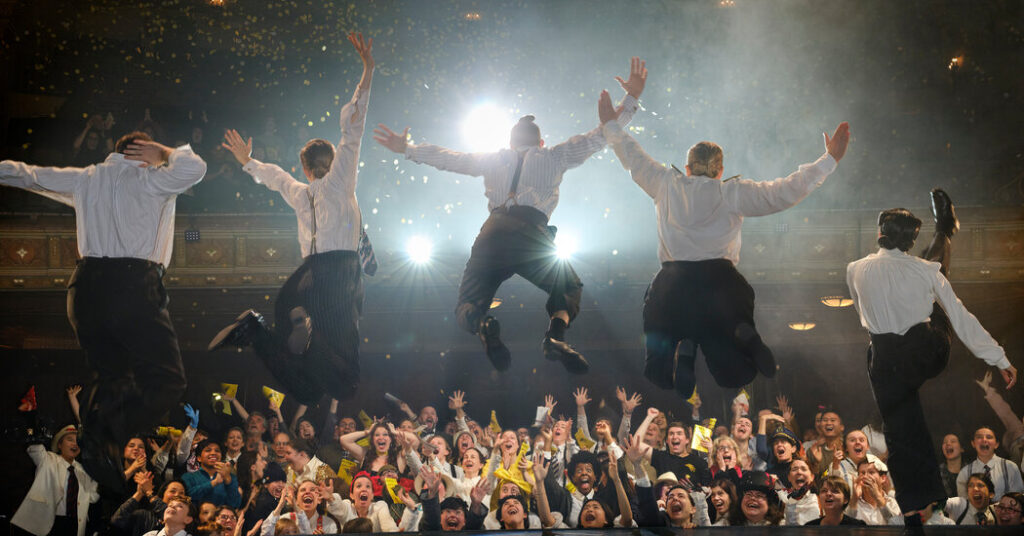
Maybe if I start from the beginning, I can make sense of it.
Last March, I went to a press preview for the new Broadway musical “Operation Mincemeat.” Two weeks later, a friend came to town from Los Angeles and asked what she should see, so I told her about the show and offered to go see it again with her.
Just a week after that, on a Wednesday morning when one of my sons was feeling a little blue, I went to the office but then stood up in the middle of the workday — I never leave my desk in the middle of a workday — bought two tickets and called his school to say he had an appointment, allowing them through a lie of omission to believe that it might be medical (and I am sorry for that). I picked him up in a cab and took him to the matinee.
Then, after my family was talking about how odd it was for me, who is famously (famously, in my family) always griping about my relative lack of time and money, to see a show three times, I decided that what my other son was actually saying was that he felt that I had been negligent in not taking him. So later that week I woke him up on Wednesday and told him to meet me at the theater for the matinee.
Here my memory becomes a blur. There were planned trips; there were spontaneous ones. There was at least once when I found myself at the theater with no real recollection of having made the decision to go. There were the more than a couple of times I went with a friend’s 8-year-old child I’ll call B here (anonymized because B is not old enough to consent to being in this ridiculous story and I don’t want to have to apologize to them later), because I’d seen B there once and learned that it was neither of our first times, nor even our second.
There was a big trip on Father’s Day so that my husband, who did not feel left out, wouldn’t feel left out. There was what I would not call lying to my family but obfuscating about where I was and what I was doing, as if I were having an affair. (An affair would have been easier to explain.) One night, The Times’s theater reporter offered me his plus-one to a different show, but I told him that I already had tickets to see “Operation Mincemeat” again. It would be my ninth time.
“Oh, dear,” he said.
“I don’t know what’s going on,” I said.
“You’re a fan,” he said. “This is what it is to be a fan.” He said it so kindly, the way a doctor talks to a mental patient in the movies.
To be clear, I take fandom seriously, but I have rarely been caught up in it myself. Don’t get me wrong. I write about culture for a living, and there are things that I love: I’m a Bruce Springsteen completist, and the first nonassigned short story I ever wrote, in 10th grade, was a kind of fan fiction about the song “Thunder Road.” I got really into Taylor Swift a couple of years ago, but everyone did. Sometimes when the Knicks are having a great season, I think about them a lot and wonder if they hang out when they’re not on the court. I’ve read “American Pastoral” by Philip Roth and “Dom Casmurro” by Machado de Assis a bunch of times. I can recite practically all of “Moneyball,” and I’ve done three complete tours through “Succession.” I love Jonathan Franzen and Elena Ferrante, but I would not use the word “unhinged” to describe my affection for either of them. In short, I have been around fandom my whole career. What I thought made me a professional was that I wasn’t susceptible to its berserk fringes.
If you don’t know — meaning, if you haven’t spoken to me recently — “Operation Mincemeat” tells the story of England’s most triumphantly daffy contribution to German defeat in World War II: an intelligence deception in which the corpse of a homeless man is dressed as a British spy, complete with a briefcase full of false attack plans attached to his wrist, and then dropped into the sea off the coast of Spain with the hope that German spies would ultimately get the plans and divert their defenses away from Sicily, where the Allies really intended to invade. The plan worked. The show’s main characters are Ewen Montagu (played by Natasha Hodgson) and Charles Cholmondeley (David Cumming), two MI-5 officers who persuade their boss, John Bevan (Zoë Roberts), to let them try this last-ditch attempt at saving the troops stationed in Sicily from Hitler. (Hodgson, Cumming and Roberts co-wrote and composed the musical, along with Felix Hagan, who is not in the cast.) The three get to work, with the help of the agency’s matronly secretary, Hester Leggatt (Jak Malone), and her ambitious new hire, Jean Leslie (Claire-Marie Hall).
But none of that is the compelling reason to see “Operation Mincemeat,” as there’s a 2021 nonmusical movie with the exact same title on the exact same subject that is right now on Netflix and far easier and cheaper to access. The musical — a fast-moving, minutely tuned execution of at-times zany and confounding precision — is performed by people you probably haven’t heard of, or hadn’t before last year’s Tony Awards, but there are just five of them, playing an astonishing 87 parts. It’s British comedy par excellence, both droll and not, combined with some vaudeville, much Monty Python and a healthy serving of Gilbert and Sullivan. It’s a British government farce. It’s a brazen sendup of class. It’s also somehow a poignant exegesis about war and the value of human life.
For the most part, the critics have praised it. The New Yorker called it a “stirring vision of real fellowship.” The Washington Post called it “exhilarating” and “jaw dropping” in its “inventiveness and virtuosity.” (The Times called it “diverting if irksome,” but I’ll get to that.) My own assessment is less measured. My editor has tamed my rhetoric for the sake of this publication’s good name, but he has still allowed me to say this: It is as wild as a show can be and still be coherent. It’s as moving and poignant as a musical can be without being sappy and sentimental. It is tonally deranged. It is utterly original. It’s not just the best musical I’ve ever seen; it’s the most rewarding theatrical experience I’ve ever had.
But is that a reason to see it over and over again?
By July, this was the question plaguing me as I sat before the show’s cadmium yellow curtain waiting for it to begin. My friend Maria recently went through something similar when “Sunset Boulevard” was on Broadway, seeing it 20 times by the end of its run. I went with her one of those times, in order to see if I could understand what had captivated her and maybe understand what was going on with me and “Mincemeat.” I liked “Sunset Boulevard” just fine, I did, but there was a moment in there when it occurred to me that just one block over, the “Mincemeat” gang was executing an astonishing dual-scene back-and-forth between spies and sailors that stays 10 steps ahead of any viewer, and I wondered what the hell I was doing in this theater and not that one.
How does this happen to a person? How does something like a random musical come in and upend the life of a practical, equanimous person who is already oversubscribed and hasn’t even seen the horny hockey show that everyone is talking about? I had to find out what was going on; I had to do something to understand why I couldn’t stop attending the show before I wound up at a performance dressed as one of its characters. I’ve been a journalist for a long time, and so I can say this: Most investigations are initiated in the public interest. Some of them are personal. This one was pursued in the hopes of an exorcism.
Before I continue, I feel I should share some disclosures, so as not to erode the sacred trust between reader and reporter.
Disclosure: Since that first press preview, I have paid for my own tickets all but once. A press agent for the show got wind of the fact that I had been several times and asked if I would moderate a panel discussion onstage during Tony season. Now, simply because you’ve read this story, your Instagram feed will feed you some video from this panel as an ad. The opening line is: “Hello, everybody. My name is Taffy, and I am a Mincefluencer.” (The Times’s theater reporter had informed me that people who continually attend “Operation Mincemeat” are called this.) Hi back.
Disclosure: I am also now the owner of two signed “Operation Mincemeat” vinyl soundtrack albums, which were given to Tony voters as a campaign promotion. I am not a Tony voter and am not allowed to accept gifts from possible subjects, but Tony voters who knew my legend asked me if I wanted theirs, and I said yes, and then I bought a record player. While I’m here, I should add that my friends and family have worried about me, but they have also indulged me. I am the owner of a sweatshirt that has five of the characters’ names emblazoned on it (MONTY & CHARLES & HESTER & BEVAN & JEAN), which I am wearing as I write this, and four mugs, given to me by different people, which feature a photo of Cholmondeley’s lovable idiot expression. (Mincefluencers: I warn you to hand-wash this mug, lest you lose part of his face to the dishwasher!)
Disclosure: At some point, I attended one of the other corpse musicals on Broadway — there were three this past season — and there I saw and confronted The Times’s theater critic, a man I would call a friend, who had given “Operation Mincemeat” a middling review.
“But why?” I begged him. “What don’t you see?”
And there was pity in his eyes, and he explained the thing that he probably has to explain to people all the time, which is that art is a matter of the soul and that criticism is not always a matter of the soul. And then, in friendship, he smiled at me with love and sympathy, because he saw that I was all wrapped up and in love, and he was happy for me that this had happened, and the pity and the happiness sort of embarrassed me and then broke my heart.
Disclosure: I don’t really know what’s going on with me. Lately I’ve been depressed. I’m a generally sunny person with a cheery disposition, but my older son is leaving for college soon. My parents are getting older. I turned 50, but I don’t know if that’s what has me down. It’s not that I’m sad to be old. It’s that with all the things that they say are alleviated from you as you age, so too come the byproducts of those alleviations: that there are no surprises anymore, that everything is predictable, that you can see every move coming. I’ve gone from someone seeking discovery to someone desperately clinging to a show that gave me discovery at least the first three times I saw it and now will give me reliable joy, which doesn’t sound so bad on its face, but is that what getting older is? Is this what it means to ossify?
Disclosure: On my first trip after being assigned this story, I took B along with me — it was my 11th time and B’s fifth. By that point, B was mounting a full-scale rendition of the musical (unlicensed and unauthorized, another reason I cannot reveal B’s identity here) in the basement of their grandparents’ home in a neighboring state.
I was no closer to figuring out why this was happening to me, so, determined to get to the root of my obsession, I turned to B.
“What do you think, B?” I asked. “Why do we love this show so much?”
B and I both had notebooks out — me because I was ostensibly doing journalism, and B because they wanted to make a note of certain costume changes and musical cues for their unauthorized production.
“Because the songs are good, and it’s really funny,” B answered. “I love that it’s a true story. When I’m sitting there, I’m so happy throughout the whole show.”
I nodded forlornly. True, I said. True. But who am I kidding? You don’t cry during a scene in which Jean and three other secretaries sing a song about job opportunities for women when men go off to war unless something else is going on.
Maybe this preoccupation is all a byproduct of my own creative ennui, in a year when little I wrote saw the light of day. Or: A friend believes I’m a frustrated performer and points out that as a writer, I never get to be with an audience at the moment of consumption, and that watching these people who wrote the show also perform it triggers a jealousy. Or: Maybe it’s all an extension of the preoccupation with World War II that is my birthright, and the delight in finally finding an angle that lives outside a concentration camp. Imagine, you can consume yourself with the war as your family demanded, but you can take a break and do it with some hilarious gentiles in England!
The more I thought about it, the harder it was to feel as if I were any closer to an answer, so I did what I always do in these situations, which is that I went to see the show again.
I kept casting the net wider, hoping for further insight, and soon I was talking to my fellow Mincefluencers. At the theater, I met people who were trying to fill a bingo card with variations of understudies. I met people who became friends through fan groups and were sleeping on one another’s couches. I overheard people talking about the performers as if they were friends; someone was concerned that a cast member had a cold and therefore sounded “pitchy,” whatever that means. Another discussed Zoë Roberts’s new tan, carbon-dating it to a vacation she had posted about on Instagram.
A woman who had seen the show 12 times told me (wearing my same sweatshirt) that she’d been going to the theater and would enjoy other shows but that nothing would stick. When she finally saw “Mincemeat,” which she attended along with a friend who won a ticket lottery, she left the theater and couldn’t stop singing its “tight harmonies” and “earworm after earworm.” It reminded her of how much she loved musical theater in the first place, but even more, she was blown away by how kind the cast is at the stage door, how eager they are to talk, how charismatic they are onstage.
Another woman, a theater major, was seeing the show also for the 12th time with her mother the night I spoke with her. They saw it in London, then were there on the first night of previews in New York, when hundreds of British Mincefluencers made the trip and surprised the cast after the show by singing “Sail On, Boys,” the sea shanty that takes on ever-greatening poignancy as the show goes on. She told me that she’s autistic, and one of the many things she loves about the show is her assessment of Charles as autistic, and maybe even Jean, too. To have these people who have written such a loving representation of her be so nice and engaging at the stage door — well, in the end it feels more like friendship.
Still another Mincefluencer saw it for the first time the night I did that panel discussion, then went back with her son as soon as they could. She found it so clever and thoughtful, and she loves the way the understudies are treated like true members of the cast. In the estimated 100 times she has listened to the album, she keeps finding new lines and new ideas.
And that’s great, but she has also seen “Into the Woods” six or seven times, and the woman in the sweatshirt saw “Les Misérables” 25 times (and the theater major and her mother have seen “The Phantom of the Opera” a combined 15 times as well). So they’re slightly less bewildered by the phenomenon of repeat attendance than I am, and it seems to me that there are people who see shows multiple times and there are those who don’t, and the ones who do can’t help me understand why this, why now.
I cast my net even wider and further backward, interviewing the cast about the remarkable origins of the show. Three of the five — Hodgson, Cumming and Roberts — were schoolmates at the University of Warwick, where they did theater together and, after graduation, formed a horror-comedy troupe with others called Kill the Beast. When Hodgson heard a podcast about the real-life Operation Mincemeat, she shared it with Cumming and Roberts, as well as with Hagan, a musician she was in a punk glam band with. The story was so nuts and unexpected that they knew it would make a great musical, and they worked at odd jobs for years while they put it together. They applied for grants, took advice, doubled, quadrupled and quintupled roles for the budget’s sake and then cast two more people and started out in a small theater, then a larger one, then an even larger one, then a West End one, then a Broadway one. I learned things I never would have known. There’s a fake hand onstage (Mincefluencers, meet me in the comments!!!). And Hodgson considered playing Hester (ibid.!!!!!).
But the cast was so used to crazed fans by then that they couldn’t really help me either. Cumming generously offered the idea that watching people triumph over fascism night after night might be healing in light of the (ahem) current conditions of the world. Hodgson wondered if I, a writer, was vexed by the fact that I can’t seem to understand the organizing principles of what makes the show so much greater than the sum of its bonkers parts. Which is quite astute and fair! Because: Maybe! Likely even. But could that really be it? Professional jealousy? Competitiveness? Roberts said that a common theme she hears from Mincefluencers is how much fun it looks like they’re all having — have I even gone into that yet? — these college friends who wrote a thing in order to make one another laugh, how a person wants to feel like a part of that.
I don’t know, but while I was at work trying to track down a person whom the show’s press agent told me had seen it more than 200 times, I remembered something Hodgson told me early on, which is that every night, and twice on Wednesday and Sunday, they get to the part when Roberts (as Bevan) comes in and says that Hitler fell for the plan, that he’s moving his troops from Sicily to Sardinia. And every night in their performance are the vestiges of a horror-comedy troupe in fright wigs with a small cult following that cannot believe they are here on a Broadway stage. They had this idea, and they worked it out meticulously over thousands and thousands of hours, not one moment of the show untouched by their inspired energy. And now, every night, they deliver it to their audience for their joy and pleasure, uncorrupted by intermediaries. Every night, Hitler’s troops get diverted to Sardinia, and every night, they are there to tell you about it, how it all turned out right in the end. They’re nearly 1,000 performances in, and it’s all still there. Whether or not I find out what has me so consumed, it’s worth going to see just for that.
Thirty-three hours and 58 minutes is a lot of time to spend inside one theater, watching the same show again and again. I have been there to watch Cumming, who flourishes a leg from beneath a skirt in that secretary scene, go from having that leg naked to having a knee brace on it to, as of this writing, having his leg being at full strength again and brace-free. I have been there for a flubbed line. I have been there when, at one of Cumming’s understudy’s first performances, there was one adorable misstep that the cast lovingly corrected as the crowd cheered. I have been there when someone seated behind me thought that “Dear Bill,” the moving and heartbreaking song in which the show slows down and begins to reveal what its entire message has been this whole time, was hilarious.
I was once there when a full-grown woman who is my above-average height sat down right in front of me on a booster seat.
But mostly, when I’m there, I have time to think. I think about how I once defined myself by productivity, and in those moments, I am overcome with self-loathing. Sometimes I have the strange dysphoria of the repeat theater customer and am embarrassed not just for myself but also for everyone onstage, acting at the beginning of the show as if we don’t know what’s going to happen by the end. (On the nights I am embarrassed, I am mostly embarrassed for myself.)
But immediately, the embarrassment makes way for shame, when I realize that they are at their job and I am just enacting insane behavior, but as soon as that shame begins to rise, so does my defiance. Why shouldn’t I be here? Why shouldn’t I indulge in the things that I love when there are so few of them? Because outside that theater, there is a flatness — an anhedonic quality that, yes, is associated with aging and maybe even with depression too, but it’s also associated with the state of the culture these days, a new culture that asks nothing of us but instead meets us where we are, which is on our phones and not interested in surprise or new emotion. The movies are one iteration after another of a thing I saw last year. On TV, it is all one boring true-crime blob of pessimism and jump-scares and banal thrills to keep a person clicking to the next episode of something because of one cheap cliffhanger after another.
I leave the Golden Theater, and around me there is nothing but stagnation, but dearth, but a corporation’s version of creativity. We consume the same story over and over, acted out by the same five or six popular, high-performing actors who look exactly the same as they did in the last thing they were in, all of it seemingly designed to remind you of something you already liked, which I guess is good business, an algorithm daring you to do nothing but have a repeat benign experience. The audience’s sophistication has peaked at the exact time that an algorithmic “mid” culture rose up and asked what is the least amount of work it could do to keep a person rolling through its offerings. I leave room for falling into the cliché of every person who ever turned 50 and wrote an essay about how terrible the culture has become, but that doesn’t diminish where I am, which is that I’m so bored I want to die.
Every now and again, there is a tiny bud that finds its way to the surface through the deep freeze of this relentless winter, this desert drought of originality and ideas. The dancing scene in “Sinners.” “Fleabag” and “Tár.” The limited series “The Curse.” “MARTY SUPREME”!!!
The Alex Katz exhibition at the Guggenheim (and the Alice Neel exhibition at the Met, while we’re at it). “Prince Faggot” by Jordan Tannahill and “The Comeuppance” by Branden Jacobs-Jenkins and sure, I’ll say the obvious, “Hamilton.” The antisemitism episode of “The Rehearsal.” The bridge of Taylor Swift’s “Would’ve, Could’ve, Should’ve” and the line about monsters being just trees in “Out of the Woods” and all of the 10-minute “All Too Well.” “Grand Theft Hamlet.” The dance scene in “John Proctor Is the Villain.” “The Favourite.” The twist at the end of “Nickel Boys,” where the form of that novel overtakes its function perfectly. These things leave me in awe, not just of their creation but of creation itself.
“Operation Mincemeat” takes its place beside all of them, uncategorizable in its utter freedom. It’s hard to find anything these days that has its farm-to-table arc of analog success. A group of college friends making shows; then having an idea to make a musical; then looking for a story as opposed to having it presented to you after it was formulated in a lab of entertainment executives; then workshopping it and becoming singularly determined to get it exactly, specifically right; then taking it from a small theater to a large one. Add to that its consideration to stay ahead of its audience, the energy and the care to do something crazy (a midscene flashback, a running joke about Cockneys that makes no sense but is even funnier every time, a totally deranged finale, Nazis in a boy band; you really do have to see it) — all just to amuse you, so that you are breathless to keep up and delighted and flattered to be reminded that you were worth the attention.
And this, perhaps, is the closest I’ve come to understanding this vexation. The tension I hold isn’t between my professionalism and the joys of fandom; it’s between the deadness of the culture and the surprise and joy of genuine originality. There is still a vestige of my brain that is fighting to save me, to defeat the doldrums of passive consumption by dragging me to fight for active passion. I can defeat those doldrums: Any day but Monday, I can stand right up from my desk and walk right over a few blocks and sit right down in a single seat and stare at the theater’s cadmium yellow curtain, trying not to face down the ridiculous crisis I have found myself in — which is that when I’m in this theater, I am happy and engaged, and when I’m not, I feel that I am useless and living in a world that seems intent on smothering the light that keeps out the dark.
That last line is a lyric from “Operation Mincemeat.”
Disclosure: I didn’t need to go again to the Halloween show for this story, but I did.
I went with B — my 12th time, B’s sixth. B was annoyed that night. Their production of “Operation Mincemeat” was coming along, but the yellow curtain their grandparents had gotten them opened horizontally, not vertically, the way it does at the Golden.
That night, B was dressed up as Hazelden, a spy stationed in Huelva, in a tan linen suit and a hat with a yellow band around it. As anyone could have seen coming, I was dressed as Ewen Montagu, in pinstripe pants and suspenders and a striped tie. There was an army of Montagus there that night, but what differentiated me was that I was also wearing a festive Carmen Miranda fruit hat, signaling a five-second deep cut from the show’s first-act finale, when Montagu and Cholmondeley are on a pub crawl and the three actors who remain dress up as a variety of waiters, dancers, urinators, bartenders and such. You’d have to see it to understand.
Within a few weeks, the show would announce its sixth extension, all the way till July, and in a few more weeks, that the original cast would be leaving (on Feb. 22!!!!), painstakingly replaced by a mixture of fan-favorite understudies and new talent — all Americans, this time. And I was so happy to hear it, because I might have been slightly closer to an answer about my behavior around this show but I wasn’t ready to face down a “Mincemeat”-less reality — or to accept what will be missing in my life once this is gone, or to address the more crucial question of what could possibly take its place.
I don’t know. Writing this story didn’t really exorcise me as I’d hoped it would. All it did was give me a new word for “yellow” and synonyms for “unhinged” (“demented,” “crazed,” “untethered,” etc.). Here I was, at the end, and I still didn’t quite know what I was doing here. I guess there is no exorcism for someone who doesn’t really want one.
On Halloween, I sat with my notebook open and tried to be a professional one more time. “B,” I said, “what is it? Why do we love this? Why are we still here?”
And B said again, with some annoyance at my badgering, “Because the songs are really good and exciting.” I asked for still more, and B said: “It makes me so happy. I love the quick changes. I just love the songs.”
I wrote it down again, but this time I wondered if maybe it really was that simple. Maybe the answer is that B is 8 and I am 50, and what B doesn’t know is that as they get older, there will be fewer things to love like this. That it will come along when it does, if it does, but it will feel more and more muted every time, so that by the time you find yourself feeling it again, by the time you realize that it is great to mellow with age but that before the process is complete you will panic, because you can feel what you’re missing and know that one day missing it won’t even bother you anymore. And right now I am in the gloaming of all that — in the perimenopause of all my passions, a time when I still remember what it is to want, but from the shoreline. This might never happen again to me, I want to tell B. It’s a surprise it happened at all. Hasn’t anyone told you yet, B? It becomes rarer and rarer to be struck in the heart by something that consumes you, and one day you forget that it used to happen at all.
But maybe B understood that. The songs are good, and it’s really funny. Enjoy it, B was saying. Take it home with you. Mount your own version of it. Keep coming back as long as you can. Why overthink it? You love what you love. Enjoy it until you can’t anymore.
The lights were dimming, so I took my Carmen Miranda headpiece off for the sake of the people behind me. The curtain went up, and there was Hodgson, sitting with her legs up at Montagu’s desk, and she gave her little laugh and began the first song — the opener, “Born to Lead,” is my absolute favorite — and I thought, Hello again, old friend. And some kind of grace descended upon me, and for just this once I stopped thinking so hard about everything and let myself be happy that it existed — happy that it somehow got to the stage, happy that I found it, happy that I was there. Oh, my God, I was so happy to be there.
Chris Buck is a New York-based photographer. He has created portraits of Seth Rogen, Barack Obama, Björk and Grumpy Cat.
The post Why on Earth Have I Seen the Same Broadway Show 13 Times? An Investigation. appeared first on New York Times.