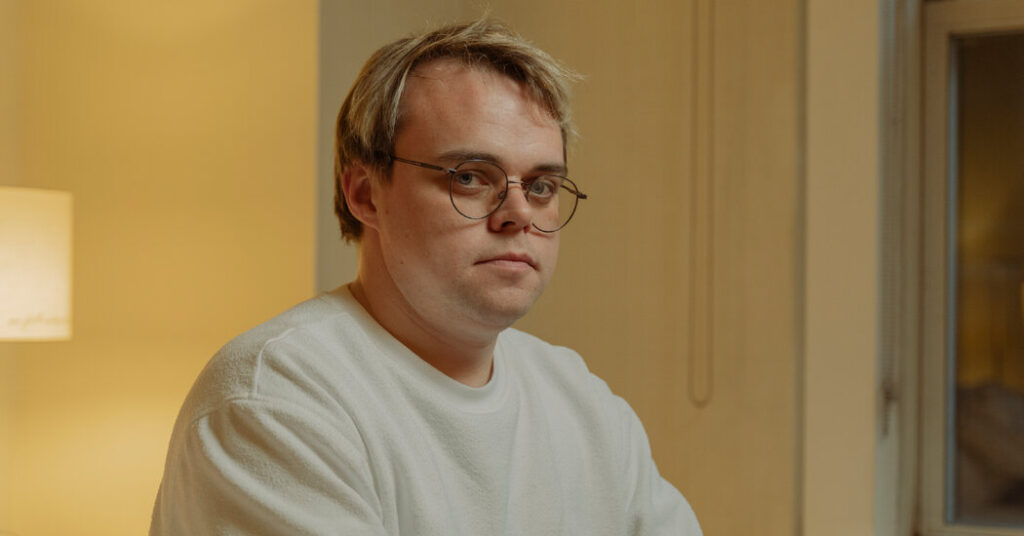
For most of his life, Pavel Talankin walked the halls of School No. 1 in Karabash, an industrial town of 10,000 in Russia’s Ural Mountains, first as a pupil, and then as the coordinator of events and extracurricular activities.
He organized holiday parties and graduation ceremonies, started a comedy club — and captured it all on video for the school’s archives. He made his office a place where students sought refuge to strum guitars, play Uno and film music videos.
“I loved this place,” Mr. Talankin, 34, said in an interview. “I loved what we were doing before the war.”
So did his students. “Usually, everyone, it seems to me, was waiting for break when we could crash into Pavel Ilyich’s office and discuss everything,” said a former student who asked not to be identified for fear of repercussions, referring to him with a respectful form of his name. “We didn’t learn lessons in that office. We learned life.”
Then in February 2022, Russia invaded Ukraine. Less than a month later, the Education Ministry introduced a new curriculum designed to inculcate the next generation to support President Vladimir V. Putin’s military ambitions.
Students competed in grenade throwing competitions. They started attending weekly patriotic lectures — in one, a history teacher said that Russians who disagreed with the government were “parasites” who should emigrate. At a school assembly, mercenaries from the Wagner paramilitary group taught students how to identify different types of mines and survive if their legs were blown off below the knee.
Mr. Talankin was ordered to film it all and upload the footage to a government database to prove that School No. 1 was in compliance with the new curriculum directives.
In a twist of fate, that footage became material for an acclaimed documentary film, “Mr. Nobody Against Putin.” It is now in the running for an Academy Award. The Russian government has acknowledged its patriotic curriculum initiative, but has publicly ignored the film.
Mr. Talankin was behind the camera when a teacher delivering a prescribed lesson stumbled over the words “denazification and demilitarization.” Mr. Putin has falsely claimed that Ukraine is run by Nazis, and that his main objective is to oust them.
“I’m just standing there filming and I understand that what’s getting into the camera isn’t just a lesson, but history,” Mr. Talankin said.
He felt uncomfortable with his role, realizing, he said, that with his camera he was serving as an enforcer, “an overseer.”
Mr. Talankin’s mother, Antonina N. Talankina, 69, also works at School No. 1, as the librarian. She said in an interview, “He was filming everything, all the time.”
She votes for Mr. Putin, her son said, but had always raised him to challenge authority. Once a year, she would take him to the local cemetery. She would tell him stories about his paternal grandparents, who wound up in industrial Karabash after being persecuted during the Stalin era, when millions were sent to forced labor camps.
He remembers gathering pillows and blankets for his mother when she camped out at the school, when the teachers were on hunger strike because they hadn’t gotten their salaries.
He went on to study film at the university in Chelyabinsk, the regional capital, 70 miles away from his town.
The war in Ukraine changed his town, his school and his job. After he saw a call on Instagram for Russians to submit stories about how their work lives had changed, he shot off an emotional, angry email. He was so disillusioned that he told the school he would resign.
But then he heard from David Borenstein, an American documentary filmmaker based in Denmark. An acquaintance had sent him Mr. Talankin’s email. Mr. Talankin cautiously agreed to send him some footage, hoping that he wasn’t being set up by Russian security services, which have been instructed to root out critics of the war in Ukraine.
The entire project hinged on “incredible trust between people who never met,” Mr. Talankin said. He decided not to quit his job at the school — yet.
He continued filming, while cooperating with the government’s decrees. He said that he was forced to share the password for the school’s social media accounts with a local government administrator. He had often posted about social events and school spirit, but the administrator posted recruitment ads for the Russian Army. Students and teachers were compelled, he said, to post government propaganda on their personal social media accounts, turning them into what he called “Kremlin bots.”
When teachers are asked to parrot Kremlin messaging, “it works,” said Mr. Talankin. Children have the same teacher from the first until the fourth grade, he said, so they have tremendous power to shape a child’s worldview.
In June 2024, shortly after the last day of school, Mr. Talankin organized one final graduation party. Then he left Russia for the first time in his life. He gave away most of his possessions.
He said he was going on a weeklong holiday in Turkey. He had a suitcase full of hard drives and no bathing suit. He had no idea where or how he would build his new life. He met Mr. Borenstein in person for the first time and saw the first cuts of the film. He was shocked to find himself featured prominently.
Mr. Borenstein said until they met, he hadn’t understood what motivated Mr. Talankin to take on such a risky project. Russians who criticize the war are regularly jailed.
“I had wondered if this was maybe his gambit to leave Russia,” Mr. Borenstein said in a phone interview. “But when I met him I discovered he was really deeply wounded about having left Russia.”
Mr. Talankin said that throughout the filming process, he thought he might need to move to a different town in Russia, but not that he would need to emigrate. He stayed in Istanbul a while, then went to Prague.
He was proud of building an archive of the Kremlin’s efforts to engineer a more militarized society.
“Sooner or later, people will ask themselves, ‘What’s going on with the Russians? Why are they all so angry and aggressive again?’ And here’s the answer, because they go to school and are told that killing is normal,” he said. “Dying for the motherland is really cool.”
Mr. Talankin’s mother remained in Karabash and faced the fallout. Trouble began before the film premiered in January 2025 at the Sundance Film Festival, where it won the Special Jury Award. At first, Mr. Talankin started receiving messages calling him a “traitor” and a “Judas.”
Within a week after the premiere, he said, the town administration had seen a bootleg copy of the film. The F.S.B. visited the school’s teachers and urged them to cut all ties with Mr. Talankin. Many did.
But he also heard from parents who were shocked at the extent of the propaganda their children were being fed. He said he received messages from teachers in the region saying they had been waiting for somebody to finally go public.
He lamented that one of the school’s recent graduates watched the film and told him he didn’t see any propaganda in it. “This was the worst comment, because it means his eyes are already accustomed to this environment.”
Ms. Talankina said that she was proud of her son, and had heard only positive feedback about the film. Still, she said, she does not talk to anyone about him, and they do not ask her about him.
“It’s taboo,” she said.
Ms. Talankina, who has never been abroad, said she did not know when she might see her son again. But she mentioned that one of his friends and classmates since kindergarten, Artyom, died in the war.
“He went to kindergarten with him, he studied in the same class with him, they graduated together” she said. “My son is abroad, but alive.” But she said that Artyom’s mother “cannot raise her son from the dead.”
When the film premiered, Mr. Talankin was stuck in Prague, waiting to receive political asylum. Without papers, he missed screening after screening. Since receiving asylum in July, he can travel and has been speaking to audiences. He is now traveling to the United States, where he thinks the message of the film is only becoming more relevant.
“It’s like a textbook, a lesson — look what awaits you if you are apolitical, if you are weak, if you give in to self-censorship,” he said.
He still doesn’t know what he is going to do next. But he won’t ever work in a school again. “Because I loved it and I had to say goodbye to all of it,” he said, “and it is very painful.”
Valerie Hopkins covers the war in Ukraine and how the conflict is changing Russia, Ukraine, Europe and the United States. She is based in Moscow.
The post How ‘Mr. Nobody’ in a Small-Town School Took on Putin appeared first on New York Times.