Who should pay for saving southern Louisiana’s endangered coastline?
The Supreme Court is set to take up a sliver of that question on Monday, as the justices hear arguments in connection with more than 40 lawsuits filed by Louisiana officials seeking to hold energy companies liable for environmental damage linked to oil and gas production, some of it dating back to World War II.
Louisiana’s Republican leaders, including Gov. Jeff Landry and Attorney General Liz Murrill, have supported the lawsuits even as they endorsed President Trump’s “energy dominance” agenda, leading to sharp criticism from the political right. At stake, potentially, are billions of dollars in damages that could be used to restore wetlands and forestall further erosion. In April, a jury awarded Plaquemines Parish near New Orleans, the state’s southernmost parish, $745 million in one of the cases.
The issue before the justices is whether the cases belong in federal court, which is seen as a friendlier venue for businesses, or before juries and elected judges in state courts. The companies, led by Chevron and Exxon Mobil, contend that they belong in federal court. They have highlighted their argument that oil companies were under federal contracts during the war, playing a key role providing aviation fuel to the United States and its allies.
The Trump administration has joined the case in support of the oil companies and will argue alongside them before the court. Only eight of the nine justices will be weighing the matter. On Thursday, Justice Samuel A. Alito Jr. recused himself, citing his financial interest in ConocoPhillips, the parent corporation of Burlington Resources Oil and Gas Company. While that company has withdrawn from the petition before the justices, it remains a party to the case in a lower court, according to a letter from the court clerk.
The parishes, which are roughly analogous to counties, that have sued argue that the cases are based on decades of illegal activity — including drilling, dredging and waste disposal without proper permits — that has accelerated coastal erosion. The cases cite a 1978 Louisiana law, the State and Local Coastal Resources Management Act, and allege that many of the violations took place after its passage.
“The challenged conduct is petitioners’ failure to obtain permits for coastal uses on or after September 20, 1980, thirty-five years after their W.W. II refinery contracts expired,” a lawyer for the parishes, Victor L. Marcello, wrote in a recent brief.
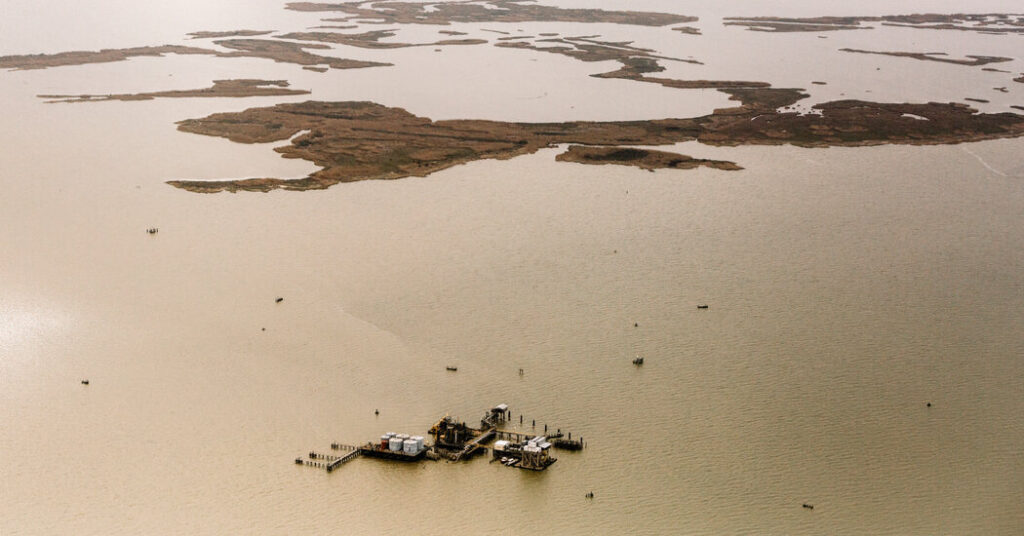
Louisiana has lost some 2,000 square miles of land since the 1930s, an area roughly equal to the entire state of Delaware. Plaquemines Parish has already been reduced by nearly half its size at that time. While global sea levels are rising because of climate change, the area is also sinking and is acutely vulnerable to storms. Levees on the Mississippi River keep New Orleans from flooding but deprive the delicate coastal ecosystem of fresh water and sediment. Canals used for oil and gas production have weakened marshes and contributed to saltwater intrusion.
The state has enacted a $50 billion coastal master plan to try to save land. Much of the money so far has come from a settlement that followed the 2010 Deepwater Horizon oil spill, but that fund is running out.
A Democratic former governor of Louisiana, John Bel Edwards, submitted an amicus brief supporting the parishes. He noted that nearly half of Louisiana’s population lives on the coast, and that the energy and seafood industries are crucial pillars of its economy. “The catastrophic land loss the state is experiencing — at a rate of one football field of coastal land every hour and a half — thus poses an existential threat to Louisiana citizens, its culture, its industrial base, and its economy,” Mr. Edwards wrote.
The justices’ decision in the Plaquemines Parish case could have broad implications for a separate batch of lawsuits filed by state and local governments against oil companies over their role in climate change. Similar questions about retroactive liability color both sets of litigation. Companies have also sought to have those climate cases removed to federal court and have asked the Supreme Court to examine the issue. So far, the justices have declined to do so.
But that could change as early as Monday, when the justices could announce whether they will hear a challenge to a Colorado Supreme Court decision allowing a case brought by Boulder to continue in state court. That suit was first filed in 2018. In May, the State Supreme Court ruled, 5 to 2, that the plaintiffs’ claims were not pre-empted by federal law, striking down a central argument that the companies have employed in their defense.
An amicus brief in the Louisiana case filed by several states discussed the parallels between the two batches of litigation. Attorney General John McCuskey of West Virginia, who signed the brief, wrote that the Louisiana case “exemplifies a vast and troubling trend: state courts positioning themselves as forums to override national policy through nuclear verdicts, onerous injunctions and more.”
Despite the broad implications, the legal question before the court on Monday is a narrow, technical point. The oil companies have claimed that the disputes should be heard in federal court because of a law known as the federal officer removal statute. That law allows federal officers and those acting on their behalf to remove legal disputes that involve their official duties from state court to federal court.
Congress has expanded the statute over the years, including with a 2011 amendment that allowed such cases to be transferred to federal court if the dispute involved actions “related to” official duties. The oil companies argue that the case fits within that definition because they extracted oil from the Louisiana coast as part of their government contracts to supply fuel during World War II.
A federal trial court judge rejected that argument, finding that the oil companies had failed to show that they extracted the oil under the order of a federal officer. The judge also concluded that the companies hadn’t shown a link between the federal contracts and the oil production at issue in the case.
A divided panel on the U.S. Court of Appeals for the Fifth Circuit, which is based in New Orleans, upheld the lower court’s decision that the cases belonged in state court, not federal, court. The majority found that the oil companies were operating under a federal officer at the time of the oil extraction, but they said that the companies had failed to show that the part of the oil production at issue in the lawsuit was related to the wartime government contracts. The Louisiana parishes objected to the companies’ crude oil production, the majority found, while the contracts dealt with oil refining.
In January 2025, the oil companies asked the Supreme Court to weigh in, asserting that the appeals court interpretation of the federal officer removal statute was too stringent, diverging from other appeals courts around the country.
The energy companies have garnered support from numerous trade associations and conservative legal figures, including William P. Barr, who served as attorney general under the first President George Bush and in the first Trump administration; and Michael B. Mukasey, who served in the same position under George W. Bush. In their brief, the pair wrote that Plaquemines Parish, with a population under 25,000, had become “a haven for trial lawyers chasing vast payouts in the name of coastal restoration.”
They also asserted that the companies could not find a fair jury there. “When it comes to assigning liability for coastal erosion in Louisiana, no local judge or jury can act as a neutral, disinterested fact-finder when there is a deep pocket sitting in the defendant’s chair responding to a lawsuit brought by the local government,” they wrote.
But Mr. Edwards, in his brief, countered that the population was “hardly hostile” to the energy industry. Louisiana is a major player in U.S. oil and gas production and handles most of the country’s liquefied natural gas exports.
Prof. Keith B. Hall, director of the Energy Law Center at Louisiana State University, said the question before the court was more technical than ideological. Some conservative justices might be inclined to interpret the federal officer category broadly, particularly since the 2011 amendment that expanded its definition. But there are also conservative philosophies that stress respect for state court jurisdiction.
“I don’t think it’s clear what the ideological divide would suggest,” Professor Hall said.
Karen Zraick covers legal affairs for the Climate desk and the courtroom clashes playing out over climate and environmental policy.
The post Supreme Court to Hear Case on Louisiana’s Eroding Coast appeared first on New York Times.