The episodes described in the indictment are vivid, even cinematic.
There is Nicolás Maduro, Venezuela’s president, selling false passports to narco-traffickers, who used their diplomatic cover to ferry a planeload of drug money out of Mexico. There’s Mr. Maduro and his wife ordering a hit on a drug boss in Caracas.
And there’s Mr. Maduro scolding officials foolish enough to place 1.3 metric tons of cocaine worth at least $67 million on a commercial flight to Paris, where it was promptly seized. Mr. Maduro, prosecutors said, soon authorized the arrests of Venezuelan military officers as a diversion from his own involvement in the fiasco.
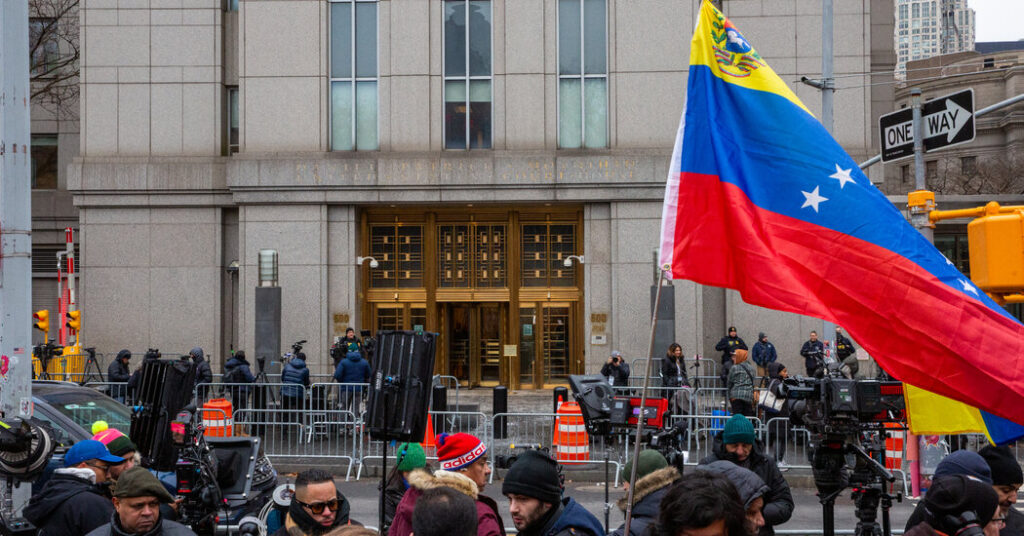
These vignettes from the federal indictment of Mr. Maduro, which paint him as a crucial actor in the drug trade, belie the complicated nature of the case against the Venezuelan autocrat, who was captured by the U.S. military this month. Federal prosecutors in Manhattan will have to fight through a thicket of complex legal issues and muster evidence from an unruly set of cooperating witnesses about incidents shrouded in secrecy and clouded by time.
And they will have to do it all while contending with a White House prone to intervention in Justice Department business, which could complicate — or upend — the whole affair.
The two key charges against Mr. Maduro accuse him of interlocking conspiracies: one to commit narco-terrorism and the other to import cocaine. The first charge effectively means prosecutors must prove that Mr. Maduro joined with terrorists in a conspiracy to deal in narcotics. The second focuses more specifically on drug trafficking. Mr. Maduro has pleaded not guilty to both charges, and to two other counts.
“This is a tough case,” said Jeffrey Brown, a former Manhattan federal prosecutor who worked on international drug cases. “The terrorism dimensions of it are harder than the narcotics dimensions.”
But, he said, the Manhattan federal prosecutor’s office “is the best-suited office to make this type of case,” given its vast experience. The agency, the U.S. attorney’s office for the Southern District of New York, also has a close relationship with the Special Operations Division of the Drug Enforcement Administration, which was deeply involved in the investigation, as were agents from the Department of Homeland Security.
The case began years ago, and Mr. Maduro was originally indicted in 2020. In fall 2025, months before Mr. Maduro’s capture, Justice Department officials in Washington told Southern District prosecutors to prepare a new indictment against the Venezuelan leader, according to two people with knowledge of the matter who requested to speak anonymously to discuss details of the process.
In contrast to the previous indictment, the new one asserts that Mr. Maduro worked with a rogues’ gallery of Latin American narco-trafficking groups, several of which have been the intensive focus of the Trump administration.
Of the five groups mentioned, three — the Sinaloa Cartel, the Zetas and Tren de Aragua — were designated as terrorists last year, shortly after President Trump returned to Washington. Mr. Trump and his allies often use the word “terrorism” to describe adversaries foreign and domestic, but the word also has a formal, legal definition that prosecutors will have to meet.
Their difficulty may come in convincing a jury that Mr. Maduro was connected to the narco-trafficking groups, a subject on which the indictment says little of substance. Prosecutors will almost certainly rely on cooperating witnesses who will recount crimes; some in the indictment date back more than 20 years. They may have to do so without the documentary evidence that often corroborates such testimony, including financial records or wiretap recordings.
“Witnesses that participated in this investigation may be dead, they may be lost, whatever the case may be,” Mr. Brown said. “The further you go back in time to rely on proof to support your case, the more problems you have.”
Another issue may involve explaining to a jury the complex nature of Mr. Maduro’s involvement in the cocaine trade.
At a cursory glance, the indictment portrays the Venezuelan president as a kingpin. A closer look reveals far more careful characterizations. The indictment does not say that drugs were Mr. Maduro’s primary source of income, but merely one aspect of multifaceted illegal activity that he “leveraged government power to protect and promote.”
Anirudh Bansal, a former chief of the Southern District’s International Narcotics Trafficking Unit, said that often the case that prosecutors actually present at trial “is much narrower” than the initial indictment.
Prosecutors do not need to prove an indictment’s every detail, he said — including allegations that officials might have highlighted in news conferences and interviews.
A downside, Mr. Bansal said, is that a smart defense lawyer will exploit differences between the indictment and the evidence presented at trial, telling jurors they should doubt the government’s case.
Others said that the White House’s involvement could add another hurdle. The president’s public statements, for example, could be targeted by defense lawyers. Mr. Trump has said that Mr. Maduro sent “hundreds of thousands” of members of Tren de Aragua to the United States, but those allegations were not reflected in the indictment and are unlikely to show up at any trial.
It is unclear how closely the administration will supervise what is likely to be a yearslong prosecution that could easily outlive Mr. Trump’s second term. Top officials have been far more focused on Venezuela’s future — and its oil — than the fine points of the legal case against him.
Shane T. Stansbury, a former Southern District prosecutor who is now a law professor at Duke University, said another challenge for the government was Mr. Maduro’s status as both an accused member of a drug-trafficking conspiracy and a former head of state.
“It’s likely there’s a lot of information that the intelligence community has gathered over the years that will be relevant to prosecutors,” he said, “but that also might be of interest to a savvy defense attorney.”
The handover of that information will be time-consuming, particularly given that much of it will likely be classified, which could trigger a lengthy review process.
Prosecutors have a lot going for them, too.
The Manhattan U.S. attorney’s office pioneered the use of narco-terrorism charges. And in 2002, it created an international narcotics unit, globalizing a strategy that had been used successfully against organized crime in the United States.
“We needed to dismantle entire organizations, not just the U.S.-based cells,” Judge Richard J. Sullivan, who as a prosecutor helped devise the unit, told The New York Times years later.
In addition, the conspiracy statutes are extremely powerful, and prosecutors do not need to convince the jury of every episode listed in the indictment to meet the burden of proof.
Scott Kalisch, a defense lawyer who has represented witnesses in similar investigations, said that such charges let prosecutors paint a broad picture of a criminal group without requiring them to show how each individual was connected to other members of the conspiracy. Mr. Kalisch, who often represents Latin American clients, said that many believed that they had to be caught in the act to be prosecuted.
“That’s the way they understand the law in South America,” he said. “But in the United States, they have this.”
Defense lawyers say that jurors are often wowed by the stories from witnesses of the exotic and violent world of narcotics trafficking and skepticism falls by the wayside.
César de Castro, a former state prosecutor turned defense lawyer, said that representing clients in conspiracy cases, particularly foreign government officials, was difficult because the allegations typically span years, forcing defense lawyers to comb through piles of irrelevant evidence.
Then, he said, “the government will trot out these so-called insider-accomplice cooperating witnesses that will tell fanciful tales of the conspiracy in unbelievably precise detail worthy of a Netflix series, and the government is not required under federal law to corroborate that testimony. And the juries eat it up.”
Jonah E. Bromwich covers criminal justice in the New York region for The Times. He is focused on political influence and its effect on the rule of law in the area’s federal and state courts.
The post Prosecutors’ Vivid Accusations Against Maduro Belie a Complex Case appeared first on New York Times.