BERLIN — A seemingly routine disruption of city life — large swaths of southwest Berlin plunged into icy darkness by a power outage — is now being investigated as a potentially far more sinister case of sabotage and has set off warnings about the vulnerability of Germany’s infrastructure.
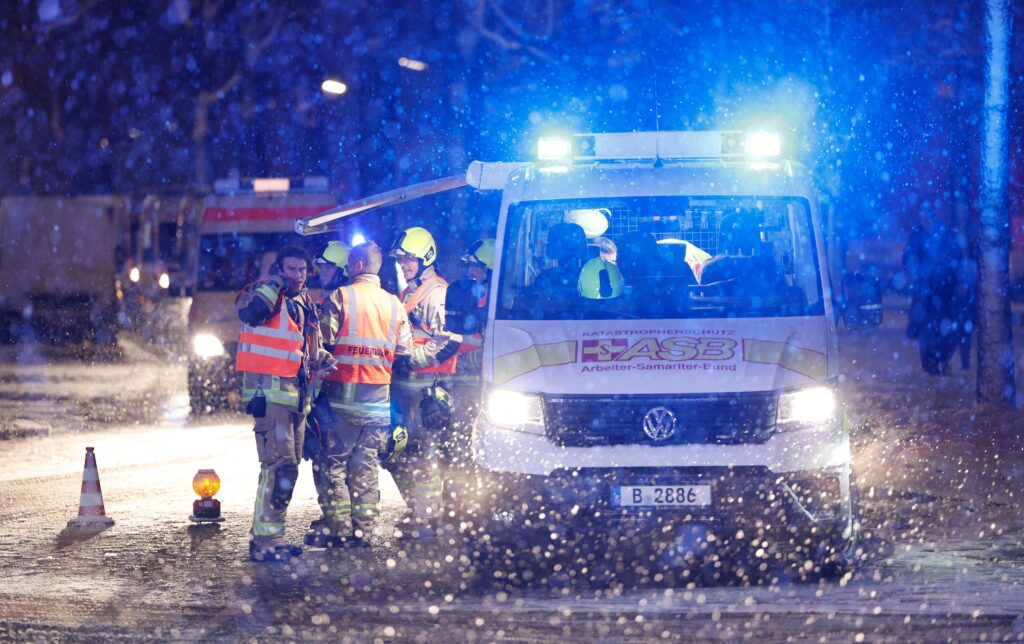
As January temperatures dropped into the teens, about 100,000 people in roughly 45,000 households were left without electricity or heating beginning last Saturday. Hospitals and care facilities switched to emergency generators. Public transportation slowed or stopped altogether.
By Wednesday, when power was fully restored, the blackout had become the longest in the German capital since the end of World War II, and authorities say it was caused deliberately — by an arson attack on a small bridge carrying bundled power cables across the city’s Teltow Canal.
On Sunday, a group calling itself the Vulkangruppe, or Volcano Group, which is described by authorities as a left-wing extremist organization, claimed responsibility.
The bridge, visible on publicly available satellite images, sits in a secluded location, where a fire could be set without immediate detection.
Security experts warned that if small-time saboteurs could disrupt electrical service for a large portion of the capital, the nation’s power grid and other critical infrastructure could be at risk of coordinated attacks by state actors such as Russia.
“We short-circuited the charred cable strands with steel bars lying around,” the Vulkangruppe wrote in a statement, framing the attack as a strike against the “climate-damaging gas industry” and data centers used for artificial intelligence, which it called “nothing more than gigantic, energy-guzzling data centers and server farms.”
The Vulkangruppe, which is believed to be a collection of several organizations, has long been known to Germany’s domestic intelligence, though its membership remains a mystery. In early 2024, the Vulkangruppe also claimed responsibility for an arson attack that halted production at a Tesla factory south of Berlin.
In Berlin this week, some residents had fled their darkened homes to stay in hotels, with relatives or in shelters. As they returned Wednesday and Thursday, some experts expressed renewed concerns about Germany’s exposure to attacks on its infrastructure — particularly sprawling networks such as power lines, railways and pipelines that experts say are impossible to guard in their entirety.
The overall risk to Germany’s infrastructure is higher than it was a decade ago, experts say — because of both geopolitical tensions and domestic extremism.
In recent years, fires set along railway lines have repeatedly disrupted train service. Left-wing extremist groups have also claimed some of those attacks. They typically frame their actions around opposition to capitalism, fossil fuels and state authority, focusing on transportation, energy or industrial sites they see as symbols of systemic harm. Authorities say the acts are intended to disrupt daily life and draw attention to ideological causes, but pose serious safety risks and economic consequences.
German security officials also warn that a series of suspicious incidents in recent years point to a heightened risk of Russian sabotage targeting critical infrastructure. Although definitive proof is often elusive, authorities describe the pattern as part of a broader hybrid campaign to destabilize Germany.
The danger to Germany’s infrastructure is not new, said Christian Rehtanz, a professor of energy systems at Dortmund Technical University.
“There have always been such threats,” Rehtanz said, pointing to left-wing terrorism by the Red Army Faction in the 1970s and today’s mix of activists and foreign actors.
For the latter, as Europe’s largest economy and home to the arms manufacturing giant Rheinmetall — a key player in Europe’s ambitions to rearm — Germany may be an especially attractive target. “Every attack, no matter what it is, is always an attempt to strike at a critical point. Germany is at the heart of Europe, so the aim is to cause as much damage as possible,” he said.
In Germany, as across much of Europe, extensive use of underground cabling makes infrastructure less accessible than in countries such as the United States or India, where more lines run above ground.
The greater challenge, experts said, lies in identifying and fixing specific weak points — a process that can take years or decades. Parts of Berlin’s power grid still rely on oil-filled cables that are up to 80 years old.
But physically protecting every component of the network is proving to be neither realistic nor affordable. Fences, cameras and patrols offer limited deterrence — and do little against emerging threats such as drones or cyberattacks, which have become a growing concern as operators seek to protect the digital systems that control physical infrastructure.
Instead, resilience depends on redundancy and preparedness — ensuring that alternatives are available when something fails, Rehtanz said.
When locals were forced to leave their freezing cold homes this week, the German Red Cross (DRK) was one of several organizations that helped coordinate shelter and food at school gyms and community centers. Now, it’s calling for improved civil protection measures.
The power outage demonstrates “how vulnerable critical infrastructure is and the importance of protecting the population,” DRK President Hermann Gröhe told the German media group RND.
Normally, during a power outage, damage to one cable would trigger an automatic switch and power would be restored from another direction in minutes. But the site of this week’s arson attack was an unusual weak point, because of the routing of multiple cables together above ground.
While German authorities have said they find the Vulkangruppe’s claim of responsibility credible, some commentators have suggested Russian involvement, citing Europe’s heightened alert since Moscow’s full-scale invasion of Ukraine in 2022 and fears of “hybrid warfare” blending cyberattacks, disinformation and covert sabotage.
Some have cited linguistic clues in the letter claiming responsibility, suggesting it may have been translated from Russian. But officials have presented no public evidence linking the outage to Moscow.
“Sabotage of infrastructure is part of the repertoire of both Russia and far-left groups, but a far-left motive is currently very likely in the case of the Berlin power outage,” said Johannes Hillje, a political consultant and expert on far-right populism. “The letter claiming responsibility appears authentic.”
Hillje added: “There is currently no evidence of masterminds or other perpetrators. However, we are in the midst of a hybrid war waged by Russia against Germany, so we should not prematurely rule out this connection.”
Confusion over who was behind the sabotage only grew after alleged members of the Vulkangruppe posted a letter Tuesday rejecting the suspicions that Russia was behind the arson attack — only to be followed by a third letter a day later in which someone claiming to represent the original Vulkangruppe, dating to 2011, insisted they had no involvement in the recent attacks.
In Berlin, the blackout quickly became a political issue ahead of state elections this fall.
Mayor Kai Wegner of Chancellor Friedrich Merz’s center-right Christian Democratic Union drew fire from other parties — particularly from the nationalist Alternative for Germany (AfD) party — after he acknowledged that he had played tennis a few hours after the blackout started.
“It’s quite possible that the AfD will benefit from the power outage, as many citizens are angry about the city’s crisis management,” Hillje said. “This crisis management will certainly have an impact on the elections in Berlin this fall.”
The post Berlin power outage exposes vulnerabilities in German infrastructure appeared first on Washington Post.