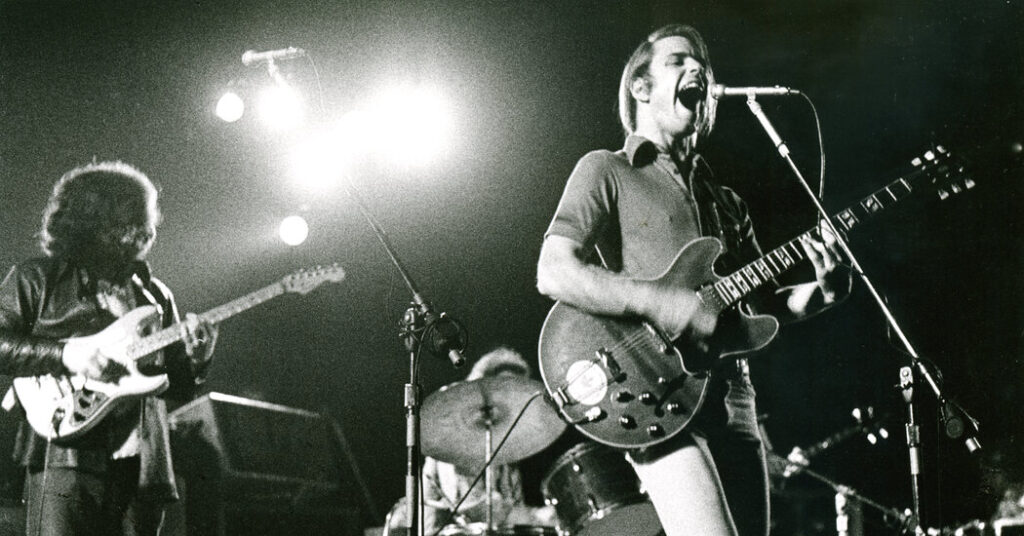
As the youngest member of the original Grateful Dead, Bob Weir was often branded the spacey kid trying to keep up with his more experienced elders, especially the guitarist Jerry Garcia and the bassist Phil Lesh. But as the years went on, Weir proved he was more than just the rhythm guitar player with the ponytail.
Equally devoted to cowboy story-songs as much as he was to zigzagging melodies, Weir, who died at 78, was a creatively restless soul who helped flesh out the Dead’s music in multiple ways.
Here are 10 of his most notable performances, with and without the Dead.
Grateful Dead, ‘Sugar Magnolia’ (1970)
Weir had sung lead with the Dead before this, including on 1968’s “Born Cross-Eyed.” But this excitable ode to his partner at the time, Frankie Weir, was where he came into his own within the band. Played with a galloping energy, and sung so earnestly that it summoned an innocent, tie-dyed bliss, “Sugar Magnolia” also showcased the earthiness Weir could bring to the Dead.
 Listen on Spotify, Apple Music or YouTube
Grateful Dead, ‘Truckin’’ (1970)
With its lyrics by Robert Hunter and music written by Garcia, Weir and Lesh, the slippery shuffle “Truckin’” was a group effort all around. Hunter’s lyrics take the listener on a tour of various Dead misadventures, including a bust in New Orleans, but it’s Weir’s disbelieving delivery on the verses — navigating tricky couplets like “Arrows of neon and flashing marquees out on Main Street” — that is the glue that holds the song together.
Listen on Spotify, Apple Music or YouTube
Grateful Dead, ‘The Other One’ (1971)
One of the earliest showcases for Weir’s voice, “The Other One” was originally part of the spiraling, multipart “That’s It for the Other One” off the Dead’s 1968 album “Anthem of the Sun.” The lyrics — some of the few Weir wrote for the Dead — also provided a glimpse into his early life with the band, from hooking up with the Merry Pranksters to dousing a cop with a water balloon. Spun off on its own (as heard here on the band’s 1971 live album, “Grateful Dead”), “The Other One” also proved that Weir could adapt to the twistier melodies that were part of the Dead’s repertoire.
Listen on Spotify, Apple Music or YouTube
‘Looks Like Rain’ (1972)
Each member of the Dead brought a different musical passion into the fold; among Weir’s was a love of country music and cowboy songs. On his first solo album, “Ace,” he and his longtime lyricist-friend John Perry Barlow took a shot at their own high-and-lonesome ballad, with magnificent results. One of the most emotional and nakedly vulnerable songs in Weir’s or the Dead’s catalog, “Looks Like Rain” is as majestic as a mountain top.
Listen on Spotify, Apple Music or YouTube
Grateful Dead, ‘Playing in the Band’ (1972)
A collaboration between Weir, Hunter and the drummer Mickey Hart, this Dead standard put the spotlight on Weir’s charged voice; here, he truly sounds in command of the band. In live versions, like this one from the band’s “Europe ’72,” it also shines a spotlight on the unique interplay between Garcia’s spiraling leads and Weir’s radical and unconventional approach to guitar, which dispensed with traditional rhythm patterns for choppier and less predictable parts.
Listen on Spotify, Apple Music or YouTube
Grateful Dead, ‘The Music Never Stopped’ (1975)
With Weir and Garcia’s guitars locked in, this funky boogie off the Dead’s “Blues for Allah” album became the Dead’s inadvertent addition to the bluesy Southern subgenre known as swamp rock. Anyone else would have sung Barlow’s paean to the power of song (“Keep on dancing through to daylight / Greet the morning air with song”) with a wink, but Weir’s utterly guileless singing is very much in keeping with his contributions to the band.
Listen on Spotify, Apple Music or YouTube
Kingfish, ‘Lazy Lightnin’’ (1976)
Weir played this song with the Dead often, but the first version — cut with the band Kingfish during the Dead’s mid-70s hiatus — brings out the supple yelp in his voice and the increasingly unconventional chord changes in his songs.
Listen on Spotify, Apple Music or YouTube
Grateful Dead, ‘Estimated Prophet’ (1977)
Is the narrator of this Weir-lead song on the Dead’s “Terrapin Station” a prophet or a madman? Weir sings it in such a stern, unwavering manner that it’s hard to say, and the band’s blend of prog and reggae behind him only deepens the song’s mystery and allure. The Dead’s performance of it during their fabled show at Cornell University in 1977 is also a must-hear.
Listen on Spotify, Apple Music or YouTube
Grateful Dead, ‘Hell in a Bucket’ (1987)
The most carousing rocker Weir ever tackled, with the Dead or anyone else, “Hell in a Bucket” is something of a hellscape in and of itself, full of bikers, breakups and resentment (“There may come a day, I will dance on your grave / If unable to dance, I will crawl across it”). Putting aside his ballad voice, Weir matched those lyrics with a delightfully indignant growl.
Listen on Spotify, Apple Music or YouTube
‘Only a River’ (2016)
If Weir conjured young ranch-hands in some of his earlier songs, “Only a River” sounds like a lullaby to a weathered cowboy on his last cattle drive. The opening track off “Blue Mountain,” the last studio solo album he made, it remains one of his most evocative songs.
Listen on Spotify, Apple Music or YouTube
The post Bob Weir: 10 Essential Songs appeared first on New York Times.