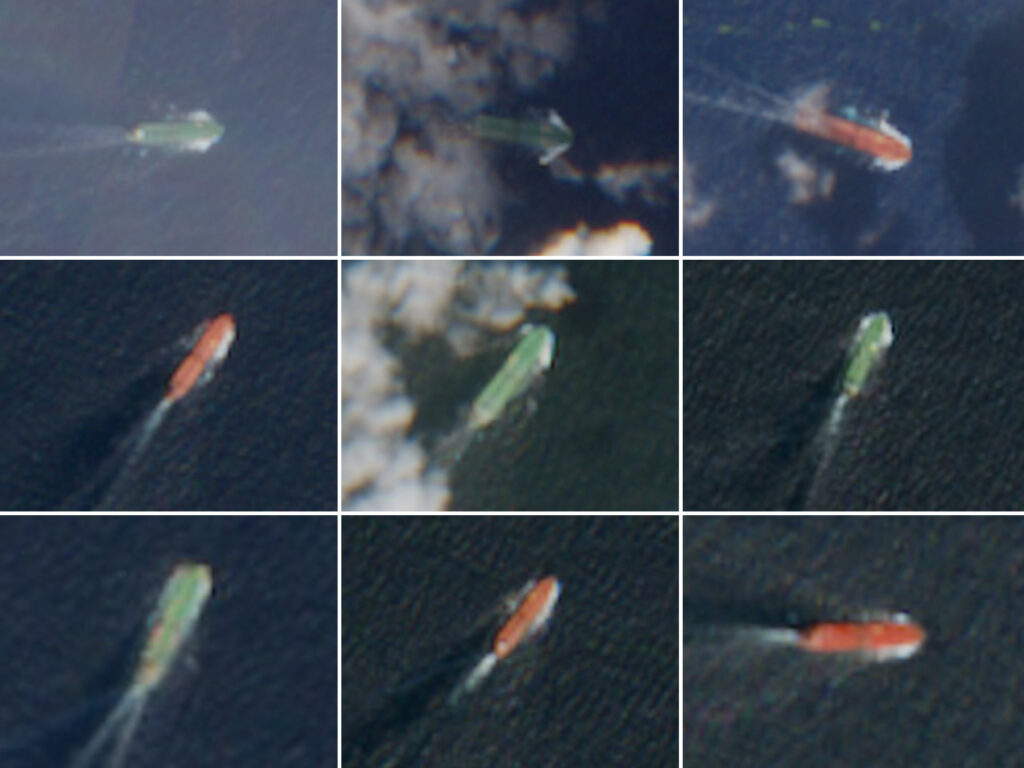
At least 11 oil tankers under U.S. sanctions were spotted this week well beyond Venezuelan waters, according to satellite-imagery analysis, having fled the maritime blockade that President Donald Trump imposed as part of the administration’s pressure campaign against the government there.
Six of the tankers were in the Caribbean Sea but had moved at least 70 miles from the Venezuelan coast; one of those ships was seized on Friday. Three others had traveled more than 450 miles into the Atlantic Ocean and, according to one analyst, were being distantly trailed by what appears to be a U.S. Navy ship.
A 10th tanker was spotted off Grenada, and an 11th off Colombia’s coast. According to the official Russian Register of Ships, that last tanker recently adopted the Russian flag.
The ships are among 16 tankers under sanctions that were seen near Venezuelan ports after the blockade took effect in December but that later went missing. Several of them were spotted earlier this month, appearing to attempt to leave.
Trump administration officials have described the blockade on all oil tankers under U.S. sanctions entering or leaving Venezuela as a key avenue for applying pressure on Venezuela’s interim government. Secretary of State Marco Rubio has said the “quarantine” gives the United States “the strongest leverage possible” with Delcy Rodríguez, who has been leading the country since the capture of Nicolás Maduro.
The 11 tankers — all but one apparently carrying oil — collectively are carrying an estimated 9.4 million barrels of oil, according to TankerTrackers.com, an independent oil-tracking firm that measures how high a vessel is above sea level to determine its load.
The firm provided some of the satellite analysis for this article. Other analysis was provided by Ollie Ballinger, a lecturer in geocomputation at University College London’s Center for Advanced Spatial Analysis. The Washington Post examined reference images of the ships to confirm the analyses.
Two of the ships that have steamed more than 450 miles — the Panamanian-flagged Veronica III and Cook Island-flagged Bertha — are subject to U.S. sanctions on Iran, and the third, the Panamanian-flagged Aquila II, is subject to sanctions targeting Russia, according to the Treasury Department’s Office of Foreign Assets Control.
Ballinger said a ship that appears to be the USS Lake Erie, a guided-missile cruiser in the Caribbean, was near the island of Saint Vincent on Monday and steaming east toward the three tankers, having traveled more than 300 miles in two days. The following day, the tankers were spotted several hundred miles east of that location.
Ballinger’s analysis, which applies machine learning to compare images of ships over time, resulted in a high-probability match. The Post was not able to confirm that the vessel in satellite imagery was the Lake Erie, and U.S. officials declined to comment on its location.
In response to questions about the Lake Erie, a U.S. official who spoke on the condition of anonymity said “the quarantine is in effect focusing on sanctioned shadow vessels transporting sanctioned PDVSA oil.”
The Lake Erie was deployed to the Caribbean in late August as part of an initial surge of warships to the region as Trump administration officials said they were evaluating plans for using military force against drug cartels. It was still in the Caribbean as of Thursday, an official familiar with the matter said.
On Thursday, the New York Times reported that a U.S. Navy vessel was chasing several oil tankers that are under sanctions in the Atlantic but did not name the ship. The Times also reported on the locations of most of the ships that are now known to have escaped the blockade.
It is unclear whether the tankers are acting independently or in coordination with the Venezuelan government.
The ships’ apparent success in skirting the blockade — while carrying hundreds of millions of dollars worth of oil — raises questions about the effectiveness of the blockade, said Gregory Brew, an international energy analyst with the Eurasia group.
“If this is a tool that the U.S. wants to use to maintain a degree of control or influence over Caracas, it’s a tool that they have to demonstrate can be used effectively and consistently,” Brew said.
Another analyst said the number of ships that have gotten through is probably an indication of how many shipowners are willing to take extraordinary risks.
“It’s very difficult to have a 100 percent blockade,” said Jorge Leon, the head of geopolitical analysis for Rystad energy, a research and consultancy firm.
He said a blockade largely aims to deter defiance through seizures and other shows of force.
The White House did not respond to a request for comment about the analysts’ claims. On Friday, a Pentagon spokesman posted on X that in the previous 24 hours “at least seven ‘dark fleet’ oil vessels have turned around to avoid interdiction.” The Pentagon did not immediately respond to inquiries seeking details about the ships he was referencing.
U.S. forces on Wednesday seized two ships, separate from the vessels that were spotted this week in satellite imagery. A ship called the Sophia was seized near the Caribbean Sea. The U.S. military said the vessel was “conducting illicit activities” in international waters.
A Russian-flagged tanker called the Marinera was apprehended near Iceland after a weeks-long pursuit across the Atlantic. The seizure was condemned by Moscow, which said, “No state has the right to use force against ships properly registered in the jurisdictions of other states.”
The ship spotted this week near Colombia that changed its flag is called the Lydya N. Analysts say some ships that have in the past flown under false flags or attempted to conceal their movements have lately adopted the Russian flag as an effort to discourage boarding without Russian approval and thus avoid interdiction.
Evan Hill in Buffalo and Dan Lamothe in Washington contributed to this report.
The post 11 tankers under U.S. sanctions defy blockade in Venezuela, satellite imagery indicates appeared first on Washington Post.