ISTANBUL — Protests in Iran continued through Saturday despite threats from the country’s supreme leader that he would expand the government’s crackdown on demonstrators.
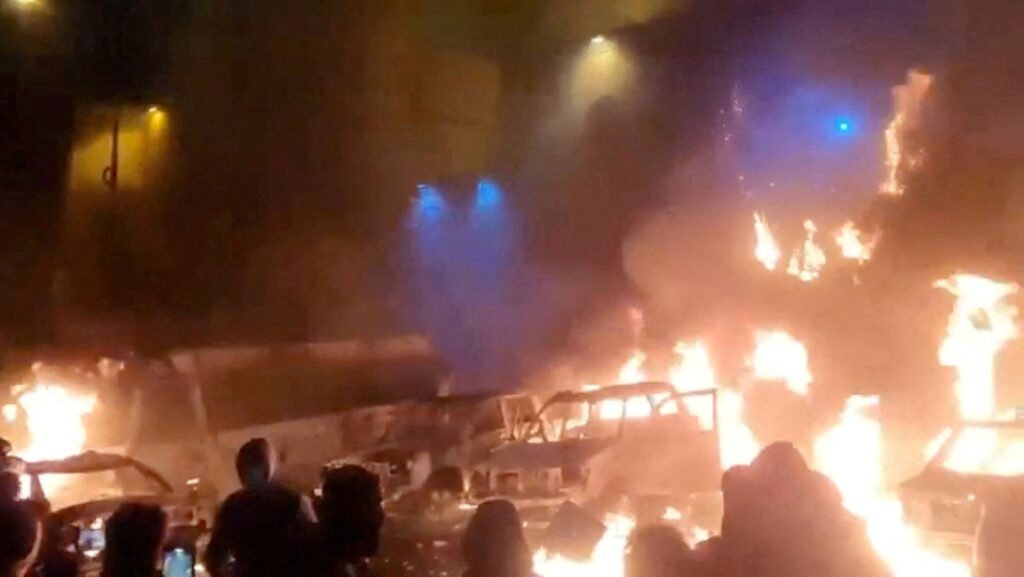
Though details remain scarce due to a severe communications blackout, videos shared by Persian-language news outlets based abroad, including BBC Persian and Radio Farda, on Friday and Saturday showed huge crowds in cities including Tehran, Mashhad and Yazd, chanting for an end to the Islamic Republic and praising Iran’s deposed monarchy. Some videos from Tehran showed buildings set on fire.
The internet monitoring group NetBlocks said Saturday that the internet shutdown had reached 48 hours and counting, and Filterbaan, a digital rights group that focuses on Iran, said international phone calls were being blocked. Iranians in the diaspora reported being unable to reach loved ones inside the country.
The weekend gatherings were the latest development in a series of protests and strikes that began nearly two weeks ago with merchants in Tehran whose businesses have been wrecked by the recent depreciation of the Iranian rial, but quickly spread across the country and to diverse social groups.
Demonstrators’ slogans have demanded a fundamental change to their political system. Several of the videos from Friday evening showed people holding the flag of Iran’s monarchy, deposed in the 1979 Islamic revolution, and one showed a man spray-painting a pro-monarchy slogan onto a large city billboard in Tehran.
Iranian President Masoud Pezeshkian on Saturday said that his government “is using all its strength to improve people’s livelihoods by removing the foundations for rent-seeking, bribery, and corruption,” while also fighting a “full-scale economic war with a foreign enemy.”
In remarks to a governing body of the Islamic Republic that were published by Tasnim News, an outlet affiliated with the Revolutionary Guard, he accused “certain media currents and holders of official platforms,” whom he did not identify, of obstructing his government’s work.
The marches Friday came after a speech by Iran’s supreme leader, Ayatollah Ali Khamenei, who said the government would not “back down” in the face of what he called “vandals.” On Iranian state television, a host warned people to stay at home and said if someone is shot, they should not complain.
Estimates of the death toll so far have varied. Amnesty International and Human Rights Watch said they had confirmed the deaths of 28 protesters and bystanders, including children, between Dec. 28 and Jan. 3. Other groups reported larger figures that they said included more recent information, like the Human Rights Activists News Agency, which said on Friday that at least 65 people had been killed.
The internet and communications shutdown “is extremely alarming: the regime typically does this as a preface to the mass slaughter of protesters,” the Center for Human Rights in Iran said in a statement on Friday. The group urged major tech companies to urgently seek to provide internet to Iranians.
CHRI said it had received credible firsthand reports of hospitals in Tehran, Mashhad and Karaj filled with injured protesters. Radio Farda published audio from someone it said was an eyewitness to protests in Kerman province, saying that he had heard hundreds of instances of gunfire Friday evening.
On Friday, President Donald Trump again threatened to hit Iran if it kills protesters, saying “we’ll start shooting, too” and that “if they start killing people like they have in the past, we’ll be hitting them very hard where it hurts.” Secretary of State Marco Rubio wrote early Saturday that “the United States supports the brave people of Iran.”
On Saturday, the foreign ministers of Australia, Canada and the European Union issued a joint statement in support of the protesters.
“We commend the bravery of the Iranian people as they stand up for their dignity and their fundamental right to peaceful protest,” they wrote. “We strongly condemn the killing of protesters, the use of violence, arbitrary arrests, and intimidation tactics by the Iranian regime against its own people.”
Iranian authorities have long sought to discredit internal dissent by linking it to Iran’s “enemies” abroad, and though they initially acknowledged some of the demonstrators’ demands as legitimate, they have increasingly turned to portraying them as “rioters.”
Tasnim, an Iranian outlet affiliated with the Islamic Revolutionary Guard Corps, reported on Saturday that 100 armed “rioters” had been arrested in a locality near the capital, Tehran.
In Beirut on Friday, at a talk organized by the newspaper Al-Akhbar, which is supportive of the Iranian-backed Lebanese militant group Hezbollah, Iranian foreign minister Abbas Araghchi said Pezeshkian had from the beginning of the protests launched “serious talks” with people from different segments of Iranian society.
“He started negotiations with the private sector and the head of the chamber of commerce and the heads of the Iranian unions, and things were on the right track until we found out there was direct intervention by foreigners inside Iran, and we found that these protests again surged,” Araghchi said at the talk, in response to questions about the protests.
In a video message on Saturday, exiled former crown prince Reza Pahlavi, who had issued the calls for protest on Thursday and Friday, again asked Iranians to take to the streets over the following two days, and called for workers in key sectors including oil and gas to begin a nationwide strike.
Mohamad El Chamaa in Beirut contributed to this report.
The post Iran on edge as protests spread — and government threats grow appeared first on Washington Post.