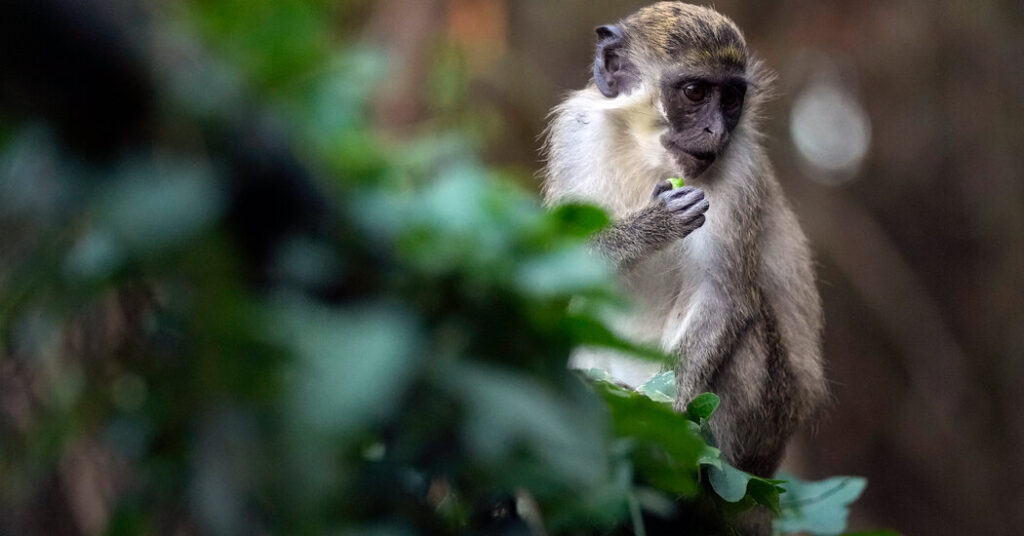
An unknown number of monkeys — as many as four but certainly more than one — are on the loose in St. Louis, according to local officials, who urged anyone who spotted one of the primates to report its location to the city’s animal control department.
The city became aware of the loose monkeys on Thursday, said Erin Ford, a spokeswoman for the city’s Health Department. The monkeys, which a primate expert from the St. Louis Zoo identified as vervet monkeys, were spotted near O’Fallon Park, in North St. Louis, the Health Department said in a statement.
“Original reports suggested there were four animals, but we cannot confirm an actual number at this time, only that there is more than one,” Justen Hauser, bureau chief of environmental health for the Health Department, said in a statement.
An animal control officer searched the area around O’Fallon Park on Thursday but did not find any of the monkeys, Mr. Hauser said. More sightings were reported and officers continued the search on Friday but had no luck, he said.
“We are working to get an idea of where they may be hiding or seeking food,” Mr. Hauser said. “Once captured, the monkeys will be transported to a facility certified to care for exotic animals.”
It was not immediately clear where the monkeys came from. It is against city ordinance to own exotic animals, Mr. Hauser said.
Vervet monkeys are common in East Africa and weight about six to 11 pounds, according to the African Wildlife Foundation. The monkeys are sometimes viewed as pests because they steal food and other items, according to the foundation.
“They are very intelligent and social, but may be unpredictable or aggressive under stress,” Mr. Hauser said.
It is unusual, but not without precedent, for vervet monkeys to roam free in the United States, which does not have a native monkey population. A wild colony of the monkeys has lived in Dania Beach, Fla., south of Fort Lauderdale, since the late 1940s, after a dozen that had been brought from West Africa fled a breeding facility and roadside zoo, according to The Associated Press. A 2020 census found that 40 descendants of those monkeys remained in Dania Beach, The Daytona Beach News-Journal reported.
Occasionally, monkeys escape from zoos, research facilities and transport trucks. In October, 21 rhesus monkeys escaped from an overturned tractor-trailer in Mississippi. Sheriff’s deputies shot and killed five of the monkeys after the truck driver mistakenly told them that the primates were infected with Covid-19, hepatitis C and herpes when they were not, the authorities said at the time.
Rylee Kirk reports on breaking news, trending topics and major developing stories for The Times.
The post Monkeys Are on the Loose in St. Louis, City Officials Say appeared first on New York Times.