In the United States, the term bird flu has become synonymous with a particular virus that has devastated poultry and dairy farms over the past few years. But that virus, called H5N1, is not the only form of bird flu in circulation.
Concerned scientists are keeping a close eye other types, including a fast-changing flu virus called H9N2.
In a study published in November, researchers in Hong Kong showed that over the last decade, this virus has acquired mutations that allow it to spread more efficiently among people and to cause more severe disease.
H9N2 is often discounted as a threat, because it causes only mild symptoms in poultry. But in people, especially children, the virus can cause more severe illness than the seasonal flu.
There have been fewer than 200 reported cases of H9N2 in humans since 1998, but the number has been rising sharply. China reported 29 human cases of H9N2 last year, compared with 11 in 2024.
Those numbers, though, are likely to be underestimates, because many infected people are never tested and the virus may spread undetected, Dr. Kelvin To, a clinical microbiologist who led the November study, said.
“If it continues to be widely circulating in poultry, mammals and humans, it may certainly one day evolve into something very serious,” Dr. To said.
Researchers like Dr. To have long feared that the next pandemic will be caused by a flu virus, and the new report suggests that mutating H9N2 bears watching. But it is not the only one.
H5N1 is “the headline stealer,” said Richard Webby, an influenza expert at St. Jude Children’s Research Hospital in Memphis. It has infected poultry and mammals worldwide, leaving behind economic devastation.
But, he added, “some of these other subtypes may have just as much, if not more, capacity for human infection and spread than H5N1.”
In September, health officials in Mexico identified the first human infection of a highly pathogenic bird flu virus called H5N2. The patient was severely ill and hospitalized, but survived.
And in November, a resident of Washington State died of an infection with another type, H5N5, the first human known to have contracted the virus. H5N5 tends to circulate among birds along the Atlantic Coast, so its presence in the West surprised some scientists.
In the United States, H5N1 continues to be the primary threat. The virus is reported to have infected 71 people, killing one, and has affected nearly 185 million commercial, backyard and wild birds since January 2022, when it was detected in wild aquatic birds in the United States.
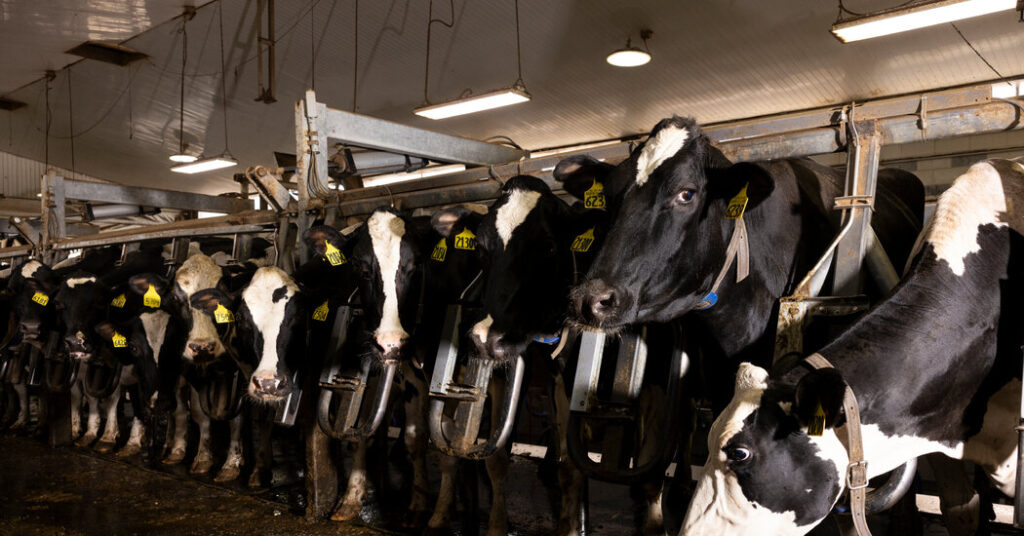
Since March 2024, when the first dairy cows were found to be infected, H5N1 has also been detected in 1,084 cattle herds in 19 states. The longer H5N1 persists, infecting animals and birds across the country, the greater are the chances are that it will evolve the ability to spread efficiently among people.
A study last year suggested that in a laboratory setting, a single mutation could tip H5N1 into a variant capable of causing a pandemic.
Last month, the Agriculture Department announced that the bird flu virus H5N1 was detected in a dairy herd in Wisconsin for the first time.
It was the third instance of the virus jumping from wildlife to dairy cattle this year; two other spillover events were detected early in the year in Nevada and Arizona. Each new spillover underscores the ongoing threat from the virus’s ability to jump species.
This year, the Trump administration dismantled biosecurity work at the Centers for Disease Control and Prevention, gutted the White House office of pandemic preparedness, and cut support for the surveillance of pandemic threats within the United States and abroad.
With the exception of a few announcements from the Agriculture Department early in the year, the administration has not held briefings on the threat posed by bird flu or efforts to prepare for worst-case scenarios.
The Agriculture Department and Secretary Brooke Rollins have spoken about bird flu to the news media and at Cabinet meetings throughout the year, the department said in an emailed statement.
The department’s response to bird flu “is grounded in decades of scientifically validated epidemiological practices and biosecurity protocols,” the statement said.
The Health Department did not immediately respond to a request for comment.
With funding cuts made in the last year by the Trump administration, many infectious disease experts say the United States is less prepared for a flu pandemic now than it was a year ago.
The number of animal species that H5N1 has been found to infect has increased in the last two years to dozens of mammalian species, from the mundane (raccoons and house cats) to the more exotic (vampire bats, vultures, ostriches and even an arctic fox.)
As the number of host species expands, “you’re setting up a scenario where you’re going to have at least more sporadic human infections,” said Dr. Nahid Bhadelia, director of the Boston University Center on Emerging Infectious Diseases.
Clinicians may incorrectly diagnose the symptoms of a novel bird flu infection, making it challenging to respond to an emerging crisis quickly enough, Dr. Bhadelia said.
In late 2024, two people, a 13-year-old Canadian girl and a Louisiana resident over 65, became seriously ill with bird flu. The girl was placed on life support because of organ failure, but she eventually recovered. Scientists still do not know how she became infected.
The Louisiana patient, who had underlying health conditions and had interacted with infected backyard birds, died in early January. (The Washington resident who died in November of an infection with H5N5 also acquired that virus from backyard flocks.)
For now, the precautions for people remain the same: Do not touch sick or dead birds or other animals; get tested if you have flulike symptoms; and do not consume raw milk or meat or feed them to your pets.
Some experts said they worried about the commingling of bird flu and seasonal flu viruses. When two types of flu viruses infect the same animal, they can exchange genetic material and generate new subtypes.
“The concern there is that H5N1 will pick up some genetic elements from the seasonal flu virus that makes it more able to infect and spread amongst humans,” Dr. Webby said. “So it’s clearly a risk, but luckily, we haven’t seen it yet.”
The current flu season is shaping up to be especially severe, featuring a virus that has picked up at least seven mutations that allow it to sidestep immunity against infection.
The commingling of people and various species at live animal markets — including in New York City — offers countless opportunities for viruses to swap mutations and gain new abilities.
One analysis in Vietnam identified six types of bird flu viruses, including H5N1 and H9N2, circulating at live bird markets.
The United States is less prepared for a flu pandemic now than it was a year ago. There are a few million doses of vaccine against H5N1 stockpiled by the federal government for use in an emergency.
But Health Secretary Robert F. Kennedy Jr. has called the stockpiled shots “dangerous,” raising concerns about his willingness to ramp up production should more doses be needed.
Mr. Kennedy also canceled nearly $600 million in contracts to develop a bird flu vaccine using mRNA, the technology that powered Covid shots and that is thought to be the best bet for a vaccine in a fast-moving outbreak.
“If you take away our capacity to rapidly respond by canceling those kinds of contracts with the very technologies that will be useful, it’s a vulnerability,” said Dr. Bhadelia, who advised the Biden administration on pandemic preparedness.
Apoorva Mandavilli reports on science and global health for The Times, with a focus on infectious diseases and pandemics and the public health agencies that try to manage them.
The post Bird Flu Viruses Raise Mounting Concerns Among Scientists appeared first on New York Times.