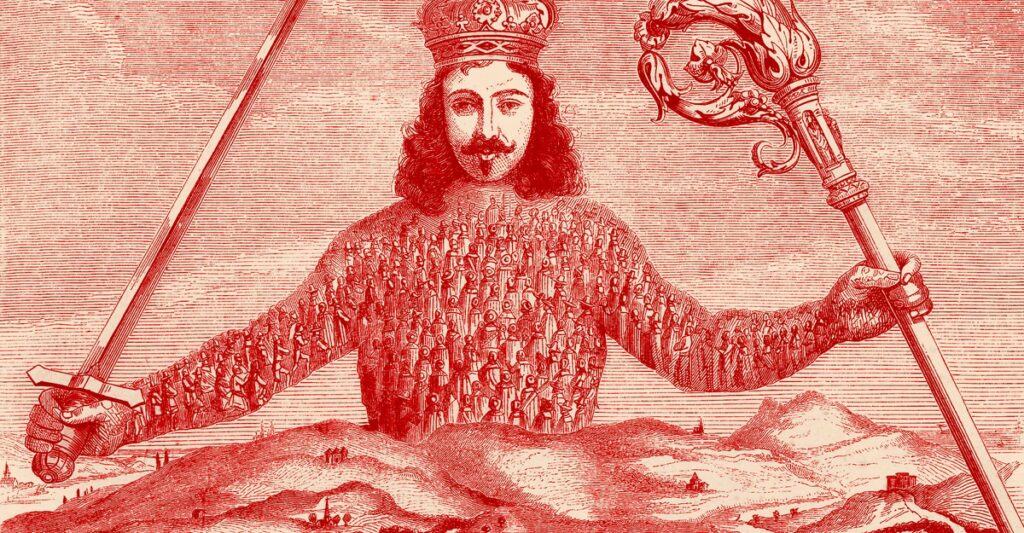
If you want to know a political leader’s governing philosophy, you could cut through a lot of bluster by just asking them who their guy is: John Locke or Thomas Hobbes? Anyone who’s taken Poli Sci 101 will understand what this means. The 17th-century philosophers each offered a picture of human nature in its rawest form, and they came to different conclusions. Locke, whose ideas were central to the birth of modern democracy, thought that people were capable of reason and moral judgment. Hobbes, on the other hand, believed that we were vicious creatures who needed to be protected from ourselves by a powerful king. Whether a leader is Lockean or Hobbesian really does set the table for the kind of government they want.
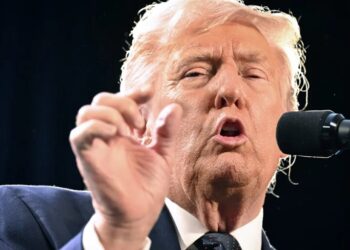
One way to understand the head-spinning nature of being an American over the past couple of decades is that this debate—one that history seemed to have settled in Locke’s favor—is alive again. Barack Obama was a Lockean through and through—insisting, repeatedly, that if citizens were just given accurate information and a fair hearing, they would converge on something like the common good. Then came Donald Trump, Hobbesian extraordinaire, who has often portrayed life under anyone’s leadership but his own much as Hobbes describes the state of nature: “solitary, poor, nasty, brutish, and short.” (Nasty is even one of Trump’s favorite words.)
Comments this week from Stephen Miller, the influential deputy chief of staff often cast as the president’s “brain,” only reinforced this impression. Miller might have been Hobbes in a skinny tie as he confidently articulated what he understood to be the “iron laws of the world since the beginning of time.” His monologue was like something out of the English philosopher’s 1651 political treatise, Leviathan: “We live in a world, in the real world,” he said, “that is governed by strength, that is governed by force, that is governed by power.”
Miller’s might-makes-right declaration came after Trump’s decision to overthrow the president of Venezuela, and in anticipation of the United States possibly acquiring Greenland from Denmark, perhaps by any means necessary (a notion that Miller’s wife found fit to turn into a meme). The will to dominate, seize other countries’ resources because you can, and generally bully those that can’t fight back is nothing to worry about, Miller reassured Americans: This is the natural state of things. This is how it all works. Power does what it wants. The rest is commentary and toothless United Nations resolutions—or, as he put it, “international niceties.”
Miller might as well etch Hobbes’s words onto a gold plaque ready to hang among other gilded tchotchkes in the Oval Office: “During the time men live without a common power to keep them all in awe, they are in that condition which is called war; and such a war, as is of every man, against every man.”
[Read: The wrath of Stephen Miller]
Hobbes helps explain the dog-eat-dog worldview of this administration—if you stop reading there. Dive in a little more, though, and you’ll find that he’s not exactly a fan of this state of affairs. By describing our natural condition as fearful, insecure, and frankly pretty terrifying—an existence of constantly watching your back—Hobbes was diagnosing a problem. Left to our own devices, without any institutions or government, we would not have any culture or science or peace. This thought experiment was his starting point, and it also helped fuel the Enlightenment then just under way.
The cure, for Hobbes, won’t seem all that palatable to most Americans today. He suggested that stability could come only through the empowerment of a strong monarch who would have a monopoly on violence and keep our worst instincts at bay. This is not democracy, obviously, but the king, as Hobbes dreamed him up, would need to keep and gain the consent of those he ruled over. This was his Leviathan, an earthly sovereign power that humans rationally create to escape the chaos of the state of nature. (Contrast this with Trumpiathan, who said in an interview on Thursday that his “own mind” was the source of his legitimacy to do what he wanted on the world stage: “It’s the only thing that can stop me.”) For Hobbes, there would be good faith in the exchange with a strongman: sacrificing a certain amount of autonomy to ensure that everyone could thrive without killing one another.
That’s Hobbes’s vision. He is trying to offer us an escape from a horror show that, as The Atlantic’s editor in chief recently put it, resembles William Golding’s Lord of the Flies: boys on an island without grown-ups or any of their rules, driven by privation and instinct to a murderous contest of dominance.
As for Miller’s vision, it’s horror all the way down. He’s not looking to solve for this state of nature. He simply calls it “the real world,” one whose anarchic rules America just needs to accept and use to its benefit. If Miller has read Hobbes, he’s drawing the wrong lesson. Even if he might like the idea of Trump as the Leviathanlike authoritarian come to bring order to the chaos (and Miller’s recent, and disputed, invocation of a president’s absolute “plenary authority” would suggest that that’s the case), this is not how Trump understands his role; otherwise, he would be bolstering international institutions and multilateral relationships rather than trashing whatever and whoever does not serve his glory.
If we were all living on the island in Lord of the Flies (and some days I feel like we are), then Trump would be Jack, the boy who recognizes that power comes not from rules but from fear, spectacle, and aggression.
[Read: Trump is fulfilling Kissinger’s dream]
If Trump and his inner circle have a guiding philosphy—to the extent that one can be discerned through a handful of often-contradictory statements—it has sometimes been described as “realpolitik.” Last year, I mentioned that this transactional approach to diplomacy and war, associated with Henry Kissinger, might be an apt way to characterize how Trump and his team think about the world. Realpolitik, as Kissinger practiced it while serving as secretary of state, eschewed moral questions in favor of reaching a balance of power among strong states for the sake of achieving stability (and to avoid the looming threat of nuclear annihilation). But does what we’re seeing in Venezuela count as realpolitik? The stated motive and the evident outcome, as well as Miller’s words, make clear that this is a raw exercise of strength for strength’s sake rather than a bid to stabilize the Western Hemisphere. The naked grab of the country’s oil (Trump has already put dibs on 30 million to 50 million barrels) removes any further ambiguity.
If Miller was trying to channel Hobbes, this would be a break with a very old American tradition of wariness about the philosopher. John Adams’s winking remark to his son John Quincy that Hobbes’s ideas were “mischievous” pretty much sums it up. The creators of a more participatory system of government did not take kindly to the notion that all people needed was a Mafia boss to offer them protection. Thomas Jefferson laid out his objections in an 1816 letter to Adams. And Miller—if he is actually interested in thinking through the implications of his “iron laws”—might do well to read it.
Jefferson agreed with Hobbes’s main contention: Government is necessary to organize human behavior. But he thought that leaders had to do a lot more than just prevent brutality and chaos. A Lockean, Jefferson had a more expansive view of human needs and capabilities. He felt that the “principle of Hobbes” was lacking because it didn’t take into account that humans have a “moral sense.” People want more than just a life without fear, he said; “every human mind feels pleasure in doing good to another.” Any worthy American government needed to reflect this instinct toward goodness, and to create the conditions for it. This also happens to be the only way to summon the kind of “real world” that someone would actually want to live in.
The post The 17th-Century Philosopher Who Helps Explain Stephen Miller appeared first on The Atlantic.