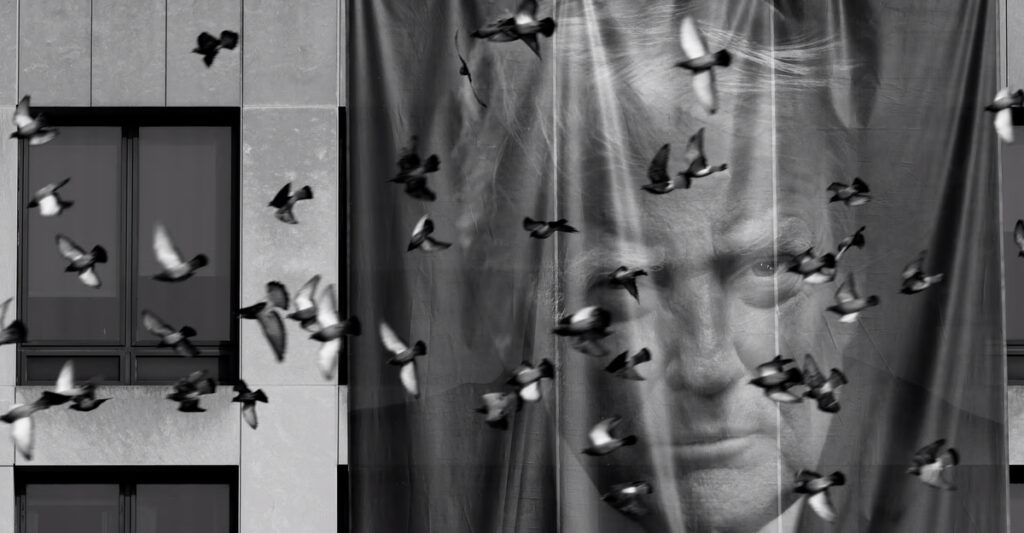
Venezuelans are celebrating—cautiously inside the country, wildly in safer places such as Madrid, Buenos Aires, and Miami, where hundreds of thousands made their homes as a brutal dictatorship impoverished their country, once the second-richest in the Western Hemisphere.
The Venezuelan dictator Nicolás Maduro has been removed from power—captured in the dead of night and arraigned before an American judge. That’s the good news. But as is so often the case with the actions of Donald Trump, it isn’t the only storyline. The United States president immediately threw cold water on the idea that the raid could pave the way for a rapid democratic transition under the leadership of last year’s Nobel Peace Prize winner, María Corina Machado. At his first press conference, a few hours after Maduro’s surgical removal, Trump said that he ordered it to get control of Venezuela’s oil, and that Machado didn’t have the “respect” to lead Venezuela.
If anyone expected more from Secretary of State Marco Rubio, who had a long-standing personal passion for freedom in Cuba before he sold his soul to Trump at a steep discount, they would have been disappointed. During his TV appearances the day after the raid, Rubio, like Trump, emphasized oil over democracy as the operation’s “No. 1” priority.
[Listen: Trump has no plan for Venezuela]
Trump’s stance in Venezuela is consistent with a geopolitics based on raw power and spheres of influence—the very sort that produced two world wars in the 20th century. In this scenario, the U.S. gets Venezuela and the Western Hemisphere, Russia gets Ukraine and as much of Europe as it can grab, and China gets Taiwan and an Asian sphere without U.S. interference. Trump has already been working to deliver Ukraine into Vladimir Putin’s open arms by cutting off aid and pushing a peace plan practically written by the Kremlin as his own. Fortunately, the Ukrainians haven’t cooperated.
That assumes Trump has any vision at all, of course. His supporters have a tendency to say that he’s playing five-dimensional chess, only to discover too late that he has eaten half the pieces.
I am not here to condemn the U.S. for toppling Maduro on the grounds of international law. Maduro was an illegitimate despot who had violated every agreement, including one in 2023 with the Biden administration, which proposed to lift sanctions in exchange for holding free and fair elections. Maduro was never going to step down unless stepped on. In Russia, Cuba, Iran, Belarus, and Uganda, dictatorships have carried on for decades—oppressing and killing their people, attacking their neighbors, and destabilizing their regions. Regime change isn’t a dirty word when the regime is among the most vicious in the world. As in Syria, no one can predict what will follow the fall of a tyrant, but now there is hope where before there was none.
Many have expressed alarm over the possibility that this rogue act could encourage Russia and China to act in kind. To do what, for example? Attack Ukraine, and attempt to murder President Volodymyr Zelensky for the tenth time? Crush democracy in Hong Kong? China already considers Taiwan to be an internal matter, and the invasion it so often rehearses is deterred by F-16s, not agreements that are only as strong as the leaders responsible for backing up what they say. That the Trump administration may withhold U.S. support from these beleaguered democracies as part of an unholy deal with Putin and Xi Jinping is troubling, but let’s not pretend that Russia and China care about international law. They allied with Maduro precisely because he shared their disdain for it. Their official protests over the U.S. strike are risible hypocrisy and show only their readiness to exploit the legal mechanisms and institutional platforms that they never obey themselves.
[Tom Nichols: Maybe Russia and China should sit this one out]
The equivalences are also false because Ukraine and Taiwan are sovereign democracies with freely elected heads of state. Maduro was a usurper who stole an election, held power by force, and abused that power to ruin the lives of Venezuelans and many others. Trump first pursued Maduro on a flimsy narcotrafficking pretext that he has already replaced with a blunt message about oil. But I’m happy to make the case that fighting authoritarianism wherever it is found is a vital role for the world’s strongest democracy. It was true under Truman and Reagan, and even if, unlike them, Trump couldn’t care less about spreading freedom abroad (or even at home), it’s true today.
Western apathy and cowardice are what embolden thugs and authoritarians, not the United States giving them a taste of their own medicine. The world’s dictators and terrorists commit acts of aggression not because the United States does, but when the United States and its allies don’t stop them. The complacency of the West has allowed Putin’s collapsing mafia state to bombard Ukraine for years. The main exports of Iran and Cuba are repression and terror. There is no rule of law if there aren’t any consequences for breaking it.
No one likes the idea of the United States as a global policeman, especially after the disastrous occupations of Afghanistan and Iraq. But Barack Obama’s unilateral retrenchment and Trump’s chaotic “America First” approach both show what happens when there’s no cop on the beat. In this metaphor, Trump is like a corrupt cop who occasionally knocks heads while always looking out for himself first. If you agree that Maduro got what he deserved but don’t like how it was done or by whom, I say—memo to the Obama administration—that sometimes it’s better to do the right thing with bad intentions than the wrong thing with the best intentions.
This brings us back to Venezuela. Machado is the most popular politician there. Her proxy, Edmundo González, won an overwhelming victory in the 2024 presidential election—only for Maduro to ignore the result, jail the opposition, murder protesters, and cling to power with the backing of the dictatorships in Cuba, Iran, and Russia. Machado is not aligned with regional leftists, such as Luiz Inácio Lula da Silva in Brazil and Colombia’s Gustavo Petro; she made a judicious choice, from hiding, to praise Trump as he was threatening Maduro in the fall, undoubtedly figuring that there was a chance she might get American power on her side. She had to try.
Her return seemed like enough of a win-win scenario to be plausible: A democratic Venezuela open to foreign investment could be profitable for Trump and his associates, while also good for the people of Venezuela and what used to be understood as the interests of the United States. But Trump chose instead to discount Machado and the millions of votes her pro-democracy party received. The opposition would be unable to control the entrenched Venezuelan power structure, some of the administration’s defenders insisted. A story in The Washington Post put Trump’s dismissal of Machado down to pique that she’d won the Peace Prize he coveted—a reminder that just when you think Trump can’t go any lower, there’s a knock on the floor.
Regardless, on Monday, Machado gave her first interview since Maduro’s capture to Sean Hannity of Fox News. She lavished praise on Trump, practically offering him her Nobel Prize. Every American should be embarrassed that this is now how democratic leaders must attempt to sway the U.S. president.
But Trump was not cajoled. His White House has made clear that it wants Maduro’s former vice president, the hard-liner Delcy Rodríguez, to be the country’s pliant new dictator, and for her to play American ball with Venezuela’s oil reserves instead of shilling for Iran, Russia, and China, as Maduro did.
[Michael Albertus: The Venezuelan opposition has a choice]
Simply replacing an anti-American dictator with one who will make a profit-sharing deal with Trump and his partners will be a disaster. The United States hasn’t been a shining city on a hill in a long time; but how far it has fallen, to become a pirate state plundering neighbors for the gain of a ruling clan. Venezuelans have suffered for too long and deserve to decide their own destiny regardless of Trump’s intentions.
As founder of the Renew Democracy Initiative, I had the honor of presenting Machado and Gonzalez with our 2025 Heroes of Democracy award last April in New York City (no, Donald, you will not be getting one of these, either). As Machado said in her acceptance speech, “We are all together in this common struggle against the enemies of freedom, wherever they are.”
President Trump should take note that this includes the White House.
The post Trump Is Not Playing Five-Dimensional Chess in Venezuela appeared first on The Atlantic.