Early in 2024, graffiti artists broke into the half-finished Oceanwide Plaza skyscraper development in downtown Los Angeles, scaled dozens of flights of stairs and, over a few days, covered much of the towers’ exterior with spray paint. Colorful tags — “Sorak,” “Libre” or “Suave,” more than six feet tall — were emblazoned on mirrored glass windows of nearly every floor.
Some taggers livestreamed their exploits; footage of the buildings quickly went viral. In the following days, base-jumpers were filmed launching themselves from the tallest tower’s summit, 49 stories up, before the site was finally secured.
Two years later, the abandoned, vandalized building still stands.
“If I could just take it and shrink it down, I would,” the Los Angeles-based artist Sayre Gomez said. Instead, Gomez has replicated the construction site in fastidious detail as a sculpture nearly nine feet tall that he will debut at a solo exhibition in Los Angeles at the David Kordansky Gallery, opening Jan. 16.
When I visited his studio in mid-December, the sculpture was still missing its upper section. Gomez said that he and his assistants would be working until the last minute to get it finished.
Gomez, 43, has, over the past decade, established himself as a leading documentarian of the urban fabric of Los Angeles, occupying an artistic niche that includes such artists as Ed Ruscha, Carlos Almaraz, Alex Israel and Alfonso Gonzalez Jr. In person, Gomez has the genial, laid-back bearing of a former skater (which he is) and the no-nonsense focus and acumen of a small business-owner (which, as the principal of a busy art studio, he also is).
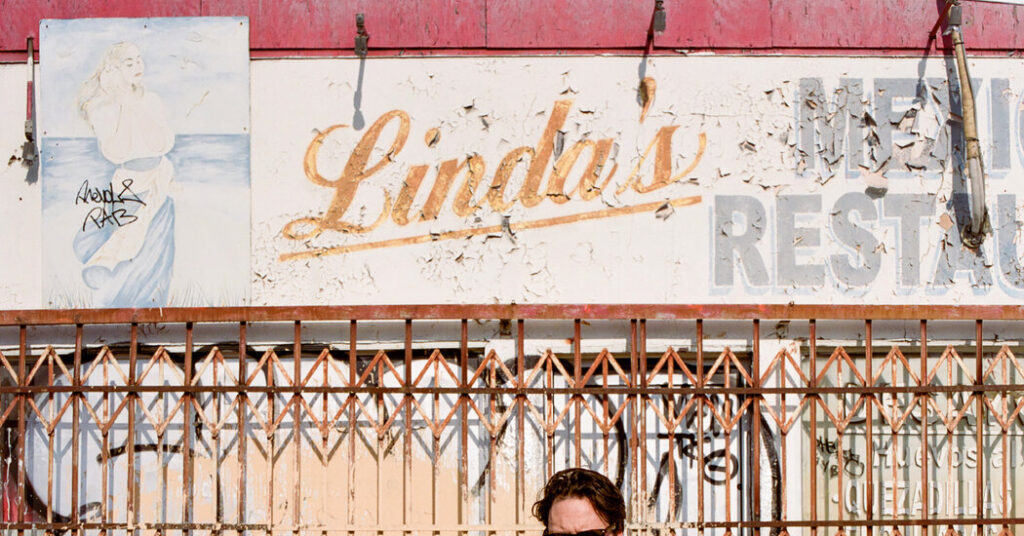
Though he has made sculptures before — miniaturized reproductions of a building in Boyle Heights, for instance, or utility poles that combine analog and digital types of communication, from internet and phone cables to printed notices stapled to their bases — Gomez’s signature medium is the airbrush. His photorealistic paintings of street scenes and architectural details are usually composites of digital photographs he has shot around town; in many, he uncannily replicates the distinctive blur and fuzz of the jpeg.
Gomez pictures the failures and inequities of capitalism: the homeless crisis; the paucity of infrastructure and social services in Los Angeles; the ubiquity of advertising; the wealth gap. Though his art is social in its concerns, people are largely absent. One painting from this exhibition, “Fire Season 9,” is a night scene of a homeless encampment on a fire-blackened front yard, its plastic fence melted grotesquely. Others feature strip mall signage and graphics on doors and windows of shops and other small businesses.
Anna Katz, senior curator at the Museum of Contemporary Art (MOCA), Los Angeles, included Gomez in her recent survey, “Ordinary People: Photorealism and the Work of Art Since 1968.” “Sayre’s paintings are evidence to me of photorealism’s tendency to show ugly or painful realities, its social consciousness,” she wrote in an email. (His work is in MOCA’s collection and those of the Hammer Museum, the Broad, the Los Angeles County Museum of Art, the Whitney Museum of American Art in New York and the Hirshhorn Museum in Washington, D.C.)
Oceanwide Plaza is a symbol of the fickle fortunes of downtown Los Angeles — and other American city centers — where a tide of development and revitalization in the late 2010s was curtailed first by the trade dispute between the United States and China, and then by the coronavirus pandemic. The building was named for Oceanwide Holdings Co., the Chinese conglomerate that initiated the mixed-used project, before it ran into financial difficulties in 2019 and building stalled.
As the city prepares to host games in the soccer World Cup in 2026, and the Olympics in 2028, this eye-catching addition on the skyline is a source of civic embarrassment and angst. About a billion dollars has already been spent on the building; it’s estimated that it will take a billion more to complete it, according to the Los Angeles Times.
“It’s really not a good look,” Gomez observed dryly. “But I think it’s the only look in a way, you know?” In Los Angeles, he said, social and economic problems are harder than in other cities to “sweep under the rug.” Gomez appreciates the “symbolic power” of the building. “You can read a million books about the end of capitalism, but then you see that, and it’s like, oh they’re right,” he said, “A billion dollars just wasted, six years later just sitting there. It’s kind of hard-core.”
Gomez’s studio occupies two adjacent buildings in Boyle Heights, east of downtown. One is a large clean room where assistants tended to the “Oceanwide Plaza” sculpture.
The other studio is taken up mainly with spray booths and paint-spattered spaces where assistants execute his paintings with airbrushes. Gomez doesn’t work on certain paintings at all, though he retains full directorial control, first creating a composition in Photoshop, then supervising the outcome as it is transferred into paint on canvas. As with many artists who work in this manner, including Jeff Koons and Takashi Murakami, his approach is pragmatic: “I’m better at some things than other people and vice versa,” he said.
To make “Oceanwide Plaza,” his most technically and logistically ambitious sculpture to date, Gomez enlisted the help of Kludge MFG, a design and fabrication company in Los Angeles. Matthew Endler, the company’s principal, said that drones took more than 7,200 photographs of the buildings, along with video, to create scans that were used as the basis for a digital model.
Endler and his team built the basic structure, then affixed 3-D printed details. They sent part of the structure to Jeff Frost, a model maker, who applied surface textures and finishes. Gomez weathered the towers with paint and varnish, and added UV-printed miniaturizations of the photographed graffiti onto each rectangle of mirrored plastic.
Gomez is a former graffiti artist and said he knows a few of the taggers who painted the towers. He recognizes many by reputation, including the dominant MTA crew, whose tags can be seen all over Los Angeles. Others, he said, are street gang members whose scrappy territorial tags occupy another subcategory of graffiti.
“It’s like a sign-in sheet,” he said of the building.
Gomez began writing graffiti in Chicago when he was 13, shortly before moving with his mother to suburban Fayetteville, Ark. There, the graffiti scene was limited, but by trespassing in trainyards he could admire — and compete with — the work of graffiti writers from New York and Los Angeles, on the sides of cargo wagons.
He moved back to Chicago to enroll at the School of the Art Institute of Chicago, first to study graphic design (an enduring influence) and then fine art, while continuing to tag. But as he began to get arrested and jailed with increasing frequency, pursuing graffiti long-term seemed to him like a dead end. “I was just having less and less fun,” he said.
A tagger friend encouraged him to apply for an M.F.A. degree, so he could teach. That took him, in 2006, to Los Angeles, where he found himself at the conceptually oriented CalArts.
I tried out my read of “Oceanwide Plaza” on Gomez: Is his sculpture, I suggested, a tribute to a monumental piece of communal protest art?
Gomez was skeptical of my interpretation. Graffiti crews don’t generally consider what they do to be political protest or art, he said. (They disdain the subcategory of “street art,” as practiced by Banksy, Shepard Fairey and others.) Rather, they see their vandalism, however creative, as a “vocation,” a commitment to disseminating their tag (their logo, their brand) as widely as possible across urban spaces. Gomez compared them to professional athletes.
As with much of Gomez’s art, “Oceanwide Plaza” is both spectacular and abject, appalling and wryly humorous. Similar to his pictures of sublime sunsets over ugly strip malls, “it’s about finding ways to embrace contradiction,” Gomez said.
In 2020, Gomez and his wife, the production designer Emmy Eves, had their first child, a boy, and the following year they had a daughter. Parenthood has both softened Gomez’s cynicism and sharpened his concerns about the future. In his upcoming exhibition at Kordansky, acerbically titled “Precious Moments,” there are sculptures of a sun-bleached playground tunnel and enlargements of twee figurines of a boy and a girl, whose hair and clothing resemble those of his children.
A trompe l’oeil painting, “Bay Window,” includes kids’ drawings and discarded pill bottles piling up beneath drawn curtains. The piece, which alludes to struggles with addiction, mental health and poverty, is deeply sad. But Gomez insists that references to childhood add some glimmer of hope and uplift in his work.
Does the state of Los Angeles today encourage Gomez to consider living somewhere else? Absolutely, he said, particularly since the devastating wildfires in January 2025, which blackened the sky above his Atwater home a few miles from Altadena. “It could actually be really good for me.”
“But where do you go?” he continued. “You can’t really run. The problems that I’m most interested in talking about are not problems that are regional. They might be more palpable, might be more visible here, but they are sweeping.”
The post In Sayre Gomez’s Art, L.A.’s Problems Move From Real to Hyper-Real appeared first on New York Times.