Venezuela’s streets were on fire as protests raged over misrule.
Paramilitary cells and security forces were killing protesters by the dozens. Delcy Rodríguez, the foreign minister at the time, in 2014, convened ambassadors from around the world in a bid to flip the narrative and fend off sanctions over rights abuses.
In the closed-door meeting, Ms. Rodríguez berated envoys from the United States and the European Union. Pointing her finger at them, she said those killed were terrorists, not protesters.
“She was yelling at them, using very aggressive language,” said Imdat Oner, a former diplomat at Turkey’s embassy in Caracas who witnessed the scene. “This is not the way a foreign minister acts. I found it shocking because it was completely out of line with diplomatic practices.”
Ms. Rodríguez lost that battle when President Barack Obama ended up imposing sanctions. But her combative tactics served her well as she climbed through the ranks of a government dominated by men who were military figures or fire-breathing ideologues.
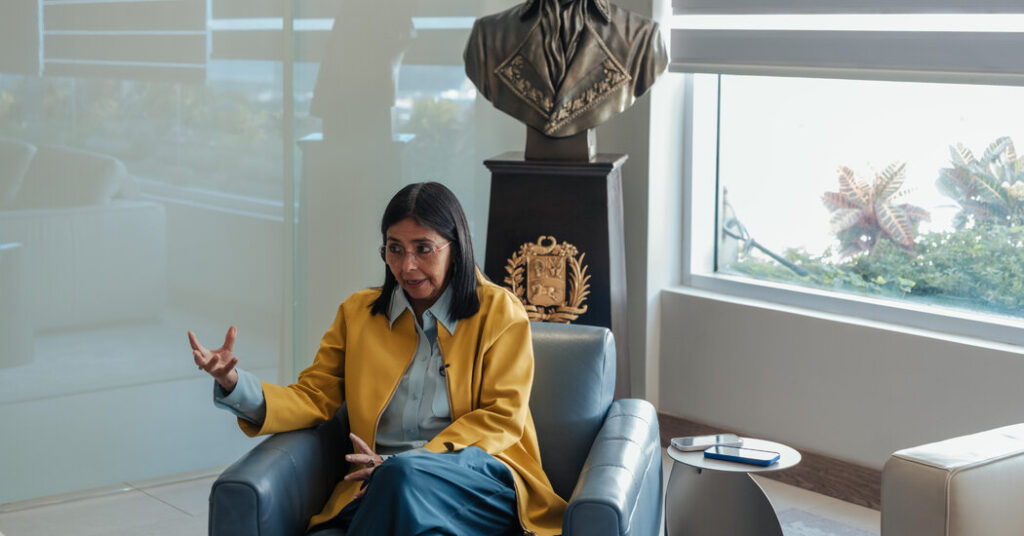
Now, with President Trump’s assent, Ms. Rodríguez is Venezuela’s interim leader after U.S. forces captured and forcibly extracted her predecessor, Nicolás Maduro, and his wife, Cilia Flores, to stand trial in New York.
Ms. Rodríguez, 56, faces an immense challenge. She must placate an American president who says the United States will run Venezuela for years to come, while trying to stabilize a cratering economy and consolidate control over governing institutions and power brokers in her inner circle imbued with hatred of U.S. meddling.
But those who know her say her capacity for hurling insults at the West, virtually a job requirement in Venezuela’s government until Mr. Maduro’s capture, is complemented by a pragmatic streak, making her a survivor of both internal purges and geopolitical shifts.
Her transformation from Mr. Maduro’s ideological provocateur into a straight-talking technocrat seemingly capable of working with Mr. Trump unspooled as she amassed power in recent years by leading an effort to pull Venezuela out of an economic crash marked by children dying of hunger.
Trained abroad in France and Britain, she holds rarefied status for some at home as the daughter of a Marxist guerrilla who kidnapped an American business executive and became a revolutionary martyr.
As foreign minister, she was part of the decision-making process seeking a reset of relations in 2017 with the United States at the start of the first Trump administration. That was when Citgo Petroleum, then the U.S. subsidiary of Venezuela’s national oil company, donated $500,000 to Mr. Trump’s inauguration.
Bringing in a new team of economic advisers from Venezuela and abroad, Ms. Rodríguez brokered a truce with Venezuela’s economic elite and embarked on a stealth privatization of natural resources by giving foreign investors control over some coveted projects, such as oil fields, cement plants and iron ore mines.
Right up until Mr. Maduro’s removal, Ms. Rodríguez echoed his defiant, anti-imperialist language in her public statements.
“The Pentagon always had a strategic objective of obtaining Venezuelan reserves” of oil, she told The New York Times in an interview in September, as Mr. Trump was tightening the military noose on Mr. Maduro. “There’s no doubt that one of the strategic objectives is what is called regime change.”
But on Friday, less than a week after the United States snatched Mr. Maduro under cover of night, Ms. Rodríguez put out a statement saying that Venezuela was exploring the possibility of restoring diplomatic ties and sending a delegation to Washington.
And on Friday, diplomats from the United States visited Caracas, Venezuela’s capital, to assess a “potential” resumption in embassy operations for the first time in nearly seven years.
Ms. Rodríguez’s previous efforts to court investors and businessmen paid off. Hyperinflation was halted and economic growth returned, fueling Ms. Rodríguez’s climb to the apex of Venezuelan politics.
“We had to re-engineer the economy,” said Rafael Correa, Ecuador’s former leftist president and a U.S.-trained economist who Ms. Rodríguez hired as her economic adviser, starting in 2018, years after he left office. “It was complete chaos.”
Venezuela, in recent years, has achieved some of Latin America’s highest growth rates, albeit from extremely reduced levels.
Mr. Correa, who still advises Ms. Rodríguez, attributed the increased stability to her work ethic and openness to technical assistance. “She is a workaholic, she never stops,” he said.
By the time of Mr. Maduro’s capture, the former leader had already delegated practically all economic matters to Ms. Rodríguez, who simultaneously held the posts of Vice President, Minister of Finance and Minister of Petroleum.
But now Venezuela’s new leader faces what is arguably her hardest challenge as she threads the needle between U.S. demands and domestic pressures.
Underscoring the strain facing her, Mr. Trump told The Times in an interview this week that she is in constant communication with Secretary of State Marco Rubio. Mr. Trump declined to comment when asked if he had spoken with Ms. Rodríguez.
Ms. Rodríguez’s government did not respond to requests for comment.
In a speech on Wednesday night describing the U.S. military attacks that Venezuelan officials said killed at least 100 civilians and military personnel, she said, “Venezuela is a peaceful country that was attacked by a nuclear power.”
But she also emphasized how realpolitik is shaping Venezuela’s new relationship with the United States as the Trump administration compels her into providing privileged access to Venezuela’s oil reserves for U.S. oil companies.
Her technocratic, numbers-heavy communication style was on display on Wednesday, when in her address she rattled off complex economic statistics and used words like “Manichaean” to describe relations with the United States. The tone was a far cry from the folksy style of Mr. Maduro, a former bus driver and self-described “working-class president.”
When she was 7, Ms. Rodríguez lost her father, a Marxist guerrilla named Jorge Antonio Rodríguez, who led the kidnapping of William Niehous, an American executive at Owens-Illinois, a bottle manufacturer.
Her father was a leader of the Socialist League, a splinter party that promoted armed struggle during the 1970s and counted Mr. Maduro among its members. Mr. Rodríguez died in prison in 1976 at the age of 34 after being charged in the Niehous kidnapping and tortured by intelligence agents from a pro-U.S. government.
After her father’s death, Ms. Rodríguez, as the daughter of hard-line leftists, effectively grew up in the wilderness of Venezuelan politics. Venezuela was a democracy at the time but dominated by two parties, one center-right, the other center-left, marginalizing political extremes.
She graduated with honors with a law degree from one of the country’s best schools, the Central University of Venezuela in Caracas. Then she studied labor law at the Sorbonne, the renowned French university.
When she returned from Paris, Venezuela was experiencing a political convulsion.
Hugo Chávez had risen to power, spawning his socialism-inspired movement that he called the Bolivarian Revolution. She joined the diplomatic corps of his nascent government, obtaining a post in Venezuela’s embassy in London. While there, she studied politics at Birkbeck College.
Her mother, also named Delcy, is a political activist sometimes called the “Matriarch of the Revolution.” She is known to be very close to her daughter, and accompanied her when she was living in London.
The languages Ms. Rodríguez honed while studying abroad, including her fluency in English, made her stand out in a government where top officials typically only speak Spanish. When she moved back to Caracas, she was often seen chatting in French with African diplomats.
By this time, her father had emerged as something of a martyr for Venezuela’s revolution. Her older brother, Jorge Rodríguez, also became a top Chávez aide and, at one point, his vice president. He is now the head of the National Assembly, positioning the siblings at the helm of two government branches.
After Mr. Chávez died in 2013, she began her meteoric rise in the Maduro government under her brother’s wing, according to people who know her.
Several Venezuelan and Western businessmen who have met Ms. Rodríguez have said they were impressed by what they described as her knowledge of technical subjects, as well as her eloquence and wit. They said she was always impeccably dressed, asked probing questions, and made subtle jokes.
Some of the businessmen have described her as a micromanager obsessed with control, adding that she insists on personally signing every document, down to the most menial approvals. This approach brought some discipline to Venezuela’s chaotic bureaucracy, but it created a growing pile of proposals languishing without her approval.
To aid her rise she sidelined rivals, according to multiple people close to the government. Most notably, she was instrumental in the resignation and eventual jailing of Tareck El Aissami, a Maduro protégé who ran the oil industry, they said.
The people who spoke to The Times about Ms. Rodríguez requested anonymity to discuss private conversations or because of concerns over retaliation.
Her allies say her obsession with work is driven by her vision of Venezuela’s economic development; her detractors say she pursues control for control’s sake, revealing a broader desire for power.
She has relied on a close-knit team of market-friendly officials to execute her economic plans. These include Román Maniglia, who currently leads Venezuela’s largest public sector bank, and Calixto Ortega Sánchez, whom Ms. Rodríguez named this week as the country’s new finance minister.
After taking charge of the economy, she brought in two economic consultants from Ecuador, who became the core executors of her stabilization plan. The consultants, Patricio Rivera and Fausto Herrera, had served under Mr. Correa, Ecuador’s former president.
While Ms. Rodríguez previously adopted the belligerent rhetoric of Venezuela’s regime, she is also known, acquaintances said, to enjoy luxury clothing brands and fine dining. She does not have children and has never married..
People who know her said she is very close to her family, spending much of her spare time with her mother, her brother, Mr. Rodríguez, and his children.
She was raised Catholic but has since embraced a broader idea of spirituality that hasn’t been promoted as part of her tough-as-nails public profile.
Ms. Rodríguez is a follower of the Indian guru Sri Sathya Sai Baba, who died in 2011, and faced claims of sexual abuse and money laundering. In Venezuela, other prominent followers of the guru include Mr. Maduro, and his wife, Ms. Flores. Followers are meant to adhere to the core tenets of truth, peace and love.
Ms. Rodriguez is “a disciple of Sai Baba’’ who has visited the guru’s ashram and paid her “obeisance’’ to him frequently, said an official of the Sri Sathya Sai Central Trust, who asked not to be named, because they were not authorized to speak to the media.
The ashram is situated in Puttaparthi, in the south Indian state of Andhra Pradesh. On her visits in recent years, she was dressed in a kurta, a type of loose collarless shirt, and was seen walking through sacred spaces, often folding her hands in homage to the guru in front of his life-size portrait and statue.
Mariana Martínez contributed reporting from Caracas, Julie Turkewitz from Maryland, Pragati K.B. from New Delhi and José María León Cabrera from Quito, Ecuador.
Simon Romero is a Times correspondent covering Mexico, Central America and the Caribbean. He is based in Mexico City.
The post How Venezuela’s New Leader Went From Revolutionary to Trump’s Orbit appeared first on New York Times.