Sitting on a gilded chair in the green drawing room of the Grand Kremlin Palace, Nicolás Maduro, the leader of Venezuela, turned to President Vladimir V. Putin of Russia and spoke of their bright future together.
“We will see relations flourish between the great Russia, today a leading power of humankind, and Venezuela,” Mr. Maduro proclaimed at the meeting, last May.
Eight months later, Mr. Maduro is sitting some 4,700 miles away in a violent and overcrowded federal detention center in Brooklyn, having been spirited out of Caracas last Saturday in a U.S. military raid ordered by President Trump.
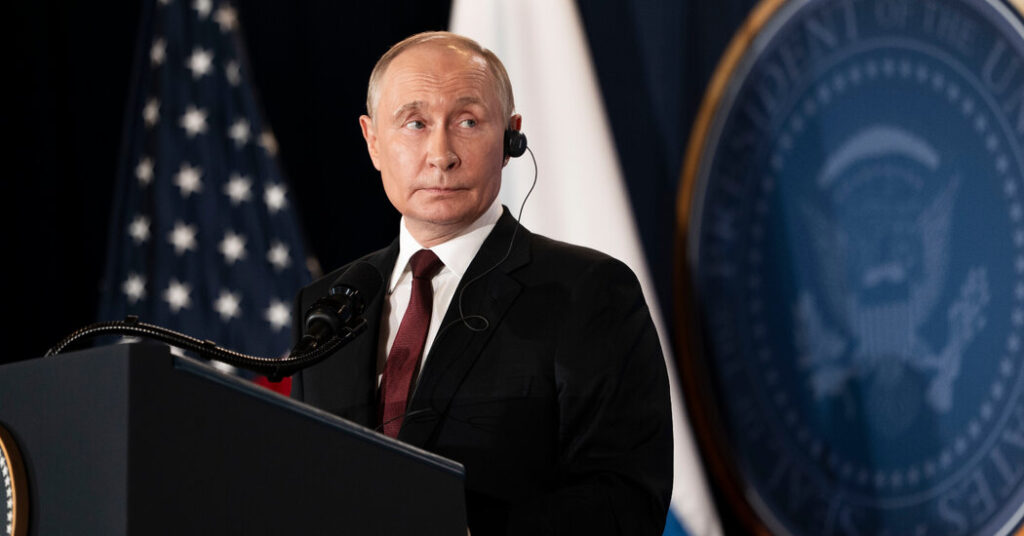
A week has passed — and Mr. Putin has said nothing.
The silence, though partly a function of Russia’s traditional New Year’s holiday period, reflects a monthslong pattern in which the Kremlin has played down actions by the United States that previously would have incited Moscow’s ire and threats.
Mr. Putin has been careful to avoid antagonizing Washington as he seeks a favorable outcome in Ukraine, even if it means standing aside in other parts of the world where he might previously have played hardball.
The most recent example came on Wednesday, when the U.S. military seized a sanctioned oil tanker that adopted Russia’s flag after the vessel fled from the U.S. Coast Guard across the Atlantic Ocean. Russia initially responded with a three-paragraph statement from its Ministry of Transport, exceptional restraint for a nation that has periodically threatened nuclear war. Mr. Putin again said nothing.
“He has one goal, which is to come out on top in Ukraine, and everything else is subordinated to that goal,” said Hanna Notte, the director of the Eurasia program at the James Martin Center for Nonproliferation Studies.
Though Russia may have been capable of complicating the U.S. mission to capture Mr. Maduro in Venezuela, Ms. Notte said, that would have risked a full rupture with Mr. Trump.
“All the indicators in Russian foreign policy right now are that Ukraine trumps everything else by far, so why would you give the Americans a bloody nose there and get on their wrong side?” Ms. Notte said.
While Moscow’s muted reaction may be strategic, Mr. Putin is also limited in what he can do as Russia faces a broader unraveling of its global power and, even in the best of times, cannot fully control the dynamics within its authoritarian client states.
The loss of influence began with his full-scale invasion of Ukraine in 2022, which eroded Moscow’s sway in other former Soviet nations in Central Asia, the Caucasus and Moldova.
The trend accelerated in late 2024 with the collapse of Bashar al-Assad’s government in Syria, which Mr. Putin spent a decade trying to save with a costly Russian military intervention. It has continued with Mr. Trump’s assertion of U.S. power over Venezuela, a top Russian partner in Latin America, and the mass anti-government street protests that are imperiling the Kremlin-friendly government in Iran.
Last year, the leaders of Armenia and Azerbaijan, two former Soviet republics that long looked to Moscow as the mediator of their disputes, traveled to the White House to sign a peace accord presided over by Mr. Trump.
“The Ukraine war is a dark hole that consumes Russia’s resources,” said Alexander Gabuev, the director of the Carnegie Russia Eurasia Center. “As the country becomes more resilient internally to Western pressure, it also becomes weaker as a global player, because it doesn’t have as many resources to throw around at its ambitions.”
Even if Russia had wanted to step in and defend Caracas, Mr. Gabuev added, Moscow was not about to go to war in Venezuela with the United States, a fellow nuclear power. He said Russia would not antagonize Mr. Trump over peripheral issues if it risked its goals in Ukraine.
For years, the Kremlin has viewed the world as an agglomeration of regions where great powers like Russia, China and the United States should have privileged interests. During Mr. Trump’s first term, Russian officials at one point offered Washington free rein over Venezuela in return for carte blanche in Ukraine. Mr. Trump has also viewed Washington as having a privileged sphere of influence, saying both Canada and Greenland should become part of the United States and in recent days vowing to “run” Venezuela, possibly for years.
Mr. Trump also has significant power to influence the outcome for Russia in Ukraine and Europe more broadly. Though he has dialed back support for Kyiv, the United States remains the dominant force in European security and is still providing the Ukrainian military with critical intelligence and weapons.
Since Mr. Maduro’s capture, Mr. Trump’s administration has reignited talk of taking Greenland from Denmark, risking the future of NATO, which was created in 1949 after World War II as a U.S.-led bulwark in Europe against Moscow’s influence.
“If Trump actually made good on invading Greenland and taking it over militarily, NATO would be finished, and that would obviously be incredible for the Russians,” Ms. Notte said.
Mr. Putin has been seeking to divide the United States from its longstanding allies in the alliance for years. Such a divide would accord Russia more power in Europe, where the Kremlin has long sought to reassert its influence, after Moscow lost sway over much of the continent following the Soviet Union’s collapse.
Amid U.S.-led talks to end the war in Ukraine, Britain and France in recent days agreed to send troop contingents to Ukraine in the event of a peace deal in order to deter a repeat Russian invasion, a move that Moscow swiftly rejected. On Friday, as if to underscore the point, Russia launched a nuclear-capable ballistic missile, known as the Oreshnik, at a target in western Ukraine just over the border from the European Union.
Paul Sonne is an international correspondent, focusing on Russia and the varied impacts of President Vladimir V. Putin’s domestic and foreign policies, with a focus on the war against Ukraine.
The post Why Putin Went Quiet When Challenged by Trump Over Venezuela appeared first on New York Times.