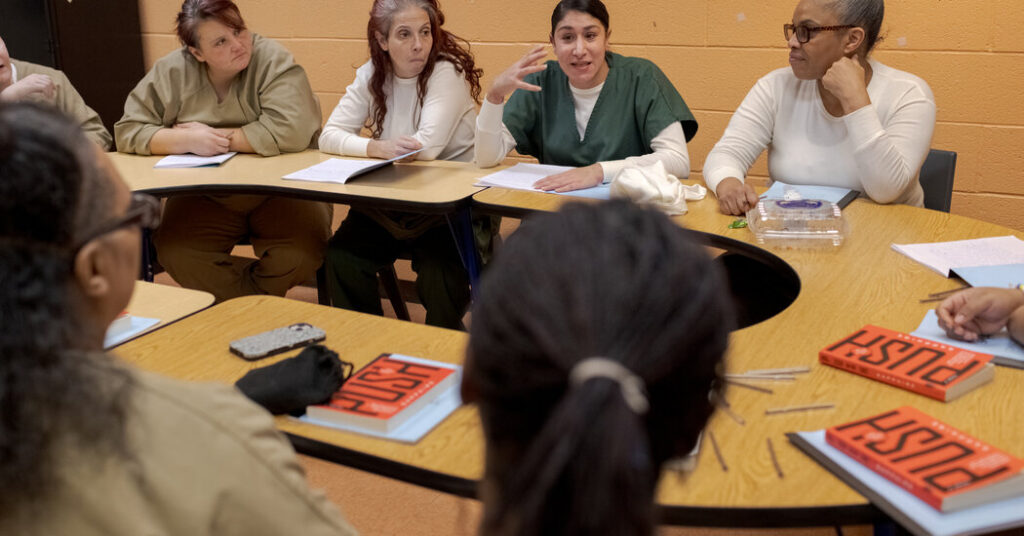
The plastic chairs were arranged in a circle inside a sparse classroom, where inspirational posters with messages about perseverance and possibility lined the cinder block walls. A dozen women in tan sweatsuits were engaged in intense conversation.
Their talk touched on marital infidelity, childhood sexual abuse and their collective impatience with people who indulge in self-pity when life goes haywire.
The women were discussing a novel called “The Paper Palace,” by Miranda Cowley Heller, in which the heroine must choose between her husband and her childhood love. But for many members of this particular book club, inside the women’s jail on Rikers Island, the broader themes had particular resonance, and their thoughts drifted beyond the literature itself, drawing connections to real life.
“You’d be surprised how intellectual certain inmates or detainees can be,” said Chantel Loney, who has been at Rikers on burglary charges since mid-October. “We’re not all ignorant people. Some of us were in the wrong place at the wrong time or made bad choices.”
The monthly club, not quite a year old, has become a lifeline for its members who cycle through the jail — some staying for weeks, others for months as they await trial or serve short sentences. It provides a few hours to relieve the boredom and unhappiness of their current lives, to imagine a different sort of existence, to talk deeply with others.
And at Rikers, which has been plagued by violence and dysfunction, it is also a rare opportunity. The library at the women’s facility is closed, its space repurposed for other needs. Programming is otherwise scarce. The prison complex has been under federal scrutiny for years, and the city faces a court-mandated deadline to close it by August 2027 — a timeline it is unlikely to meet.
That the club exists at all amid such conditions is a minor miracle. It was the brainchild of Nora Fried, a standup comic from Prospect Heights, Brooklyn, who co-hosts a podcast called “New Yorker of the Week” and works as assistant to the national organizing director at the American Civil Liberties Union. The idea came to her during a period of personal crisis. She had recently gotten sober and found solace in reading during the difficult transition.
One book in particular sparked her idea: “The Autobiography of Malcolm X.”
“He learned to read in jail, and from that experience was able to start this amazing movement during the civil rights period,” she said. “And I immediately thought to myself: I wish I could just start a book club in a prison. You still have a voice and a mind. There’s nothing dangerous about giving someone the opportunity to enlighten themselves, and there’s danger in letting someone sit and rot.”
Ms. Fried reached out to the Department of Correction and got a receptive response. “They said, ‘We’ve been wanting to start a book club, so if you want to lead it, go for it.’”
Ms. Fried bought some initial books on her own; since then, the project has been largely funded by charitable donations.
The first meeting of the club, called the Rosebuds Reading Collective, drew seven women to discuss “Educated,” a memoir by Tara Westover, whose parents practiced a radical form of Mormonism and raised her and her siblings off the grid in a remote part of Idaho. Education was her path to a different life.
Ms. Fried sets clear ground rules at each meeting. “Nothing that you say in this room should go beyond these walls,” she tells the group. “Try to be respectful of each other. Try not to talk over people. When I’m speaking, I’m not lecturing, and I’m not teaching. I’m asking questions because I’m interested to hear your opinions.”
Ms. Fried is not rigid about where the conversation takes them. “Even if we go completely off track with a book, if this is the time where they can think and talk and feel released, that’s so important,” she said.
The strategy has paid off. At that first session, what was planned as a one-hour discussion stretched to two and a half hours. Ms. Fried was energized, satisfied that she’d made a mark, however big or small. “Even if it’s just that these women had a better month because of this,” she said. “That’s fine. I’ll take it.”
With no background in teaching or in criminal justice, Ms. Fried draws on her comedy skills to help her read the room. Each month, a different mix of women shows up, requiring slightly different techniques for drawing them out. “Every single time, at a show or doing an open mic, it’s always a new group of people,” she said. “So you always have to win back the room. I didn’t realize that I would be having to do that at Rikers, but I use those techniques: Who’s my crowd? Who clearly is annoyed, who’s really amped to be here? It’s basically doing crowd work.”
Since last February, the club has read a wide range of books, including “Quit Like a Woman,” by Holly Whitaker, a memoir and self-help book about sobriety; “A Piece of Cake,” a memoir by Cupcake Brown that touches on child abuse, prostitution and homelessness; and “The Girls,” by Emma Cline, a coming-of-age novel loosely based on the Manson cult of the 1960s.
The selections reflect Ms. Fried’s careful attention to what will resonate — books about addiction and recovery, trauma and redemption, stories that mirror the women’s own experiences.
Despite the noise and distractions in their housing units, the women demonstrate remarkable focus when engaged with compelling material. “If that book is good, I’m going to block everything out,” one member said.
Loreal Moore, 34, said she read seven books in the first three weeks she was in custody for criminal trespassing. “I love reading, but I never get a chance to, when I’m out on the streets,” she said. Recently, Ms. Moore finished “The Body Keeps the Score,” by Bessel van der Kolk, a dense exploration of trauma. When she learned about the book club, she immediately wanted to join.
Amanda Camia, 35, joined too. Unlike the others in tan, she wears green — the color for those who have been sentenced and will serve the entirety of their sentences at Rikers. She is there for nine months for kicking a nurse in the face while coming out of an overdose.
“Things like this, it gets you out of that housing area that you’re just stuck in all day,” Ms. Camia said. “There’s no motivation. There’s no productivity, but this changes that a little bit.”
Tammy Hogan, 59, another book club regular, has been at Rikers since June on grand larceny charges and expects to be released next month. Reading, she said, has changed her life a few times.
When she first went to prison in 1996, she had a fifth-grade education. A nun named Sister Grace gave her books. “She said, by the time you finish your bid, I guarantee you are gonna have an education.” Four years later, Hogan left with her G.E.D.
During another long sentence, she earned an associate degree in sociology.
Ms. Loney, 31, has been at Rikers since mid-October on burglary charges and has a 5-year-old, a 4-year-old and a 7-month-old baby. “Being in a book club helps us forget exactly where we are,” she said. “It helps with anxiety and depression. It pulls certain inmates together because it’s a time when you’re in a room with people you might not otherwise even talk to.”
After the first meeting, Ms. Fried was so moved by the women’s discussion of “Educated” that she contacted the author and encouraged her to visit the group.
Ms. Westover came to Rikers several months later. Ms. Fried recalled being struck by the author’s demeanor. “She was so humble and had this very peaceful energy about her,” she said. “It was striking, considering the violent, chaotic dynamic she grew up in. She came in and shared her story — ‘I got out of Idaho and look at me now. Against all odds, I did this. I wrote a book.’ ”
The visit made an impact.
Janice Cruz, 54, was a regular in the club for about seven months until she was moved to the women’s prison in Bedford Hills, N.Y. She said the group created a sense of community. “We don’t always agree, but it was wonderful to see women open up and know you are not alone,” she said.
Ms. Cruz, who is serving time for manslaughter, described Ms. Westover’s visit as a highlight.
“I was definitely one of those ladies that didn’t have time to read much and was living everyone else’s problems but mine,” Ms. Cruz said. “Reading has truly helped me in my recovery. It was the catalyst that told me ‘I’m going to be OK’ on my journey to redemption.”
The post At the Rikers Jail, the Women Have No Library. But They Have a Book Club. appeared first on New York Times.