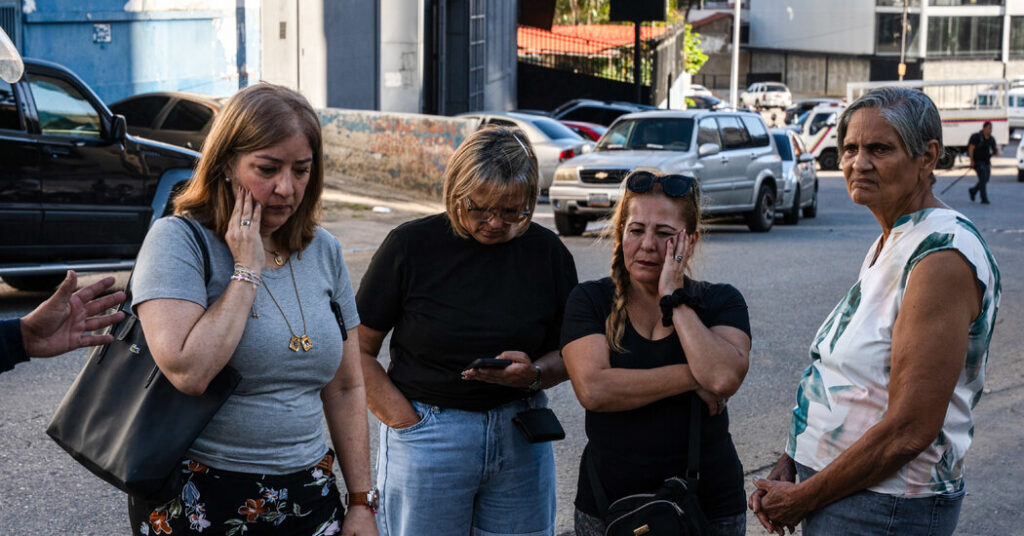
In Venezuela on Friday, relatives of political prisoners waited for hours under the scorching sun outside two notorious prisons, hoping to hear news about the possible release of their loved ones.
Some were exhausted after a night spent on hourslong bus journeys they’d started from around the country after Venezuela’s interim government announced on Thursday that it would release an “important number” of imprisoned people.
On the outskirts of Caracas, the capital, authorities at Rodeo I — which holds almost 100 political prisoners according to the rights group Foro Penal — permitted families to visit loved ones, a regular Friday occurrence. Coming out of the prison, some family members who spoke to The New York Times said their relatives hadn’t been aware of the American attack and the ouster of Nicolás Maduro last week, let alone Thursday’s announcement about prisoner releases, and had only learned of both from the visitors.
“My brother is very anxious, but very happy,” said Mary López, sister of Luis López, a journalist who has been detained for almost 19 months. “He told me to be here waiting for him.”
Ángel Indriago, a 52-year-old merchant, said he had decided to take a 17-hour bus trip to Caracas from Carúpano, Sucre State, expecting political prisoners to be freed. “This is a historical moment,” he said Friday morning, adding that it was as if Venezuela’s soccer team was going “to the World Cup for the first time and I had the opportunity to be there.”
Rights groups estimate that between 800 and 900 political prisoners are incarcerated in Venezuela. But as of Friday afternoon, only nine had been confirmed released.
That comparatively small number and the seeming lag in potentially more prisoners’ releases have created uncertainty among their relatives, as well as complaints by rights groups of a lack of transparency and “a cruel mockery” of detainees.
Outside El Helicoide, which according to organizations holds more than 50 political prisoners and has a record of human rights abuses, few people stood outside in the morning hours. Gabriela Álvarez, a friend of Jesús Armas, who is incarcerated inside, was wearing a shirt with the message “free Jesús” and his portrait stamped on it.
“We all have mixed feelings,” she said. “Yesterday we all thought he was going to be freed and we would be able to see him and hug him. Clearly, it didn’t happen. But we are here, holding firm.”
The post Outside Prisons in Caracas, Venezuelans Anxiously Await Release of More Political Detainees appeared first on New York Times.