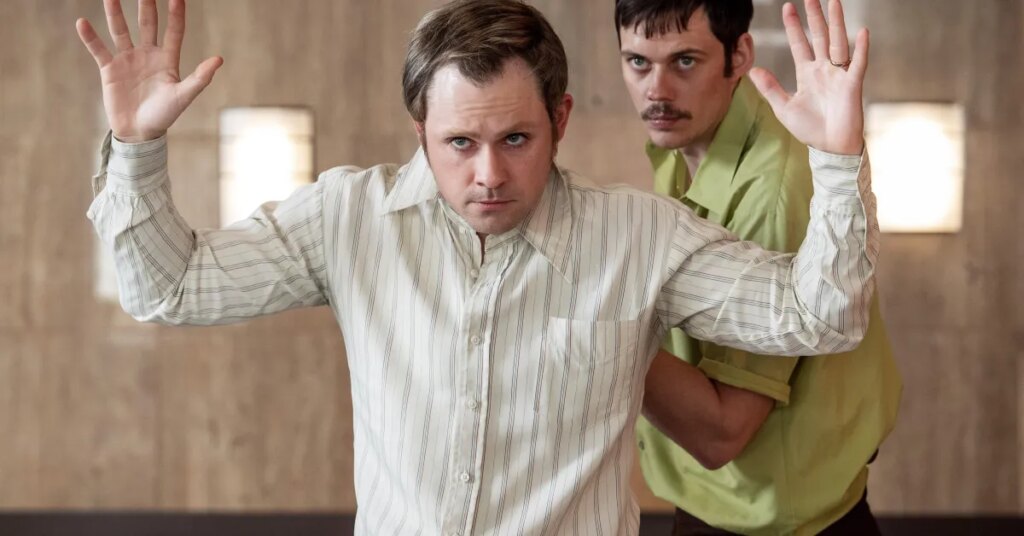
Dead Man’s Wire, out in theaters Jan. 9, is inspired by a real-life hostage crisis that took place in Indianapolis in 1977, when a businessman was held captive for three days and paraded by his captor through the streets with a wire around his neck attached to a shotgun.
Tony Kiritsis, portrayed in the film by Bill Skarsgård, kidnapped Richard Hall (Dacre Montgomery), an executive at Meridian Mortgage Co., a company that had loaned Kiritsis money three years prior to buy land and set up a shopping center. Kiritsis claimed that Meridian steered retailers away from the property, forcing him to default on the loan.
[time-brightcove not-tgx=”true”]
Facing foreclosure, he took Hall hostage on Feb. 8, 1977, as revenge, tying a wire around his neck attached to a shotgun that could go off if Hall made a sudden movement—hence the movie’s title Dead Man’s Wire. The movie traces Hall’s kidnapping and the aftermath and how Kiritsis captivated Indianapolis over the three days as he marched Hall to the Indiana Statehouse and then hijacked a police car to drive Hall to his apartment, which he claimed was filled with explosives.
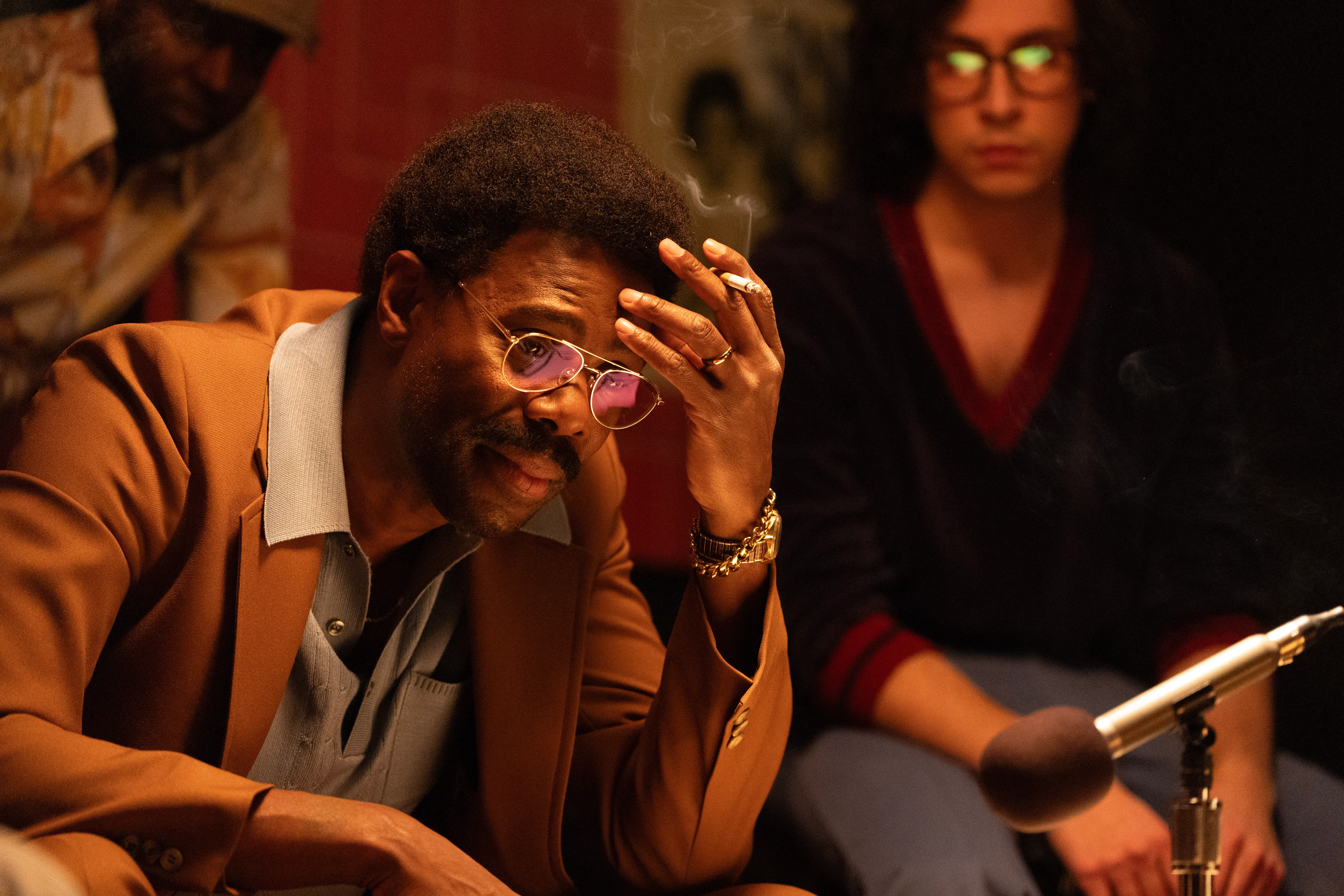
He would only talk to local radio personality Fred Heckman of WIBC, played by Colman Domingo, readily airing his grievances about Meridian on air. After calling a press conference to vent some more, Kiritsis released Hall on Feb. 10 after 63 hours in captivity. He spent the next decade in psychiatric care.
Here’s what we know about the real Kiritsis and his crime.
44 years of anger
An Army veteran who served during the Korean War, he held several jobs, including as a lathe operator, trailer court manager, and car salesman. He never married, never even had a pet, because he didn’t want to be attached to anything, his brother James told the Associated Press.
Kiritsis grew up the fourth of five children in a Greek Orthodox family and spoke only Greek until elementary school, the AP reported in 1977. His childhood friend Bob Grey recalled to the Star the good times they spent together watching NASCAR, growing tomatoes, and going to garage sales and dance halls.
Kiritsis’s brother James noticed a personality change in his brother after their mother died of cancer. “He never understood why God took our mother at age 41,” James said. “Maybe that’s what`started it.”
James added that Kiritsis was very quiet as a child, but also had a temper, explaining, “If a guy ran him off the road, you could bet he’d get punched.”
Court documents reviewed by the AP showed he was arrested in 1968 on a charge of assault with intention to murder, but the case was dismissed. He had also been arrested after firing two shots at his brother Tom, but charges in that case were also dismissed. “He’s a very hot-tempered individual,” sheriff’s detective Ronald Beasley told the AP. “When he gets mad, he does just about anything he wants to.”
The reason for the hostage crisis
The movie captures Kiritsis’s fury. It starts with the fictional Kiritsis storming into the Meridian office building looking for the top executive M.L. Hall (Al Pacino).
Irate to find out the man was in Florida, he kidnaps his son Richard Hall instead and threatens to kill him unless the firm cancels his debt, and he receives immunity from prosecution.
“This company’s done me wrong, so I’m going to let the world know what you and your dad have done to me,” he seethes to Hall as he drags him out of his office.
What’s clear in the film and in real life is that Kiritsis wanted attention and an audience. For most of the three-day crisis, Kiritsis would only talk to local radio personality Heckman of WIBC, admitting, “I went down there for vengeance, and by god, I’ll have vengeance.” He described himself as “an angry man for 44 years” and, at the same time, “the most stable person I’ve ever known.”
He thought of himself as a David standing up to a Goliath.
Similarly, in the movie, Skarsgård speaks of betrayal in his call to Domingo and laments how the company “wouldn’t let the little guy win.” He argues Hall and his father “lure in common folk, give them a taste of the American dream, and spit them out” and then “rigged the game with your math and mountains of money in the back in order to bleed us dry.”
Meridian “betrayed me” and “scammed to ruin my life,” he told Heckman in real life. The real Heckman, as the movie shows, aired the recorded phone conversation. Afterwards, viewers started calling in to donate funds “because he was this little guy getting screwed by the big company,” as Heckman put it to the Star.
What the hostage crisis was really like
The city of Indianapolis came to a standstill as Kiritsis marched Hall, who wasn’t wearing a coat, down four blocks in near zero-degree temperatures to the Indiana statehouse.
In the first official call authorities were able to have with Hall, he said, “This is Dick Hall. I’ve got food. I’ve got water and I’m being treated alright.” Hall also called his wife and reassured her that he would be fine.
Police and Meridian played along with Kiritsis’s demands in the hopes that Kiritsis wouldn’t kill Hall and release him quickly. Authorities announced that they would offer Kiritsis immunity, and Meridian issued an apology, even though the leadership didn’t think they did anything wrong.
Tom Cochrun, the news director at the local TV news station WISH, recalled Kiritsis’s erratic moods to the Indianapolis Star, from screaming and yelling to crying and laughing. Journalists were worried that viewers were going to see an execution live on air.
As in the film, Kiritsis’s brother James tried to stay loyal to his brother. In real life, he described his sibling back then as “a businessman fighting for his damn life.” In the movie, his character goes up to a TV news reporter to explain why his brother isn’t a terrible guy.
The hostage situation really did end three days in, when Kiritsis announced to authorities that he wanted to make a speech and marched Hall out of his apartment building with a shotgun still attached to a wire wrapped around Hall’s neck. Skarsgård keeps asking whether cameras are rolling because he wants to be on all the national news channels. He thanks Heckman for giving him a platform, removes the wire from Hall’s neck, and then fires a gun at the ceiling.
What happened to Tony Kiritsis
Though authorities did promise Kiritsis total immunity from prosecution if he released Hall, they went back on their promise as soon as he let Hall go.
He was charged with kidnapping, armed extortion and armed robbery, but acquitted by reason of insanity. After the verdict, Indiana legislators passed what would become known as “The Kiritsis Law” to enable verdicts of “guilty but mentally ill” and “not responsible by reason of insanity,” the Indiana Prosecuting Attorneys Council explained to the Star in 2001.
Kiritsis spent 11 years committed to psychiatric wards until his release in January 1988. A postscript in the film notes that after two years as a patient, he was eligible for release but refused to sign the papers because they required voluntary psychiatric treatment, and he didn’t want to commit to that.
According to the Star, Kiritsis had difficulty finding an apartment to rent and never owned a car because he was unable to get approved for car insurance. He primarily lived off of a military pension. His health went downhill after being diagnosed with diabetes in 2000. That same year, he fell into a diabetic coma, and doctors had to amputate part of his right foot. On top of that, he struggled with alcoholism since the 1977 hostage crisis.
On Jan. 28, 2005, Kiritsis died in Indianapolis at the age of 72. In a letter to the editor that appeared in the Star shortly after his brother’s death in 2005, James wrote: “In spite of the media justifiably and constantly portraying Tony Kiritsis as a mad man, I choose to remember him prior to that fiasco as a man proud of his Greek heritage, a loving and caring brother, a man who loved my family, had compassion for others and cared deeply for animals.”
In a way, Kiritsis expected life would be difficult after his stunt. As he told Heckman during the hostage crisis: “When I got on this f***ing road, I knew it was a long, narrow, one-way dead-end road.”
The post The Wild True Story Behind Dead Man’s Wire appeared first on TIME.