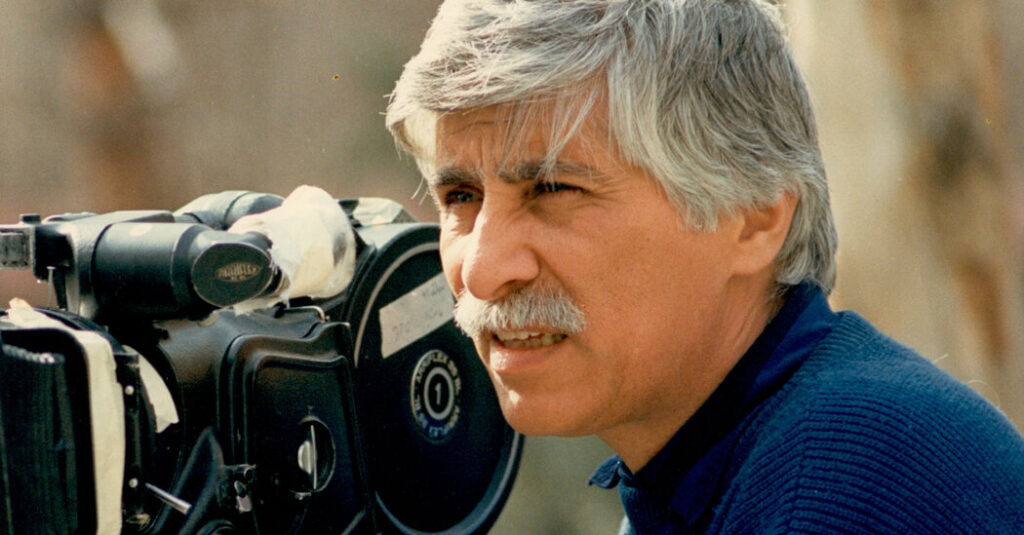
Bahram Beyzaie, a filmmaker, playwright and scholar who was hailed as a giant of Iranian culture for leading the nation’s cinematic New Wave starting in the late 1960s, melding the history and mythology of Iran with a haunting portrayal of its political reality, died on Dec. 26 at his home in Palo Alto, Calif. He was 87.
His death was caused by pancreatic cancer, which he had been battling for five years, said his wife, Mojdeh Shamsaie, an actress who appeared in several of his films. Mr. Beyzaie had been a lecturer in Iranian studies at Stanford University for 15 years.
Following Mr. Beyzaie’s death, Reza Pahlavi, the eldest son of the last shah, called him “one of Iran’s national cultural luminaries.”
Celebrated Iranian filmmakers hailed Mr. Beyzaie (pronounced bay-zah-EE) as a champion of artistic freedom who faced down his country’s conservative religious factions and their attempts recast the nation’s legacy, particularly after the 1979 theocratic revolution led by Ayatollah Ruhollah Khomeini.
“He endured years of exclusion, enforced silence and exile, yet he never surrendered his voice or his convictions,” said Jafar Panahi, whose thriller “It Was Just an Accident” won the Palme d’Or at last year’s Cannes Film Festival. “Many of us, directly or indirectly, learned from him. We learned how to stand against forgetting.”
Wildly prolific in multiple arenas, Mr. Beyzaie wrote more than 70 books, plays and screenplays — among them, “Theater in Iran,” published in the mid-1960s, which is still considered a definitive work.
He initially gained fame in the theater, becoming Iran’s most heralded playwright and director, staging more than a dozen works that often mined Persian heritage while pushing boundaries. His 2016 work “Tarabnameh,” based on traditional Takhte-Hozi plays that combined music, comedy, dance and poetry, ran in two parts about 10 hours.
He was best known as an auteur, writing and directing 10 feature films, including landmarks of Iranian cinema like “Bashu, the Little Stranger” (1989), “Travellers” (1992) and “Killing Mad Dogs” (2001).
Mr. Beyzaie’s first feature film, “Downpour” (1972), was also one of his most influential, a cornerstone of the Iranian New Wave, “which placed the country on the world map of engaged cinema,” the prominent Iranian writer Hamid Naficy observed in a 2020 essay for the Criterion Collection site.
The film concerned a teacher in a working-class Tehran neighborhood who offered his students a fresh, challenging perspective, putting him at odds with the community’s traditionalists. Mr. Beyzaie described it as “poem about daily life” in a 2013 interview with the culture site ARThound. Filmed on location, it focused on the travails of ordinary people, drawing comparisons to the postwar work of Italian directors like Roberto Rossellini and Vittorio De Sica.
“The tone puts me in mind of what I love best in the Italian neorealist pictures,” the director Martin Scorsese was quoted as saying on the Film Foundation website. “And the story has the beauty of an ancient fable.”
Throughout his career, Mr. Beyzaie paid little heed to conventional thinking or political factions. “My audiences,” he once said, “are those who strive to go one step further, not those who are the guardians of the old equations or those who dread self-examination and self-reflexivity.”
Bahram Beyzaie was born on Dec. 26, 1938, in Tehran, the second of four children of Nayereh Movafegh, who managed the home, and Ne’matallah Beyzaie, who worked for the government’s land management bureau and published poetry under the name Zokā’i.
Raised in the Bahá’í faith, Mr. Beyzaie grew up feeling the pressure of being a member of a persecuted religious minority, Ms. Shamsaie said in an interview.
During his teens, he often skipped school to visit local movie houses, where he found himself absorbed by films like Carol Reed’s “The Third Man” (1949) and Akira Kurosawa’s epic “Seven Samurai” (1954).
During high school and as a student at the University of Tehran, he pored over the works of Shakespeare as well as the Greek tragedies and the traditional theater of Japan, China, India and pre-Islamic Persia. He also began writing plays.
After a year at the university, he left to pursue independent research on Iranian theater. He made his mark as a playwright with “The Dolls,” a 1962 production that explored themes of control and freedom through the conceit of dolls coming to life.
Mr. Beyzaie’s stature in the cultural world of Iran continued to rise throughout the 1960s. He helped found Iran’s Writers’ Association and became a theater instructor at his former university.
By the end of the decade, he had begun directing films for Kanoon, an Iranian institute devoted to the intellectual development of children and young adults. “The Journey” (1972), a critically acclaimed short film that he wrote and directed concerning a young boy accompanied by a friend on his quest to find his parents on the outskirts of Tehran, captured what Mr. Beyzaie saw as Iran’s efforts to come to terms with its cultural and historical roots.
Following “Downpour,” Mr. Beyzaie’s career in feature films continued with “Stranger and the Fog” (1975), the story of a mysterious wounded man who shows up at a seaside village. More technically ambitious than his previous work, the film was seen by few at the time but came to be held in high regard.
Many of his other films also had limited exposure, as they were banned by the Iran’s post-revolutionary government because of what was perceived as provocative subject matter. Mr. Beyzaie also flouted authorities repeatedly by making films about strong, independent women.
Mr. Beyzaie’s 1982 film “Death of Yazdgerd” was an adaptation of his 1979 play about the murder of the country’s last king before the Arab-Islamic conquest in the seventh century; the play had been translated into multiple languages and performed around the world. The film version, a study in multiple perspectives, drew comparisons to Mr. Kurosawa’s 1950 classic “Rashomon,” but it, too, was banned in Iran.
He faced similar roadblocks with “Bashu, the Little Stranger,” which chronicled a young boy’s search for refuge from the horrors of the Iran-Iraq war and provoked censors with its pointed antiwar stance.
Still, it was named the greatest Iranian film of all time in a 1999 survey of critics by the Iranian magazine Picture World. The film was screened in 2025 at the Venice Film Festival, where it won the Venice Classics Award for Best Restored Film.
Over the years, Mr. Beyzaie’s work continued to inflame political and religious groups as well as government authorities, who repeatedly interrogated him. For nearly two decades after the revolution, he was forbidden to stage his plays, and he eventually lost his university post.
“It is a blessing that in this country,” he once said dryly, “all the political groups agree on shutting down the cultural work despite their competition with each other.”
Despite the ever-present hurdles, Mr. Beyzaie continued to make films into the 2000s. He left Iran in 2010 to assume his post at Stanford, where he also ran acting workshops and staged plays.
In addition to his wife, whom he married in 1993, he is survived by their son, Niassan; two daughters, Niloofar and Negar, from his first marriage, to Monir Azam Raminfar, which ended in divorce in 1992; a sister, Bahin; a brother, Bijan; and three granddaughters.
Throughout Mr. Beyzaie’s career, he waged a ceaseless war against repression.
In 1992, when Iranian authorities insisted that he cut certain scenes from “Travellers,” he responded with defiance.
“I will break my own hand,” his letter to the Ministry of Culture and Islamic Guidance read, “before I let you turn me into my own censor.”
Alex Williams is a Times reporter on the Obituaries desk.
The post Bahram Beyzaie, Filmmaker Who Led Iran’s New Wave, Dies at 87 appeared first on New York Times.