As Hollywood cranks up the hooting calliope of awards season — the congratulatory FYC marketing, the glittering fashion feasts, the breathless horse-race prognostication and industry analysis (does the Academy of Motion Picture Arts and Sciences’ recent decision to move the Oscars from ABC to YouTube spell the end of life as we know it?) — it is worth taking a moment to remember that all of this magnificence and mishegoss began with a bit of bad weather and the obliging shelter of a barn.
A small and simple structure, standing near the corner of Selma and Vine, which Cecil B. DeMille leased after he, Jesse Lasky, Samuel Goldwyn (then Goldfish) and Arthur Friend decided that their first choice of Flagstaff, Ariz., was too cold and dark to shoot an adaptation of the play “The Squaw Man.”
In 1913, the barn became home to the Jesse L. Lasky Feature Play Co. “The Squaw Man,” Hollywood’s first feature film, co-directed by DeMille, was released the following year.
It is astonishing to think that everything we now know as “Hollywood,” from the wandering tourists and landmark buildings of the actual neighborhood to the global “dream machine” with all its enduring art, complicated mythology and current anxieties, began under a cedar-shingled roof where DeMille set up in a tiny corner office and actors changed costumes in horse stalls.
“We’ve got the barn, we’ve got the talent — hey, kids, let’s put on a show” is not just a tagline from all those Judy Garland/Mickey Rooney films; it’s the literal backbone of every cinematic story you’ve ever watched. Including on YouTube.
Even more astonishing, given Los Angeles’ reputation for razing or abandoning its history, is the fact that the Lasky-DeMille Barn remains open for business, home now to the Hollywood Heritage Museum, nestled beneath the trees in a parking lot across from the Hollywood Bowl on Highland.
Yes, that’s right. That little old-fashioned building with the deep porch that you might have wondered about as you parked for a “Sound of Music” singalong or drove up Highland on the way to the 101 on-ramp is the birthplace of the industry that put L.A. on the map.
“Although motion pictures have furnished a means of livelihood to thousands,” Lasky wrote in a 1926 edition of the Hollywood News that is part of the museum’s archives, “probably the greatest advantage they have given Southern California … is advertising. … No words, no amount of expensive magazine advertising could achieve the results that have been obtained through motion pictures. Our marvelous climate, our industries, our state’s unequaled advantages as a place for homes, as the ideal spot in which to raise families, all have been brought daily and nightly before hundreds of millions of persons throughout the world.”
The Hollywood Heritage Museum, which celebrated its 40th anniversary in December, is, in many ways, the antithesis of the 4-year-old Academy Museum of Motion Pictures.
From the tony stretch of Wilshire it shares with Los Angeles County Museum of Art and the Petersen Automotive Museum, the Space Age bubble of the Academy Museum’s David Geffen Theater and the Streamline Moderne architecture of the old Macy’s department store it repurposed seem worlds away from the quaint barn, dwarfed by the nearby Bowl and inevitable traffic of Highland.
But while the Academy Museum offers exhibits that honor Old Hollywood, the nonprofit, mostly self-supporting Hollywood Heritage Museum is Old Hollywood, preserved and tended to with great care, an enduring reminder that most of humanity’s greatest endeavors began in small, unlikely, jerry-rigged spaces.
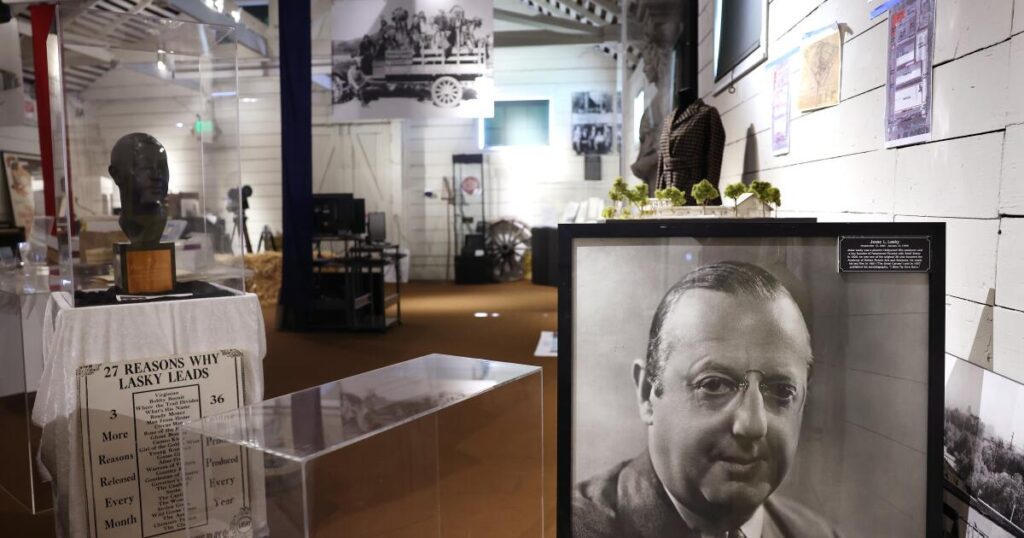
For 15 bucks (members get in free), visitors can, on Saturdays, Sundays and the first Thursday of every month, step into that history, admire the high roof, still-solid walls and stalls that served as the first Star Waggons. DeMille’s office has been re-created with personal items (including the director’s shoes and boots) donated by Paramount Pictures, and various exhibits detail the making of DeMille’s “The Squaw Man,” “The Ten Commandments,” “The Greatest Show on Earth,” “The Crusades” and other films, and offer glimpses into early Hollywood with a collection of props, costumes, cameras, projectors and memorabilia.
Screenings of silent films, hosted by the Hollywood Heritage’s Silent Society and often accompanied by live music, play here amid a changing palette of special exhibits, curated from the museum’s collection and the contributions of private collectors. (A recent celebration of pioneering leading ladies included a scarf that belonged to Carole Lombard; it was found in a suitcase that survived the plane crash in which she died. If you think I did not cry when I saw it, you would be wrong.)
It is a small space, low-tech and not at all fancy — a chapel rather than a cathedral — but the museum’s dedicated and all-volunteer staff, including museum director Angie Schneider and board president Margot Gerber, have a voluminous archive at their fingertips and know everything there is to know about early Hollywood, the industry and the neighborhood.
There are no gleaming marble floors, touch-screen activated holograms or digital-age wizardry. Just old-fashioned storytelling. And that’s the whole point.
Moving among the meticulously marked exhibits, it is possible to quiet, or at least contextualize, any hysteria one might be feeling over the fate of mid-budget movies or whether AI will soon turn all human creativity over to coders and remember that once upon a time, not that long ago, a few people took a big chance on the wild and crazy idea that moving pictures were the future.
And, just as important, that 40 years ago, in a city where too many historic buildings have in fact been demolished or abandoned, a few other people believed that saving the space in which that future began was important.
Dec. 13 marked the 40th anniversary of Hollywood Heritage and on Saturday, the museum opens an exhibit celebrating the history of the barn, including the heroic efforts to save and preserve it.
Those efforts began with Lasky and DeMille. Lasky’s company merged with Adolph Zukor’s Famous Players Film Co. in 1916 and eventually became Paramount Pictures. The barn was moved onto the Paramount lot in 1926, where for decades it served as a location set (after the porch and a set of railroad tracks were added, it was used during filming of the TV series “Bonanza,” among other things) and a gymnasium for actors and others working on the lot.
One of the museum’s permanent exhibits is a miniature of the Paramount lot in the 1930s, in which the barn is central, and one of the anniversary exhibits showcases period photos and equipment of its days as a gym.
The barn was declared a registered California landmark in 1956 but when Paramount remodeled its lot, the studio gave the barn to Hollywood Historic Trust and it was moved once again to a site near the Capitol Records Building. There it languished until 1982 when Hollywood Heritage decided to save it.
Founded in 1980 by five women determined to protect the neighborhood’s historic buildings, Hollywood Heritage had Hollywood Boulevard’s central core designated as a National Register Historic District.
They first turned their attention to Janes House, a 1903 Queen Anne/Dutch Revival that is the oldest surviving Hollywood home. After years of serving as the Misses Janes School of Hollywood, where the children of Golden Age notables including Lasky, Charlie Chaplin and Douglas Fairbanks Jr. were taught, it had fallen into disrepair. Though Hollywood Heritage was not able to buy the house, it helped get it designated a historic cultural monument. Janes House was bought by a developer and moved to the back of its lot where it was restored; it is now the speakeasy No Vacancy.
The Lasky-DeMille Barn became their next and signature project. In 1983, the group had it moved with great fanfare through the streets of Hollywood to its current site, which had been earmarked for a film museum in the 1960s. After the barn was repaired and restored, it officially opened as a museum on Dec. 13, 1985.
With collections of postcards, menus, ashtrays, hotel keys and other historic items from iconic businesses including Yamashiro, the defunct Garden Court Apartments, the Brown Derby and the Wattles estate, the museum also reflects the larger concern of Hollywood Heritage — the preservation of the neighborhood that the early film industry helped create.
At a news conference in December, co-founders Fran Offenhauser and Christy Johnson McAvoy used the 40th anniversary of the organization to announce a “Come Back to Hollywood” advocacy plan at its Preservation Resource Center on Hollywood Boulevard. Focusing on 11 historic buildings, including the Warner Pacific Theatre and former Hollywood Reporter building, the group will be hosting a series of events to encourage owners and tenants of historic properties, as well as local government, to find ways to revitalize and repurpose the buildings.
The Resource Center is home to another of the organization‘s many projects — the restoration of “City of Hollywood,” a 1930s miniature of the area. Part of a larger series of miniatures taken on a nationwide tour in the 1940s to publicize L.A. as a destination city, the miniature is an exquisite (if not block-by-block accurate) depiction of the “city” at a time when Hollywood Boulevard was, as Offenhauser says, “the Fifth Avenue of the West.” Which is something she, and Hollywood Heritage, hopes to help recapture.
Watching as the lights and black-light-painted signs of the Hollywood miniature come to life as the center’s lights dim, it is tough not to want the same thing. Carefully constructed by cabinetmaker Joe Pellkofer and a team of artists almost 100 years ago, the 11 x 12 grid of 450 buildings is as magical as anything produced in the Lasky-DeMille Barn or on any studio lot, a “city” made by and for the people who built an industry that changed the world.
That industry, and its relationship to the city and state that cradled it for so long, is in a state of upheaval (or cataclysm, depending on who’s talking), which makes a pilgrimage to the Hollywood Heritage Museum even more powerful.
All stories have a beginning, and in times of change and uncertainty over the future, it’s good to remember how and where it all began. Thanks to Hollywood Heritage, we can all stand under that cedar roof, where the horse stalls are still visible, and remember that all the red carpets, enduring classics, famous flops, box office predictions, film festivals, the rise of television, awards shows, streaming wars, billion-dollar hits, the entertainment press, technological advances and enduring “kid, I’ll make you a star” dreams started right here, in a rented barn.
The post This little-known L.A. museum has preserved the birthplace of the American film industry appeared first on Los Angeles Times.