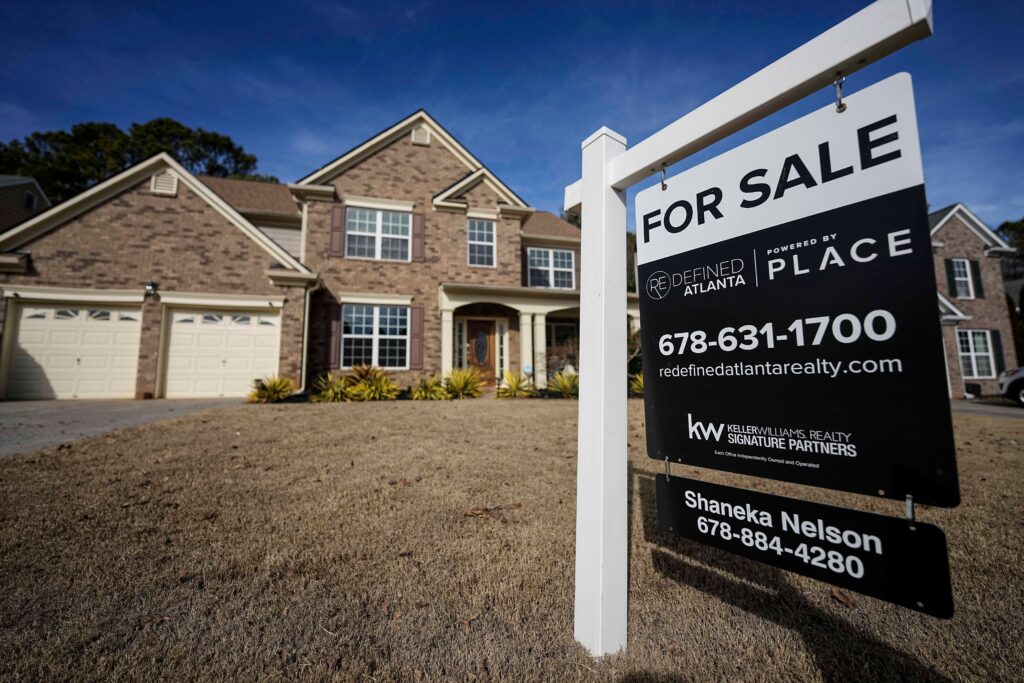
The Trump administration is preparing an executive order focused on housing — with special attention to first-time buyers — as the White House attempts to address voter concerns about affordability.
An order could include policies that President Donald Trump has already floated, like a 50-year mortgage or a ban on institutional investors buying single-family homes, according to five people close to the deliberations, who spoke on the condition of anonymity to discuss private conversations. Other proposals are newer, like helping home buyers withdraw from their 529 or 401(k) savings accounts to make down payments without incurring tax penalties.
Exact timing or language is not final, and plans have been in flux over the past few weeks, the people said. But it’s clear the White House increasingly sees housing policy as central to its broader affordability agenda. More details are expected when Trump speaks at the World Economic Forum in Davos, Switzerland, later this month, according to the president’s social media posts and housing officials.
Bill Pulte, head of the Federal Housing Finance Agency and a close Trump confidant, told The Washington Post on Thursday that an executive action was coming and would later need to be “codified by Congress.”
“We’ve got 30 to 50 different ideas that are in front of the president,” Pulte said. “He’ll be releasing a handful of them in Davos.”
Officials have been planning an executive order aimed at housing for months. But timing stalled as different factions within the administration clashed over an approach. Two of the people close to the talks said internal divisions sometimes boiled down to how much the federal government should tell states and cities what to do. Other disagreements centered on what role Congress should play.
White House spokesperson Davis Ingle said in a statement that Trump had pledged to slash red tape, cut interest rates and tackle unfair business practices that make it harder for Americans to buy homes.
“As the President indicated over Truth Social, he will be unveiling more details about his housing proposal in Davos — any discussion from unnamed sources until then is baseless speculation,” Ingle said.
For much of last year, the administration’s policy agenda has involved blaming undocumented immigrants for housing shortages and clawing back fair housing regulations. Officials also want to take mortgage giants Fannie Mae and Freddie Mac public after years of government control — a tremendously complicated endeavor that could lead to a massive stock offering but, if not done carefully, roil the mortgage market.
Yet fresh momentum appeared to pick up this week after a meeting of top housing and White House officials on Tuesday. Trump announced the ban on institutional investors on Truth Social on Wednesday, saying he would call on Congress to seal the deal, and drawing favorable reaction from GOP lawmakers. On Thursday, he said Fannie and Freddie would use some $200 billion in cash to buy mortgage bonds — which he said would drive mortgage rates and monthly payments down.
Administration officials are also looking at ways to implement so-called “portable mortgages,” where homeowners can take their old mortgages with them when they move to a new house, the people close to the discussions said. They are considering “assumable mortgages,” where home buyers take over the sellers’ mortgage. Both of those ideas could help offset the rise in mortgage rates over the past several years, and they could also entice homeowners with low rates to sell without fear of taking on a higher mortgage, opening up more supply in the process. Officials are discussing expanding Opportunity Zones — an economic tool for investing in distressed areas — and other deregulatory policies as a means of boosting homeownership, as well.
Pulte also teed up more actions related to home builders this week, saying on X that they “need to start building out their lot supply, including optioned land which is ‘ready to go.’”
Builders have been in talks with the administration for the past year on ways to cut environmental regulations, energy codes and permitting restrictions, including those that make it harder to turn land from raw to developable lots and pile on costs, said Jim Tobin, president and chief executive of the National Association of Home Builders.
“If there is an executive order, I don’t expect it to be narrow,” Tobin said. “I expect it to be broad.”
But Trump’s announcements have come with few details or clarity on Congress’s role. Some proposals could also work against affordability goals; many mainstream economists say a 50-year mortgage would likely increase overall costs for borrowers, because they’ll pay far more in interest over five decades than they would with the conventional 30-year loan.
Inside the administration, officials see a two-pronged approach to addressing home prices, according to a GOP pollster close to the White House, speaking on the condition of anonymity to discuss private conversations. One path is to increase housing supply through construction; another is decreasing the number of buyers by disincentivizing investors and making it easier to sell homes without paying capital gains taxes. Under current law, most married couples can exempt the first $500,000 in capital gains on the sale of their primary residence from taxes.
White House officials have reviewed polling that shows voters aged 18 to 24 see affordability through a housing lens, said the GOP pollster. That age group helped deliver the presidency to Trump in 2024, which makes the White House especially sensitive to its political standing with them. The pollster said administration officials are focused on first-time home buyers, which often includes people aged 25 to 40 years old in addition to 18-to-24-year-olds.
“This voting cohort who is deeply concerned about this and worried about housing prices delivered, in a lot of ways, the election to President Trump in 2024,” the pollster said. “Affordability means housing in every bit of data we’ve seen.”
The pollster expects the final plan to pave the way for Trump to take Fannie Mae and Freddie Mac public. He also said he expects the administration to “play around” with the step-up in cost basis, a U.S. tax rule that adjusts the value of inherited assets to their market price at the time of death, which can reduce capital gains taxes for heirs. That would include taxes on homes.
David Dworkin, president and chief executive officer of the National Housing Conference, said making it easier for younger buyers to withdraw from their 401(k)s penalty-free “will have a bigger impact than any down payment program ever proposed.” At the same time, the way to make homes more affordable is to build more of them.
“Everything the president does to help us build more units is going to have an impact,” Dworkin said. “Some of these ideas are going to be more impactful than others. Some may have unintended consequences we want to be careful about. But it’s too easy to say, ‘Oh this is risky, let’s not do anything.’ We’ve got to make progress here.”
Fannie and Freddie’s new bond purchases could be part of the strategy around taking them public, because the move would add value to their balance sheets and help the companies make more money. But the broader effect on affordability could be more muted. Mortgage rates typically track Treasury yields, which fall in times of economic uncertainty. In a Thursday analyst note, Gennadiy Goldberg, head of U.S. Rates Strategy at TD Securities, said that based on the projections for Treasury yields, the 30-year mortgage rates could drift down toward 5.25 percent by the end of the year, compared to 6.16 percent this week.
But if Fannie and Freddie’s vast securities purchases happen quickly, mortgage rates could tick down a bit more, to 5 percent by year-end, Goldberg wrote.
Democrats this week criticized the Trump administration for promoting policies those on the left have tried before, like banning institutional investors from the single-family market. But housing is one of the only policy areas with bipartisan support lately. A popular bill from Sens. Tim Scott (R-South Carolina) and Elizabeth Warren (D-Massachusetts) would increase housing supply and pare back regulations that slow new construction. Its progress slowed late last year after House Republicans pressed to keep it out of the annual defense policy bill. But a similar bill is moving forward in the House, and there’s hope a breakthrough will come eventually.
“My focus is on advancing meaningful solutions that expand housing supply and lower costs — including building on our unanimously passed ROAD to Housing Act — because that’s how we make the American Dream more attainable,” Scott, who chairs the Senate Banking Committee, said in a statement.
Theodoric Meyer contributed to this report.
The post Trump officials prepare executive order on housing affordability appeared first on Washington Post.