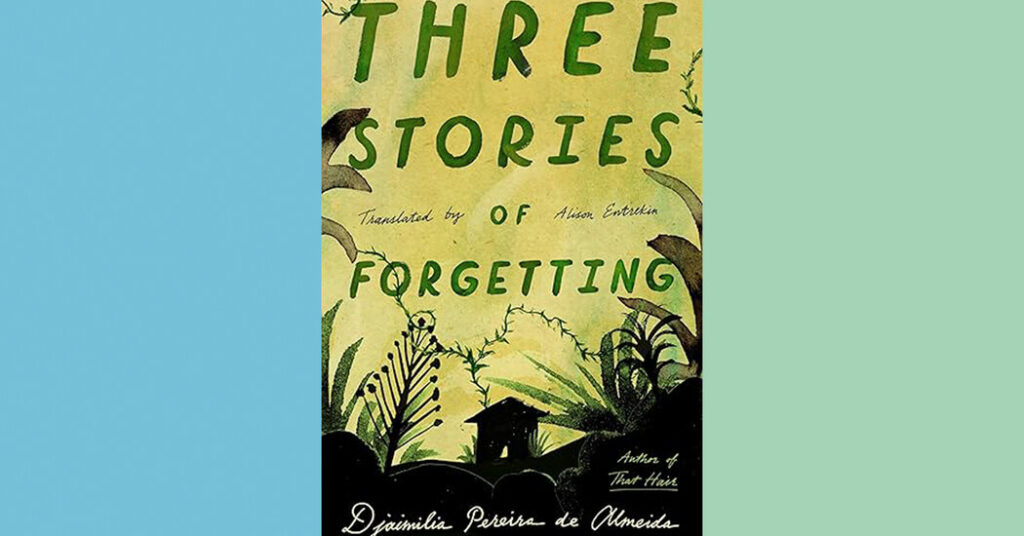
THREE STORIES OF FORGETTING, by Djaimilia Pereira de Almeida; translated by Alison Entrekin
Next to the São Luiz Theater in Lisbon stands a statue of the Portuguese writer Fernando Pessoa, inscribed with one of his famous lines: “Oh salty sea, how much of your salt is Portugal’s tears?”
The quote comes from the poem “Portuguese Sea,” which was published in 1922 and evokes the colonial nostalgia of an era when empire-building meant bravery and sacrifice, not theft and eradication. Yet even today, more than a century later, Portugal still struggles with how to account for its past: Textbooks in the country are strewed with euphemisms and oversights, to the point that the government recently imposed guidelines so that public schools do not skirt over the more violent aspects of the nation’s history.
Boa Morte da Silva, the protagonist of “Seaquake” — the second of three novellas in Djaimilia Pereira de Almeida’s new book, “Three Stories of Forgetting” — spends his days near Pessoa’s statue, guarding parking spots for loose change. Born in Angola in 1938, Boa Morte fought for the Portuguese in Guinea-Bissau’s war of independence, before arriving in the Port of Lisbon in 1979 “with the shirt on his back.” Burdened with an unrelenting hernia and nearly destitute, he now drifts through his days mostly feeling invisible.
His mood swings and troubles — described in rambling letters to his long-lost daughter, Aurora — make him seem unlikely to feel the kind of nostalgia evoked in Pessoa’s poem. But we then learn that he was estranged from his family over a matter of national pride. He knows he is seen as a traitor, an Angolan who killed for Portugal and is now neglected by the very empire he served. Still, he says: “I’m a full citizen, even if folks take me for a tramp. I’m still awake.”
“A Vision of Plants,” the first novella in the collection, and “Bruma,” the third, also feature old men who dwell on their past — although “dwell” isn’t quite the right verb, since what they share is an instinct to circle around crucial facts, holding on to a frail sense of self by trying to evade the more terrible truths of their lives.
Celestino, the retired 19th-century sea captain in “A Vision of Plants,” throws himself headlong into gardening, haunted all the while by past murders and his years sailing ships for the slave trade. “Not a single flower mourned the death of the enslaved men and women Celestino had suffocated on the high seas,” Pereira de Almeida writes.
Bruma, sold into slavery at 13 years old, builds a cabin in the forest, using it not so much as a retreat but as a foundation, a late attempt to reclaim his life. “His back had been whipped, his finger joints trodden, his nipples and fingernails tugged at with pliers,” we learn. “But no matter how they’d tortured him, they couldn’t destroy his other abode.”
Born in Luanda, Angola, and raised in Portugal, Pereira de Almeida is no stranger to the sense of displacement brought on by former empires, even if these days she is one of her country’s rising literary stars. Her decision to minimize the sea — the great symbol of the Grandes Navegações (Great Navigations) era — in favor of plants and forests is a poignant choice, made even more compelling by Alison Entrekin’s careful translation.
The “Forgetting” in the title — an impossible act, of course — is double-edged, alluding not only to the fractured memory of the protagonists, but to society’s conscious decision to look away from them. Rumors swirl around Celestino, obscuring him. The harsh reality of Boa Morte’s life on a Lisbon street is both masked and worsened, today’s reader might surmise, by the rich expatriates flocking to the city and driving up rents.
After lamenting the weeping mothers and praying children of those who went to sea for their country, Pessoa ends his poem on a triumphant, rather sentimental note. “Was it worth it?” he asks, clearly signaling that it was. Pereira de Almeida might beg to differ.
THREE STORIES OF FORGETTING | By Djaimilia Pereira de Almeida | Translated by Alison Entrekin | FSG Originals | 288 pp. | Paperback, $18
The post For These Three, the Age of Empire Never Quite Ended appeared first on New York Times.