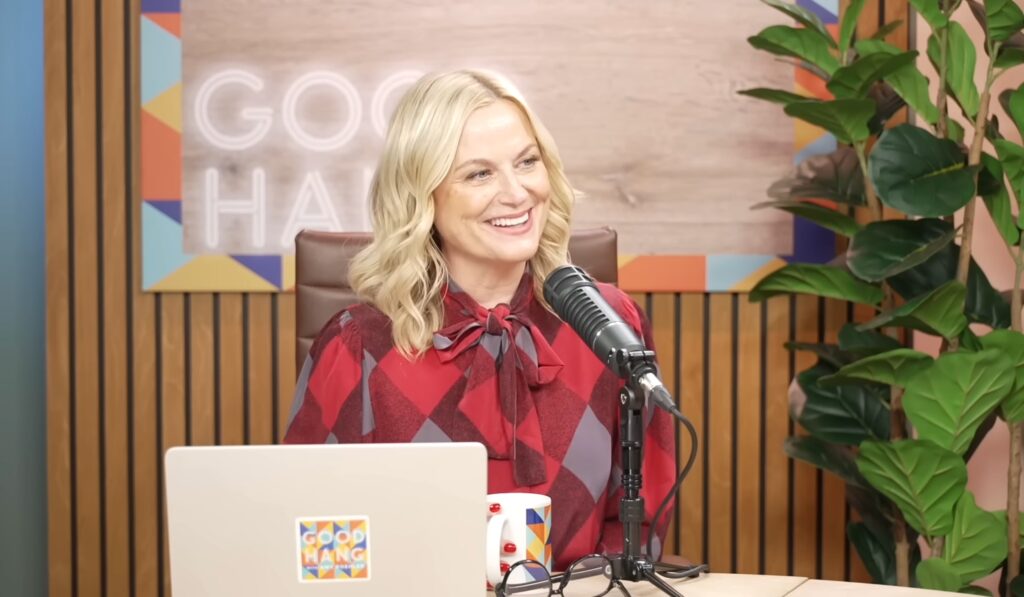
Every Monday afternoon, something wonderful happens on Instagram for a certain sector of the internet: Amy Poehler announces who will sit down with her the next day for an interview on her podcast, “Good Hang.”
“God is real and it’s this podcast’s talent booker,” one commenter wrote when the reveal was Julia Louis-Dreyfus, beloved star of “Seinfeld” and “Veep.”
“The booker of this show is out of control,” another declared upon seeing Academy Award winner Olivia Colman slotted onto the schedule.
“GIRL who is in charge of booking because I’m like so in awe of your guests it’s actually insane,” one fan wrote upon learning that Paramore lead singer Hayley Williams was Poehler’s next guest.
You may have assumed, at this point in the evolution of the podcast industry, that listeners would reject yet another “celebrities talking to other celebrities” podcast, something they already have more of than one could ever possibly need or want. But “Good Hang,” launched in March, quickly captured a devoted base of fans dazzled by the lighthearted conversations between the “Saturday Night Live” veteran and an eclectic mix of A-list guests — actors, comedians, singers, chefs, a former first lady — all of whom seem to find a charming rapport with the gentle yet insightful interviewer. It’s hard for new podcasts to break through in general. But by the summer, “Good Hang,” produced by the Ringer and Poehler’s production company Paper Kite, had landed in the Top 50podcasts in America, and ended the year at No. 10 on Spotify’s most-listened-to chart.
On Sunday, “Good Hang” will be up for another honor: a trophy in the first-ever, extremely 2026 category of “Best Podcast” at the Golden Globe Awards.
When the long list of eligible podcasts was released last fall, the 25 options included politics-heavy programs ranging from the liberal (“Pod Save America”) to the conservative (both Megyn Kelly and Ben Shapiro, who ran a high-profile ad campaign asking for voter consideration). Behemoths such as “The Joe Rogan Experience” and the New York Times’ “The Daily” also made the initial cut.
But to the surprise of observers who thought the Globes — which recently came under the control of Penske Media’s Dick Clark Productions — might be tempted to signal support of an ally of President Donald Trump, its short list avoided the culture wars and politics altogether in favor of lifestyle and showbiz-focused shows. Poehler is competing alongside Alex Cooper’s “Call Her Daddy,” “The Mel Robbins Podcast” and NPR’s “Up First,” as well as two other celebrity-helmed shows, “Armchair Expert With Dax Shepard” and “SmartLess,” hosted by Jason Bateman, Sean Hayes and Poehler’s ex-husband, Will Arnett.
Less than a year old, Poehler’s show is by far the newest entry, but it has all the hallmarks of a front-runner: rave reviews from listeners, an enormous number of streams and downloads, and Poehler’s personal popularity within the industry, especially among the voting body of the Globes, which she has co-hosted four times with close pal Tina Fey. Poehler never won an Emmy for her post-“Saturday Night Live” turn as the earnest Leslie Knope in NBC’s “Parks and Recreation,” but the Globes awarded her the prize for best TV comedy actress in 2014.
So how did Poehler’s show break through in an era of celebrity — and especially comedian — podcast overload?
Timing was key, even as Poehler joked in the premiere that “I like to be five or six years late to any trend.” The goal of the show was to have fun and lighten people’s moods, she said, but she emphasized that she is not a therapist or a self-help expert. “I don’t care if you get any better. I don’t have advice for you,” she deadpanned, adding, “I want us to feel like there’s a way to have laughs amid all of the craziness that is life.”
During the show, she doesn’t elaborate on exactly why this has been such a difficult time for so many people; guest Maya Rudolph, who appeared at a live taping in Los Angeles, described her experience playing Kamala Harris on SNL and came the closest to explicitly addressing the political climate before Poehler lightly redirected her. But Poehler makes it clear that she knows people are going through a lot right now, and she wants “Good Hang” to be a distraction. (A publicist for the show said Poehler was not available for an interview for this story.)
“When we were thinking about this podcast, it was like, all the guys get to just goof around and have fun, and it’d be like, straight comedy escapism — and our stuff has to be, I don’t know, about menopause,” Poehler said during her episode with Fey, dutifully adding, “Which is also important.”
While escapism isn’t a groundbreaking concept, Poehler is uniquely positioned to be a source of joy, given that she’s the voice of Joy, literally, in the “Inside Out” Pixar movies. (Nick Jonas was absolutely floored by this hardly secret revelation during his episode.) Plus, she’s the face of “Parks and Recreation,” one of TV’s most popular comfort-watches that became especially important during the pandemic. She has a keen awareness of the emotional attachment that viewers have to the half-hour political comedy — she and “The Wire” star Idris Elba bonded over the phenomenon of starring in TV shows that mean so much to fans — and devoted a “Good Hang” episode to an inside joke among the “Parks and Recreation” cast about “Philly Justice,” an imaginary TV legal drama for which they eventually created a mock trailer.
But Poehler has also proved that she can chat with anyone, thanks to that “yes, and …” mentality instilled in her through years of improv comedy.
“I had a dream the other night,” explained Dakota Johnson, officially meeting Poehler for the first time during her guest spot. She noted that her dream was like a movie plot. “So, Matty Healy from the 1975 was in my dream, and he was murdering people. … And when the people were looking for him — they were cops, maybe, I don’t know — he would turn into a piece of asparagus.”
“This is a really good idea,” Poehler chimed in. “A24 would be all over that.”
Johnson continued, saying that in the dream, Angelina Jolie was there, and she also turned into asparagus.
“What? She’s in this, too?” Poehler exclaimed. “Let’s make a movie.”
Her enthusiasm is contagious, whether she’s talking to Michelle Obama about the pleasures of once again driving her own car (something she could not do during her years in the White House) or reminiscing about the fun-yet-stressful SNL days with Rudolph. (They recalled the time that a member of the cleaning staff tried to console a sobbing writer by saying, “Don’t cry, sexy.”) She’s comfortable with macabre humor, such as the time she tried to trick Andy Samberg into believing that Frisbee, Seth Meyers’s dog and Samberg’s enduring nemesis, had died. (Samberg didn’t fall for it.)
The show occasionally tackles difficult issues, such as when Poehler welcomed her former “Parks and Recreation” co-star Aubrey Plaza, who made her first public comments about her husband’s recent death and her own grieving process. Such conversations subsequently make news, but there’s little indication that’s intentional on Poehler’s part. Poehler just makes her visitors feel comfortable.
That extends to the listeners (or viewers watching on YouTube), as well, and evokes the kind of relationship that Americans once had with its late-night hosts. Even in a sea of tough competition from many other celebrity podcasts, Poehler has somehow re-created the magic of a dying TV genre for a new medium, with a warmth and camaraderie that inspires listeners to return every week.
“Good Hang’s” most clever gimmick is the introduction that kicks off each episode, during which Poehler invites someone who knows the guest to participate in a brief video call where they “talk well” behind the guest’s back, and the person suggests questions that Poehler should ask. Jon Hamm called in from a film set — wearing a tuxedo with a hot-air balloon in the background — and urged her to ask Paul Rudd when he stopped being worried about whether his acting was good enough; Louis-Dreyfus suggested Poehler ask Ina Garten how to make a proper lemon sorbet, and meanwhile gave viewers a glimpse of her refrigerator as she retrieved her own attempt at making the dessert to show Poehler.
With this kind of informal warmup, instead of opening in a professional podcast studio, Poehler makes listeners feel like a part of a casual conversation. This tradition started on a high note during the first episode last March, where the guest was Fey, and Poehler invited her former SNL colleagues Meyers, Rachel Dratch and Fred Armisen, along with comedian Zarna Garg, for the introductory video chat to come up with questions.
A multitude of tech problems instantly erupted for Dratch, including her hopelessly tangled wired headphones. Just as things started to calm down, her old-timey doorbell rang with a food delivery, causing her dog to start barking and all five professional comedians on the call to dissolve into hysterical laughter.
It’s hard to watch it and not feel like part of the group — and just for a few minutes, no matter what’s going on in your life, feel transported to somewhere else.
The post How Amy Poehler’s ‘Good Hang’ broke through celebrity podcast fatigue appeared first on Washington Post.